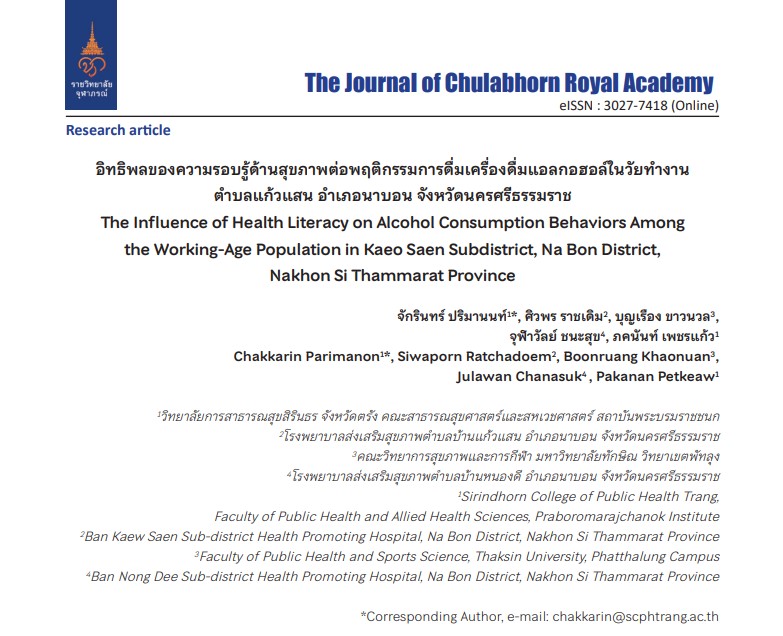
อิทธิพลของความรอบรู้ด้านสุขภาพต่อพฤติกรรมการดื่มเครื่องดื่มแอลกอฮอล์ในวัยทำงาน ตำบลแก้วแสน อำเภอนาบอน จังหวัดนครศรีธรรมราช
คำสำคัญ:
ความรอบรู้ด้านสุขภาพ, การดื่มเครื่องดื่มแอลกอฮอล์, ประชากรวัยทำงานบทคัดย่อ
การศึกษาแบบภาคตัดขวาง เพื่อศึกษาระดับความรอบรู้ด้านสุขภาพและพฤติกรรมการดื่มเครื่องดื่มแอลกอฮอล์ วิเคราะห์อิทธิพลของระดับความรอบรู้ด้านสุขภาพต่อพฤติกรรมการดื่มเครื่องดื่มแอลกอฮอล์ในกลุ่มประชากรวัยทำงาน อายุ 15 - 59 ปี พื้นที่ตำบลแก้วแสน อำเภอนาบอน จังหวัดนครศรีธรรมราช โดยกลุ่มตัวอย่างจำนวน 215 คน ใช้วิธีการสุ่มตัวอย่างแบบง่ายโดยการจับฉลากแบบไม่คืนเครื่องมือที่ใช้ คือ แบบประเมินความรอบรู้ด้านสุขภาพสำหรับผู้ดื่มเครื่องดื่มแอลกอฮอล์ ตรวจสอบคุณภาพเครื่องมือโดยค่าสัมประสิทธิ์แอลฟาของครอนบาค ได้เท่ากับ 0.82 และแบบประเมินปัญหาการดื่มสุรา ซึ่งพัฒนาโดยองค์การอนามัยโลก วิเคราะห์ข้อมูลโดยใช้สถิติเชิงพรรณนาได้แก่ การแจกแจงความถี่ ร้อยละ ค่าเฉลี่ย ส่วนเบี่ยงเบนมาตรฐาน ค่าต่ำสุด ค่าสูงสุด และสถิติถดถอยแบบขั้นตอน
พบว่า ผู้ดื่มเครื่องดื่มแอลกอฮอล์ส่วนใหญ่มีระดับความรอบรู้ด้านสุขภาพไม่เพียงพอและมีปัญหารวมกันถึง ร้อยละ 67.44 ขณะที่อยู่ในระดับพอเพียงและดีเยี่ยมเพียงร้อยละ 21.86 และ 10.70 ตามลำดับ และผู้ดื่มเครื่องดื่มแอลกอฮอล์ส่วนใหญ่เป็นกลุ่มเสี่ยง ร้อยละ 65.12 รองลงมา คือ เสี่ยงต่ำ ร้อยละ 18.60 ขณะที่กลุ่มอันตรายและติดมีร้อยละ 12.56 และ 3.72 ตามลำดับ แบบจำลองถดถอยมีนัยสำคัญทางสถิติ (F = 173.364, p < 0.001) อธิบายความแปรปรวนของพฤติกรรมการดื่มได้ ร้อยละ 62.10 (R² = 0.621) โดยพบว่า ทักษะการตัดสินใจ และทักษะการไต่ถาม มีความสัมพันธ์เชิงลบกับพฤติกรรมการดื่ม หมายถึงหากมีทักษะเหล่านี้สูงขึ้น พฤติกรรมการดื่มจะลดลง ซึ่งทักษะการตัดสินใจเป็นปัจจัยที่มีอิทธิพลสูงที่สุด ข้อเสนอแนะ คือ พัฒนาความรอบรู้ด้านสุขภาพ โดยเฉพาะทักษะการตัดสินใจและไต่ถาม จัดทำสื่อสุขภาพที่เข้าใจง่าย สร้างสภาพแวดล้อมลดการดื่ม และบำบัดผู้ดื่มอันตรายอย่างองค์รวม สรุปคือ การเสริมทักษะควบคู่มาตรการเฝ้าระวังและสนับสนุนจากชุมชนและนโยบาย จะช่วยลดการดื่มเสี่ยงและผลกระทบระยะยาว
Downloads
เอกสารอ้างอิง
World Health Organization. Global status report on alcohol and health 2018. https://www.who.int/publications/i/item/9789241565639. Accessed February 9, 2024.
World Health Organization. South-East Asia Regional workshop to address the challenges of illicit tobacco trade and unrecorded alcohol. https://www.who.int/publications-detail/SEA-NCD-109. Accessed February 9, 2024.
Nutbeam D. Health literacy as a public health goal: a challenge for contemporary health education and communication strategies into the 21st century. Health Promot Int. 2000;15(3): 259-267. doi:10.1093/heapro/15.3.259.
ขวัญเมือง แก้วดำเกิง. ความรอบรู้ด้านสุขภาพ กระบวนการ ปฏิบัติการ เครื่องมือประเมิน. กรุงเทพมหานคร: ไอดี ออล ดิจิตอล พริ้นท์: 2567.
Okan O, Rowlands G, Sykes S, Wills J. Shaping alcohol health literacy: A systematic concept analysis and review. Health Lit Res Pract. 2020;4(1):e3-e20. doi:10.3928/24748307-20191104-01.
Yin M, Yangyuen S, Somdee T. The relation of social-ecological factors and health literacy to medical students’ alcohol use behavior in Hubei province, China. J Res Health Sci. 2023;23(4):e00599. doi:10.34172/jrhs.2023.134.
Yangyuen S, Mahaweerawat C, Thitisutthi S, Mahaweerawat U. Relationship between health literacy in substance use and alcohol consumption and tobacco use among adolescents, Northeast Thailand. J Educ Health Promot. 2021;10(1):120. doi:10.4103/jehp.jehp_603_20.
Health Data Center. ระบบคลังข้อมูลด้านการแพทย์และสุขภาพ (HDC) สำนักงานสาธารณสุขจังหวัดนครศรีธรรมราช เขตสุภาพที่ 11. https://hdc.moph.go.th/nst/public/main 2567. Accessed October 30, 2024.
ณัฐิยา ชูพงศ์, บุญเรือง ขาวนวล, จักรินทร์ ปริมานนท์. อิทธิพลของความรอบรู้ด้านสุขภาพต่อพฤติกรรมการดื่มแอลกอฮอล์: กรณีศึกษาพื้นที่รับผิดชอบโรงพยาบาลส่งเสริมสุขภาพตำบลบ้านกองเสา อำเภอนาบอน จังหวัดนครศรีธรรมราช. วารสารกฎหมายและนโยบายสาธารณสุข. 2568;11(1): 91–102.
Krejcie RV, Morgan DW. Determining sample size for research activities. Educ Psychol Meas. 1970;30(3):607-610. doi:10.1177/001316447003000308.
ปริทรรศ ศิลปกิจ, พันธุ์นภา กิตติรัตนไพบูลย์. แบบประเมินปัญหาการดื่มสุรา แนวปฏิบัติสำหรับสถานพยาบาลปฐมภูมิ. บริษัท ทานตะวันเปเปอร์ จำกัด: 2552.
ปริฉัตร พิริยะพิเศษพงศ์, พัชรี เปรมปรีดา, จักรินทร์ ปริมานนท์, บุญเรือง ขาวนวล, จุฬาวัลย์ ชนะสุข. ความรอบรู้ด้านสุขภาพที่มีความสัมพันธ์ต่อพฤติกรรมการดื่มเครื่องดื่มแอลกอฮอล์ในพื้นที่รับผิดชอบโรงพยาบาลส่งเสริมสุขภาพตำบลบ้านหนองดี อำเภอนาบอน จังหวัดนครศรีธรรมราช. วารสารสภาการสาธารณสุขชุมชน. 2567;6(3): 115–128.
ฝนทิวา โคตรนาลา, ลำพึง วอนอก, วรรณศรี แววงาม, สุกัญญา ฆารสินธุ์, กฤชกันทร สุวรรณพันธุ์. ความรอบรู้ทางสุขภาพกับการบริโภคเครื่องดื่มแอลกอฮอล์ของนักเรียนมัธยมศึกษาตอนปลายของโรงเรียนแห่งหนึ่งในจังหวัดชัยภูมิ. วารสารวิทยาศาสตร์สุขภาพและการสาธารณสุขชุมชน. 2561;1(2): 147–163.
จุฬาวัลย์ ชนะสุข, บุญเรือง ขาวนวล, จักรินทร์ ปริมา-นนท์, ภคนันท์ เพชรแก้ว. ความสัมพันธ์ระหว่างความรอบรู้ด้านสุขภาพกับพฤติกรรมการดื่มแอลกอฮอล์ในเขตพื้นที่โรงพยาบาลส่งเสริมสุขภาพตำบลบ้านคลองจัง อำเภอนาบอน จังหวัดนครศรีธรรมราช. วารสารการส่งเสริมสุขภาพและอนามัยสิ่งแวดล้อม. 2568;48(2): 11–23.
สิทธิกร สาริวาท. ปัจจัยที่มีความสัมพันธ์กับการดื่มเครื่องดื่มแอลกอฮอล์และพฤติกรรมการดื่มเครื่องดื่มแอลกอฮอล์ของนักเรียนชั้นมัธยมศึกษาในพื้นที่อำเภอเสริมงาม จังหวัดลำปาง. วารสารสมาคมเวชศาสตร์ป้องกันแห่งประเทศไทย. 2565;12(1): 33–49.
ดาวน์โหลด
เผยแพร่แล้ว
รูปแบบการอ้างอิง
ฉบับ
ประเภทบทความ
สัญญาอนุญาต
ลิขสิทธิ์ (c) 2026 ราชวิทยาลัยจุฬาภรณ์

อนุญาตภายใต้เงื่อนไข Creative Commons Attribution-NonCommercial-NoDerivatives 4.0 International License.
บทความที่ได้รับการตีพิมพ์เป็นลิขสิทธิ์ของราชวิทยาลัยจุฬาภรณ์
ข้อความที่ปรากฏในบทความแต่ละเรื่องในวารสารวิชาการเล่มนี้เป็นความคิดเห็นส่วนตัวของผู้เขียนแต่ละท่านไม่เกี่ยวข้องกับราชวิทยาลัยจุฬาภรณ์ และคณาจารย์ท่านอื่น ในราชวิทยาลัยฯ แต่อย่างใด ความรับผิดชอบองค์ประกอบทั้งหมดของบทความแต่ละเรื่องเป็นของผู้เขียนแต่ละท่าน หากมีความผิดพลาดใด ๆ ผู้เขียนแต่ละท่านจะรับผิดชอบบทความของตนเองแต่ผู้เดียว


