
Nutritional Status and Eating Disturbances among Patients with Neurocognitive Disorder
DOI:
https://doi.org/10.33192/smj.v78i8.281329Keywords:
Nutritional status, eating disorder, neurocognitive disorderAbstract
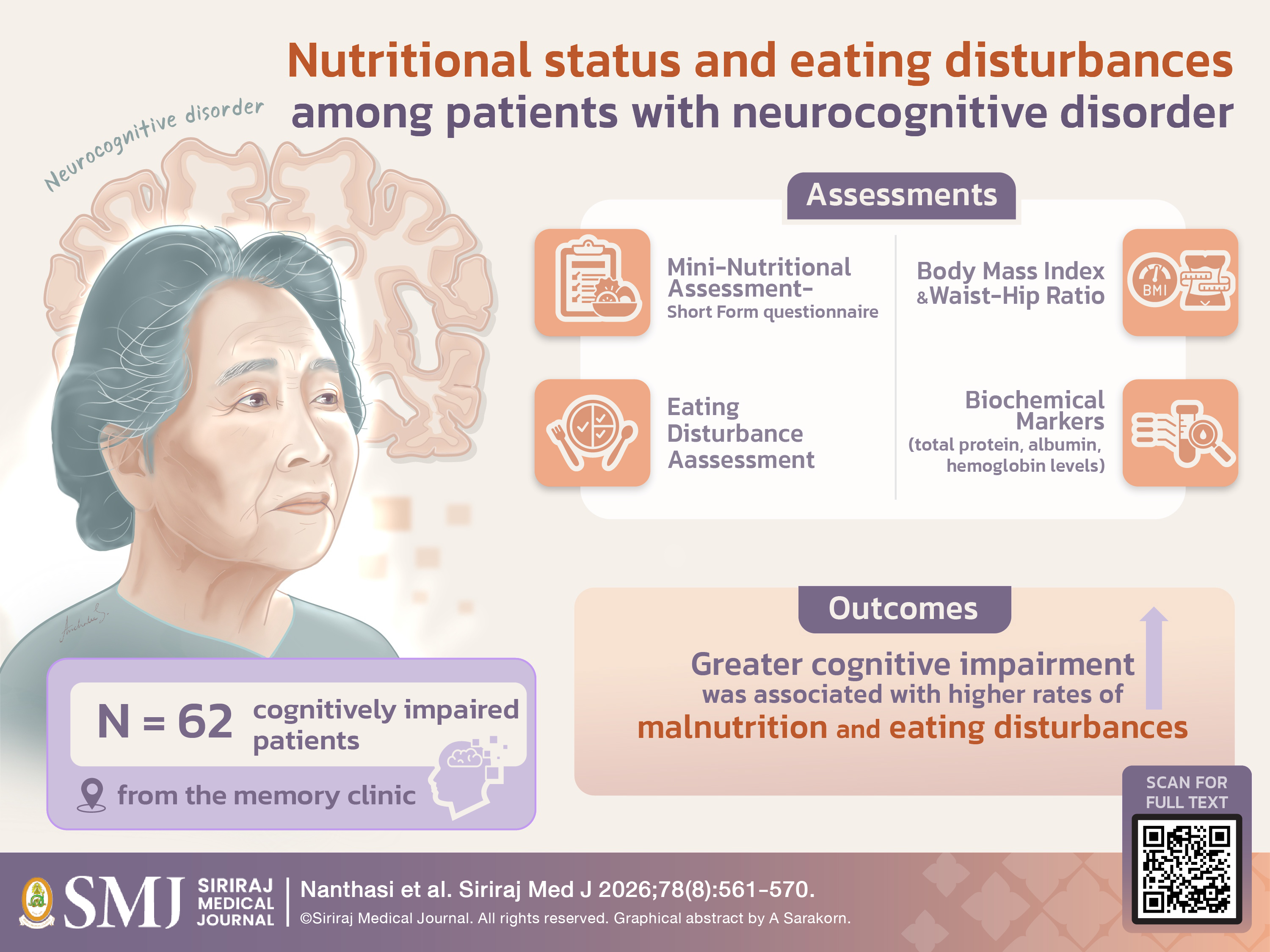
Objective: Evaluate the prevalence of malnutrition and explore the issue of eating disturbances in cognitively impaired patients at the memory clinic.
Materials and Methods: Sixty-two cognitively impaired patients from the memory clinic were assessed. The cognitive stage was categorized using the Clinical Dementia Rating scale-Sum of Boxes. Participants underwent a comprehensive assessment including: Mini-Nutritional Assessment-Short Form (MNA-SF) questionnaire, Body Mass Index (BMI) and Waist-Hip Ratio (WHR) measurements, biochemical markers such as total protein, albumin, and hemoglobin levels, and a comprehensive questionnaire to evaluate eating disturbances. Logistic regression and chisquare analyzed the relationship between cognitive impairment severity, nutritional status, and eating disturbances.
Results: Participants were classified into three groups: mild cognitive impairment (MCI) (n=30), mild dementia (n=22), and moderate dementia (n=10). No significant differences were observed between the groups in terms of BMI, WHR, total protein, albumin, and hemoglobin levels. Based on the MNA-SF score, the odds of malnutrition increased with the severity of cognitive impairment. Moderate dementia patients exhibited a significantly higher risk of malnutrition compared to MCI patients (adjusted OR = 8.87; 95%CI = 1.59-49.46; p = 0.013). The prevalence of eating disturbances increased with the severity of cognitive impairment. Patients with moderate dementia had higher odds of experiencing changes in eating habits compared to those with MCI (aOR=9.37; 95%CI = 0.98–89.64; p=0.052).
Conclusions: Cognitive impairment was associated with increased malnutrition risk and progressive eating disturbances, including changes in appetite and eating habit.
References
Perry E, Walton K, Lambert K. Prevalence of Malnutrition in People with Dementia in Long-Term Care: A Systematic Review and Meta-Analysis. Nutrients. 2023;15(13).
Cereda E, Pedrolli C, Klersy C, Bonardi C, Quarleri L, Cappello S, et al. Nutritional status in older persons according to healthcare setting: A systematic review and meta-analysis of prevalence data using MNA((R)). Clin Nutr. 2016;35(6):1282-90.
Bourdel-Marchasson I, Rolland C, Jutand MA, Egea C, Baratchart B, Barberger-Gateau P. Undernutrition in geriatric institutions in South-West France: policies and risk factors. Nutrition. 2009;25(2):155-64.
Taniguchi Y, Shinkai S, Nishi M, Murayama H, Nofuji Y, Yoshida H, et al. Nutritional biomarkers and subsequent cognitive decline among community-dwelling older Japanese: a prospective study. J Gerontol A Biol Sci Med Sci. 2014;69(10):1276-83.
Michelakos T, Kousoulis AA, Katsiardanis K, Dessypris N, Anastasiou A, Katsiardani KP, et al. Serum folate and B12 levels in association with cognitive impairment among seniors: results from the VELESTINO study in Greece and meta-analysis. J Aging Health. 2013;25(4):589-616.
Briani C, Dalla Torre C, Citton V, Manara R, Pompanin S, Binotto G, et al. Cobalamin deficiency: clinical picture and radiological findings. Nutrients. 2013;5(11):4521-39.
Lu Y, Gwee X, Chua DQ, Lee TS, Lim WS, Chong MS, et al. Nutritional Status and Risks of Cognitive Decline and Incident Neurocognitive Disorders: Singapore Longitudinal Ageing Studies. J Nutr Health Aging. 2021;25(5):660-7.
Chowdhary N, Barbui C, Anstey KJ, Kivipelto M, Barbera M, Peters R, et al. Reducing the Risk of Cognitive Decline and Dementia: WHO Recommendations. Front Neurol. 2021;12:765584.
Cipriani G, Carlesi C, Lucetti C, Danti S, Nuti A. Eating Behaviors and Dietary Changes in Patients With Dementia. Am J Alzheimers Dis Other Demen. 2016;31(8):706-16.
Liu W, Lee K, Galik E, Resnick B. Factors associated with eating performance in nursing home residents living with dementia and other comorbidities. BMC Geriatr. 2024;24(1):946.
Kai K, Hashimoto M, Amano K, Tanaka H, Fukuhara R, Ikeda M. Relationship between eating disturbance and dementia severity in patients with Alzheimer's disease. PLoS One. 2015;10(8):e0133666.
Ciliz O, Tulek Z, Hanagasi H, Bilgic B, Gurvit IH. Eating Difficulties and Relationship With Nutritional Status Among Patients With Dementia. J Nurs Res. 2023;31(1):e260.
Cederholm T, Bosaeus I, Barazzoni R, Bauer J, Van Gossum A, Klek S, et al. Diagnostic criteria for malnutrition - An ESPEN Consensus Statement. Clin Nutr. 2015;34(3):335-40.
Soeters P, Bozzetti F, Cynober L, Forbes A, Shenkin A, Sobotka L. Defining malnutrition: A plea to rethink. Clin Nutr. 2017;36(3):896-901.
Kondrup J, Allison SP, Elia M, Vellas B, Plauth M, Educational, et al. ESPEN guidelines for nutrition screening 2002. Clin Nutr. 2003;22(4):415-21.
Koyama A, Hashimoto M, Tanaka H, Fujise N, Matsushita M, Miyagawa Y, et al. Malnutrition in Alzheimer's Disease, Dementia with Lewy Bodies, and Frontotemporal Lobar Degeneration: Comparison Using Serum Albumin, Total Protein, and Hemoglobin Level. PLoS One. 2016;11(6):e0157053.
Rubino F, Cummings DE, Eckel RH, Cohen RV, Wilding JPH, Brown WA, et al. Definition and diagnostic criteria of clinical obesity. Lancet Diabetes Endocrinol. 2025;13(3):221-62.
Committee TTBF. Thai Mental State Examination (TMSE). Siriraj Hospital Grazette. 1993;45:359-74.
O'Bryant SE, Waring SC, Cullum CM, Hall J, Lacritz L, Massman PJ, et al. Staging dementia using Clinical Dementia Rating Scale Sum of Boxes scores: a Texas Alzheimer's research consortium study. Arch Neurol. 2008;65(8):1091-5.
Rubenstein LZ, Harker JO, Salva A, Guigoz Y, Vellas B. Screening for undernutrition in geriatric practice: developing the short-form mini-nutritional assessment (MNA-SF). J Gerontol A Biol Sci Med Sci. 2001;56(6):M366-72.
Kaiser MJ, Bauer JM, Ramsch C, Uter W, Guigoz Y, Cederholm T, et al. Validation of the Mini Nutritional Assessment short-form (MNA-SF): a practical tool for identification of nutritional status. J Nutr Health Aging. 2009;13(9):782-8.
Waist circumference and waist–hip ratio: report of a WHO expert consultation, Geneva, 8–11 December 2008. World Health Organization; 2008.
Ikeda M, Brown J, Holland AJ, Fukuhara R, Hodges JR. Changes in appetite, food preference, and eating habits in frontotemporal dementia and Alzheimer's disease. J Neurol Neurosurg Psychiatry. 2002;73(4):371-6.
Kiesswetter E, Colombo MG, Meisinger C, Peters A, Thorand B, Holle R, et al. Malnutrition and related risk factors in older adults from different health-care settings: an enable study. Public Health Nutr. 2020;23(3):446-56.
Maltais M, Rolland Y, Hay PE, Armaingaud D, Cestac P, Rouch L, et al. The Effect of Exercise and Social Activity Interventions on Nutritional Status in Older Adults with Dementia Living in Nursing Homes: A Randomised Controlled Trial. J Nutr Health Aging. 2018;22(7):824-8.
Kamo T, Takayama K, Ishii H, Suzuki K, Eguchi K, Nishida Y. Coexisting severe frailty and malnutrition predict mortality among the oldest old in nursing homes: A 1-year prospective study. Arch Gerontol Geriatr. 2017;70:99-104.
Chuansangeam M, Wuthikraikun C, Supapueng O, Muangpaisan W. Prevalence and risk for malnutrition in older Thai people: A systematic review and meta-analysis. Asia Pac J Clin Nutr. 2022;31(1):128-41.
Unsal P, Guner M, Ozsurekci C, Balli N, Bas AO, Ozturk Y, et al. Prevalence of nutrition disorders and nutrition-related conditions in older patients with Alzheimer's disease. Nutr Clin Pract. 2023;38(5):1142-53.
WHO. The Asia-Pacific perspective: redefining obesity and its treatment. Sydney: Health Communications Australia; 2000.
Harris D, Haboubi N. Malnutrition screening in the elderly population. J R Soc Med. 2005;98(9):411-4.
Sanchez-Rodriguez D, Annweiler C, Ronquillo-Moreno N, Tortosa-Rodriguez A, Guillen-Sola A, Vazquez-Ibar O, et al. Clinical application of the basic definition of malnutrition proposed by the European Society for Clinical Nutrition and Metabolism (ESPEN): Comparison with classical tools in geriatric care. Arch Gerontol Geriatr. 2018;76:210-4.
Volkert D, Beck AM, Faxen-Irving G, Fruhwald T, Hooper L, Keller H, et al. ESPEN guideline on nutrition and hydration in dementia - Update 2024. Clin Nutr. 2024;43(6):1599-626.
Eisenmann Y, Golla H, Schmidt H, Voltz R, Perrar KM. Palliative Care in Advanced Dementia. Front Psychiatry. 2020;11:699.
Gupta E, Patel P. Palliative care in dementia. Ann Palliat Med. 2024;13(4):791-807.
Tanaviboon P, Muangpaisan W, Jongsawadipatana A, Siritipakorn P, Intalapaporn S. Validation of Self-application-based Malnutrition and Limited Mobility Screening Tools Compared with Standard Diagnostic Tools in Older Adults. Siriraj Med J [internet]. 2025 Jan. 1 [cited 2026 May 18];77(1):29-38.
Additional Files
Published
How to Cite
License
Copyright (c) 2026 Siriraj Medical Journal

This work is licensed under a Creative Commons Attribution-NonCommercial-NoDerivatives 4.0 International License.
Authors who publish with this journal agree to the following conditions:
Copyright Transfer
In submitting a manuscript, the authors acknowledge that the work will become the copyrighted property of Siriraj Medical Journal upon publication.
License
Articles are licensed under a Creative Commons Attribution-NonCommercial-NoDerivatives 4.0 International License (CC BY-NC-ND 4.0). This license allows for the sharing of the work for non-commercial purposes with proper attribution to the authors and the journal. However, it does not permit modifications or the creation of derivative works.
Sharing and Access
Authors are encouraged to share their article on their personal or institutional websites and through other non-commercial platforms. Doing so can increase readership and citations.