
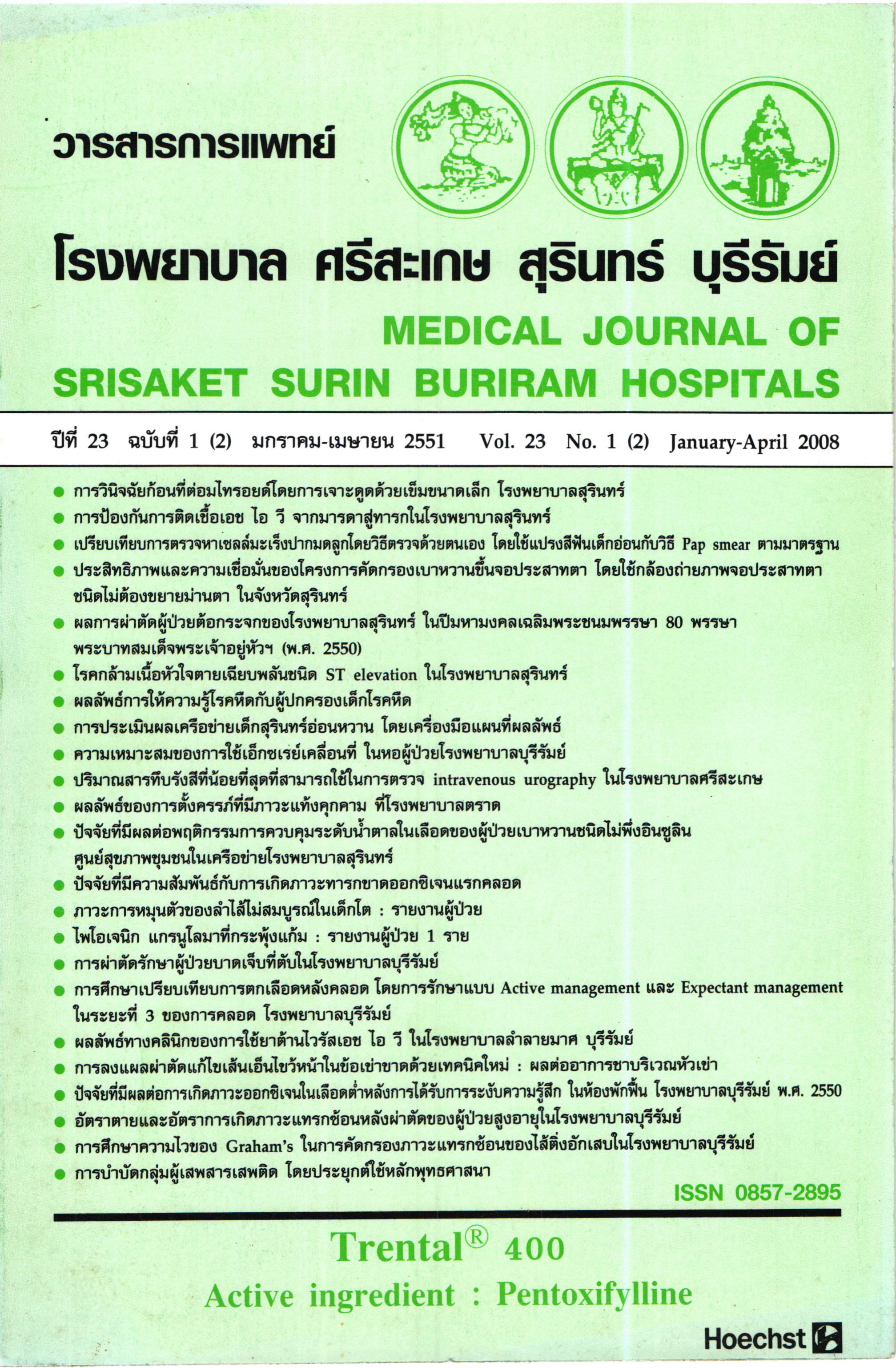
อัตราตายและอัตราการเกิดภาวะแทรกซ้อนหลังผ่าตัดของผู้ป่วยสูงอายุในโรงพยาบาลบุรีรัมย์
Article Sidebar
Main Article Content
บทคัดย่อ
บทนำ: ปัจจุบันประเทศไทยมีการพัฒนาด้านสาธารณสุขมีประสิทธิภาพดียิ่งขึ้น จึงพบว่า อายุขัยเฉลี่ยของประชากรไทยสูงขึ้น โรงพยาบาลบุรีรัมย์จึงมีผู้ใช้บริการด้าน ศัลยกรรมที่เป็นผู้สูงอายุเพิ่มมากขึ้นด้วย
วัตถุประสงค์: เพื่อศึกษาอุบัติการณ์การเกิดภาวะแทรกซ้อน และการตายหลังผ่าตัดของผู้ป่วย สูงอายุในโรงพยาบาลบุรีรัมย์
วิธีการศึกษา: ศึกษาแบบพรรณนาย้อนหลังโดยทบทวนจากเวชระเบียนผู้ป่วยที่เข้ารับการรักษา ในโรงพยาบาลบุรีรัมย์ ตั้งแต่ตุลาคม พ.ศ. 2549 ถึงกรกฎาคม พ.ศ. 2550
ประชากร: ผู้ป่วยที่อายุตั้งแต่ 70 ปีขึ้นไป ได้รับการรักษาด้วยวิธีการผ่าตัดทุกชนิดทั้งภายใต้ การให้ยาระงับความรู้สึก และเทคนิคการใช้ยาชาเฉพาะที่ ในกลุ่มงานศัลยกรรม โรงพยาบาลบุรีรัมย์
สถิติ: ใช้สถิติแบบพรรณนาโดยใช้ร้อยละ ค่าเฉลี่ย มัธยฐาน ส่วนเบี่ยงเบน มาตรฐาน คำนวณปัจจัยเสี่ยงต่อผลการรักษาด้วย odd ratio พิจารณานัยสำคัญทางสถิติที่ P < 0.05 โดยใช้โปรแกรม SPSS สำเร็จรูป
ผลการรักษา: ผู้ป่วยในการศึกษา362 ราย ค่ามัธยฐานของอายุคือ72 ปี (อายุระหว่าง 70-96 ปี) เพศชายร้อยละ 62.2 ได้รับการวินิจฉัยเป็น ไส้ติ่งอักเสบเฉียบพลัน ร้อยละ 15.3, อุบัติเหตุ ร้อยละ 12.5, แผลในกระเพาะอาหารและภาวะแทรกช้อน ร้อยละ 9.5, ถุงน้ำดีอักเสบ ร้อยละ 6.4 และไส้เลื่อน 5.9 ผู้ป่วยตายหลังผ่าตัดร้อยละ 5.5 เกิดภาวะแทรกช้อนหลังผ่าตัด ร้อยละ 33.1 ภาวะแทรกช้อนหลังผ่าตัดที่พบ บ่อย 3 ลำดับแรก คือ ไตวาย ร้อยละ 6.1, ติดเชื้อในกระแสเลือด ร้อยละ 3.6 และปอดอักเสบ ร้อยละ 3.6 อัตราตายหลังผ่าตัดเพิ่มขึ้นอย่างมีนัยสำคัญทาง สถิติในผู้ป่วยที่มีการเจ็บป่วยร่วม (p = 0.042) ปัจจัยด้านเพศ อายุมากกว่า 80 ปี และอัตราการเกิดภาวะแทรกซ้อนหลังผ่าตัดที่ไม่เกี่ยวข้องโดยตรงกับการผ่าตัด (ทั้งภาวะไตวาย ติดเชื้อในกระแสเลือด และปอดอักเสบ)ไม่มีผลต่อการตายหลัง ผ่าตัดอย่างมีนัยสำคัญทางสถิติ
สรุป: อุบัติการณ์การเกิดภาวะแทรกช้อนหลังผ่าตัดในผู้ป่วยสูงอายุในโรงพยาบาลบุรีรัมย์ พบร้อยละ 33.1 และอุบัติการณ์การตายหลังผ่าตัดพบร้อยละ 5.5 โดยปัจจัยที่ เกี่ยวข้อง คือการที่ผู้ป่วยมีโรคร่วมก่อนผ่าตัด
Article Details
เอกสารอ้างอิง
2. Ross AF, Tinker JH. Anesthesia risk. In : Miller RD, ed. Anesthesia 3rd edition. New York : Churchill-Livingstone. 1990:716-42
3. สมรัตน์ จารุลักษณานันท์, ฐิติมา ชินะโชติ, อักษร พูลนิติพร, ศิริลักษณ์ กล้าณรงค์, อรลักษณ์ รอดอนันต์, สุรศักดิ์ ถนัดศีลธรรม. การศึกษาอุบัติการณ์การเสียชีวิตหลังให้ยาระงับความรู้สึก สำหรับการผ่าตัดในประเทศไทย : การวิเคราะห์ปัจจัยเสี่ยง. J Med Assoc Thai 2548;88:S38-S40
4. Arbors MS, Meursing AE, Van Kleef JW, de Lunge JS, Spoormans HH, Touw P, et al. Impact of anesthesia management characteristics on severe morbidity and mortality. Anesthesiology 2005;102:251-2
5. Bufalari A, ferri M, Cao P, et al. Surgical care in octogenarians. Br J Surg 1996;83:1783-7
6. Larry McNicol, David A Story, Kate Leslie, Paul S, Myles Michael Fink, Andrew C Shelton, et al. Postoperative complications and mortality in older patients having non-cardiac surgery at three Melbourne teaching hospitals. MJA 2007;186:447-52.
7. Hamel MB, Henderson WG, Khuri SF, Daley J. Surgical outcomes for patients aged 80 and older : morbidity and mortality for major noncardiac surgery. J Am Geriatr Soc 2005;53:424-9.
8. Leung JM, Dzankic S. Relative importance of preoperative health status versus intraoperative factors in predicting postoperative adverse outcomes in geriatric surgical patients. J Am Geriatr Soc 2001;49:1080-5.
9. Liu LL, Leung JM. Predicting adverse postoperative outcomes in patients aged 80 years or older. J Am Geriatr Soc 2000;48:405-12.
10. Walters U, Wolf T, Schrader T. ASA classification and preoperative Variables as predictors of postoperative outcome. Br J Anaesth 1996;76:217-22.
11. พัชรี ยิ้มรัตนบวร. อัตราตายของผู้ป่วยที่มารับบริการทางวิสัญญีตามสภาพก่อนผ่าตัด. วิสัญญีสาร. 2549; 32:13-8.
