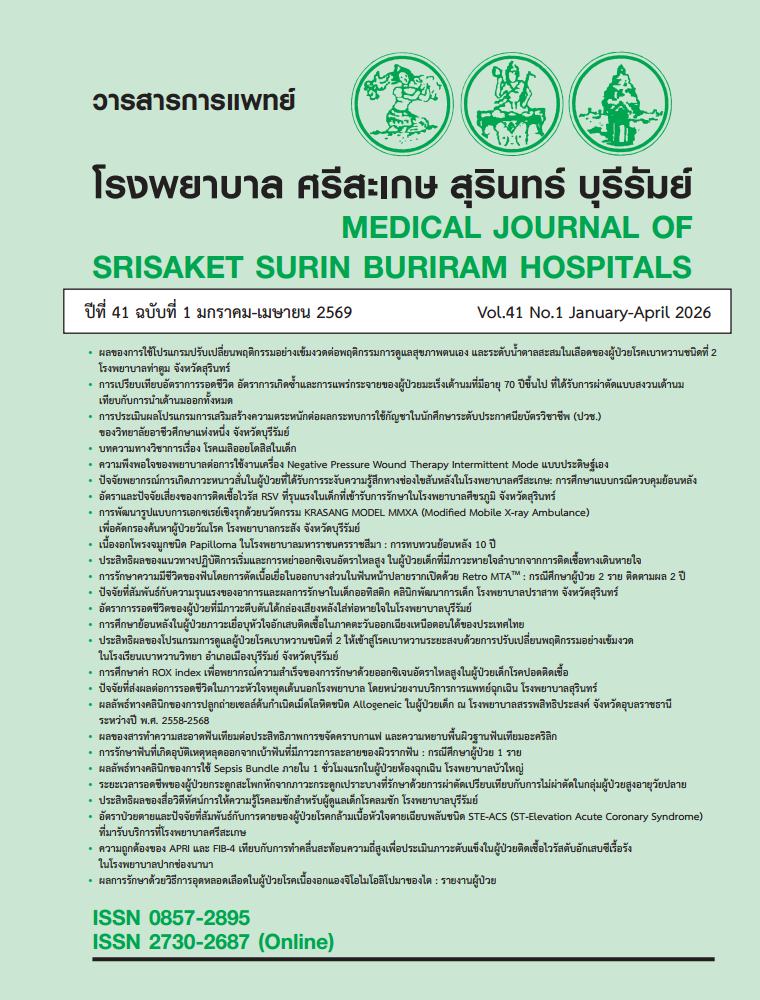
ผลลัพธ์ทางคลินิกของการปลูกถ่ายเซลล์ต้นกำเนิดเม็ดโลหิตชนิด Allogeneic ในผู้ป่วยเด็ก ณ โรงพยาบาลสรรพสิทธิประสงค์ จังหวัดอุบลราชธานี ระหว่างปี พ.ศ. 2558–2568
Article Sidebar
Main Article Content
บทคัดย่อ
หลักการและเหตุผล: การปลูกถ่ายเซลล์ต้นกำเนิดจากผู้บริจาค (Allogeneic hematopoietic stem cell transplantation: Allo-HSCT) เป็นวิธีการรักษาที่มีประสิทธิภาพในการหายขาดสำหรับโรคทางโลหิตวิทยารวมถึงโรคพันธุกรรมและมะเร็งของระบบเลือด
วัตถุประสงค์ของการวิจัย: เพื่อวิเคราะห์ผลลัพธ์ และภาวะแทรกซ้อนของการปลูกถ่ายการปลูกถ่ายเซลล์ต้นกำเนิดจากผู้บริจาคที่เป็นพี่น้องที่มี HLA ตรงกันในผู้ป่วยเด็ก ณ โรงพยาบาลสรรพสิทธิประสงค์ เพื่อเป็นข้อมูลในการวางแผนการดูแลผู้ป่วยให้ได้มีประสิทธิภาพและมีอัตราการหายขาดได้ มาตรฐานระดับสากล
วิธีการศึกษา: การศึกษานี้เป็นการวิจัยเชิงพรรณนาแบบย้อนหลัง เก็บข้อมูลผู้ป่วยเด็กที่ได้รับการปลูกถ่าย Allo-HSCT ที่มี HLA-match 10/10 ตรงกันทั้งหมดกับผู้บริจาคที่เป็นพี่น้องพ่อแม่เดียวกัน (HLA-matched sibling donor) ณ โรงพยาบาลสรรพสิทธิประสงค์ ระหว่างปี พ.ศ. 2558-2568 รวมทั้งสิ้น 18 ราย วิเคราะห์ข้อมูลด้านประชากร โรคที่ได้รับการรักษา ลักษณะของการปลูกถ่าย ภาวะแทรกซ้อน และผลลัพธ์ทางคลินิก
ผลการศึกษา: ผู้ป่วยมีอายุเฉลี่ย 8.5 ปี (2–14 ปี) เป็นเพศชาย ร้อยละ 55.6 กลุ่มโรคที่ได้รับการรักษาแบ่งเป็น กลุ่มโรคมะเร็งเม็ดเลือดและไม่ใช่มะเร็ง ร้อยละ 50 แหล่งเซลล์ต้นกำเนิดส่วนใหญ่เป็น peripheral blood stem cells ร้อยละ 88.9 conditioning regimen ที่ใช้ได้แก่ myeloablative, Reduced Intensity และ Non Myeloablative ค่าเฉลี่ยจำนวน CD34+ cell เท่ากับ 5.05 ×10⁶/kg และ Neutrophil engraftment เฉลี่ยที่ Day +12, ระยะเวลาเฉลี่ยในการเกิด Platelets engraftment D +21.5 พบ Acute GVHD (aGVHD) grade I-II ร้อยละ 33.3, ไม่พบ aGVHD grade II-IV Chronic GVHD ร้อยละ 11.1 Veno-Occlusive Disease( mild ) ร้อยละ 5.5 ผลการรักษาโดยรวมพบผู้ป่วยรอดชีวิตโดยไม่มีโรค (Disease Free survival) ร้อยละ 72.2 โรคกลับเป็นซ้ำในผู้ป่วยมะเร็งและเสียชีวิตจากโรคมะเร็ง (relapse) ร้อยละ 27.8 ไม่มีรายใดเสียชีวิตจากภาวะแทรกซ้อน ค่าใช้จ่ายเฉลี่ยในการรักษาต่อราย ณ ช่วงที่นอนโรงพยาบาลอยู่ที่ 547,391 บาท การวิเคราะห์กลุ่มย่อยในผู้ป่วยโรคไม่ใช่มะเร็งรอดชีวิตและหายขาดจากโรค ร้อยละ 100 ในขณะที่กลุ่มโรคมะเร็ง มีอัตราการเสียชีวิตจากการกลับเป็นซ้ำของโรคสูงถึง ร้อยละ 55.6 อย่างมีนัยสำคัญทางสถิติ (p=0.015)
สรุป: การปลูกถ่ายเซลล์ต้นกำเนิดจากพี่น้องที่มี HLA ตรงกันในผู้ป่วยเด็ก ณ โรงพยาบาลระดับภูมิภาค มีความสำเร็จของการรักษาที่ดี โดยเฉพาะในโรคไม่ใช่มะเร็งและไม่พบภาวะแทรกซ้อนที่รุนแรง และการเสียชีวิตจากกระบวนการปลูกถ่ายเซลล์ต้นกำเนิด
Article Details

อนุญาตภายใต้เงื่อนไข Creative Commons Attribution-NonCommercial-NoDerivatives 4.0 International License.
เอกสารอ้างอิง
Fucharoen S, Winichagoon P. Thalassemia in SouthEast Asia: problems and strategy for prevention and control. Southeast Asian J Trop Med Public Health 1992;23(4):647-55. PMID: 1298071
Hunger SP, Mullighan CG. Acute Lymphoblastic Leukemia in Children. N Engl J Med 2015;373(16):1541-52. doi: 10.1056/NEJMra1400972.
Hunger SP, Lu X, Devidas M, Camitta BM, Gaynon PS, Winick NJ, et al. Improved survival for children and adolescents with acute lymphoblastic leukemia between 1990 and 2005: a report from the children's oncology group. J Clin Oncol 2012;30(14):1663-9. doi: 10.1200/JCO.2011.37.8018.
Qasim W, Cavazzana-Calvo M, Davies EG, Davis J, Duval M, Eames G, et al. Allogeneic hematopoietic stem-cell transplantation for leukocyte adhesion deficiency. Pediatrics 2009;123(3):836-40. doi: 10.1542/peds.2008-1191.
Aboobacker FN, Kulkarni UP, Korula A, Devasia AJ, Selvarajan S, Lionel S, et al. Hematopoietic Stem Cell Transplantation is a cost-effective alternative to enzyme replacement therapy in Gaucher Disease. Blood Cell Ther 2022;5(3):69-74. doi: 10.31547/bct-2021-020.
Peters C, Balthazor M, Shapiro EG, King RJ, Kollman C, Hegland JD, et al. Outcome of unrelated donor bone marrow transplantation in 40 children with Hurler syndrome. Blood 1996;87(11):4894-902. PMID: 8639864
Oberg JA, Bender JG, Morris E, Harrison L, Basch CE, Garvin JH, et al. Pediatric allo-SCT for malignant and non-malignant diseases: impact on health-related quality of life outcomes. Bone Marrow Transplant 2013;48(6):787-93. doi: 10.1038/bmt.2012.217.
Sabloff M, Chandy M, Wang Z, Logan BR, Ghavamzadeh A, Li CK, et al. HLA-matched sibling bone marrow transplantation for β-thalassemia major. Blood 2011;117(5):1745-50. doi: 10.1182/blood-2010-09-306829.
Anurathapan U, Pakakasama S, Rujkijyanont P, Sirachainan N, Songdej D, Chuansumrit A, et al. Pretransplant immunosuppression followed by reduced-toxicity conditioning and stem cell transplantation in high-risk thalassemia: a safe approach to disease control. Biol Blood Marrow Transplant 2013;19(8):1259-62. doi: 10.1016/j.bbmt.2013.04.023.
Rocha V, Gluckman E; Eurocord and European Blood and Marrow Transplant Group. Clinical use of umbilical cord blood hematopoietic stem cells. Biol Blood Marrow Transplant 2006;12(1 Suppl 1):34-41. doi: 10.1016/j.bbmt.2005.09.006.
Petersdorf EW. Optimal HLA matching in hematopoietic cell transplantation. Curr Opin Immunol 2008;20(5):588-93. doi: 10.1016/j.coi.2008.06.014.
Hammad M, Hafez H, Sidhom I, Yassin D, Salem S, Alsheshtawi K, et al. Hematopoietic stem cell transplantation from HLA-matched sibling donors in children with acute lymphoblastic leukemia: A report from the Children's Cancer Hospital Egypt. Front Oncol 2022;12:983220. doi: 10.3389/fonc.2022.983220.
Mehta RS, Ramdial J, Kebriaei P, Champlin RE, Popat U, Rezvani K, et al. Haploidentical vs HLA-matched sibling donor HCT with PTCy prophylaxis: HLA factors and donor age considerations. Blood Adv 2024;8(20):5306-14. doi: 10.1182/bloodadvances.2024013853.
Shao DF, Li JH, Hu T, Zhang ZX, Zhang L, Li JJ, et al. Clinical outcomes of individualized busulfan-dosing in hematopoietic stem cell transplantation in Chinese children undergoing with therapeutic drug monitoring. Bone Marrow Transplant 2022;57(3):473-8. doi: 10.1038/s41409-021-01545-x.
Olson TL, Pollack MM, Dávila Saldaña BJ, Patel AK. Hospital survival following pediatric HSCT: changes in complications, ICU therapies and outcomes over 10 years. Front Pediatr 2023;11:1247792. doi: 10.3389/fped.2023.1247792.
Parsons SK, Tighiouart H, Terrin N. Assessment of health-related quality of life in pediatric hematopoietic stem cell transplant recipients: progress, challenges and future directions.
Expert Rev Pharmacoecon Outcomes Res 2013;13(2):217-25. doi: 10.1586/erp.13.11.
Tian J, Wei A, Wang B, Yang J, Zheng H, Qin M. Allogeneic hematopoietic stem cell transplantation for pediatric acute lymphoblastic leukemia. Ann Hematol 2024;103(1):297-305. doi: 10.1007/s00277-023-05506-w.
Zhang MJ, Davies SM, Camitta BM, Logan B, Tiedemann K, Eapen M, et al. Comparison of outcomes after HLA-matched sibling and unrelated donor transplantation for children with high-risk acute lymphoblastic leukemia. Biol Blood Marrow Transplant 2012;18(8):1204-10. doi: 10.1016/j.bbmt.2012.01.007.
Litzow MR, Pérez WS, Klein JP, Bolwell BJ, Camitta B, Copelan EA, et al. Comparison of outcome following allogeneic bone marrow transplantation with cyclophosphamide-total body irradiation versus busulphan-cyclophosphamide conditioning regimens for acute myelogenous leukaemia in first remission. Br J Haematol 2002;119(4):1115-24. doi: 10.1046/j.1365-2141.2002.03973.x.
Brown RA, Adkins D, Goodnough LT, Haug JS, Todd G, Wehde M, et al. Factors that influence the collection and engraftment of allogeneic peripheral-blood stem cells in patients with hematologic malignancies. J Clin Oncol 1997;15(9):3067-74. doi: 10.1200/JCO.1997.15.9.3067.
