
Prognostic Factors for Changes in Activities of Daily Living After Acute Ischemic Stroke
DOI:
https://doi.org/10.33192/smj.v78i8.280808Keywords:
Ischemic stroke, activities of daily living, prognostic factors, caregivers, functional recoveryAbstract
Objective: Disability in activities of daily living (ADL) is one of the most common sequelae of ischemic stroke. The factors that govern the course of functional recovery in this group of patients need to be identified to inform clinical management. The objective of this study was to explore the prognostic factors of ADL for the functional outcome of patients with acute ischemic stroke at 3-month follow-up.
Materials and Methods: A prospective cohort study in patients with acute ischemic stroke was performed. Prognostic factors were obtained from patient records. The Barthel index (BI) was used to evaluate functional status both before discharge and at a 3-month follow-up. Correlates of worsening or unchanged ADL were calculated using multivariable ordinal logistic regression.
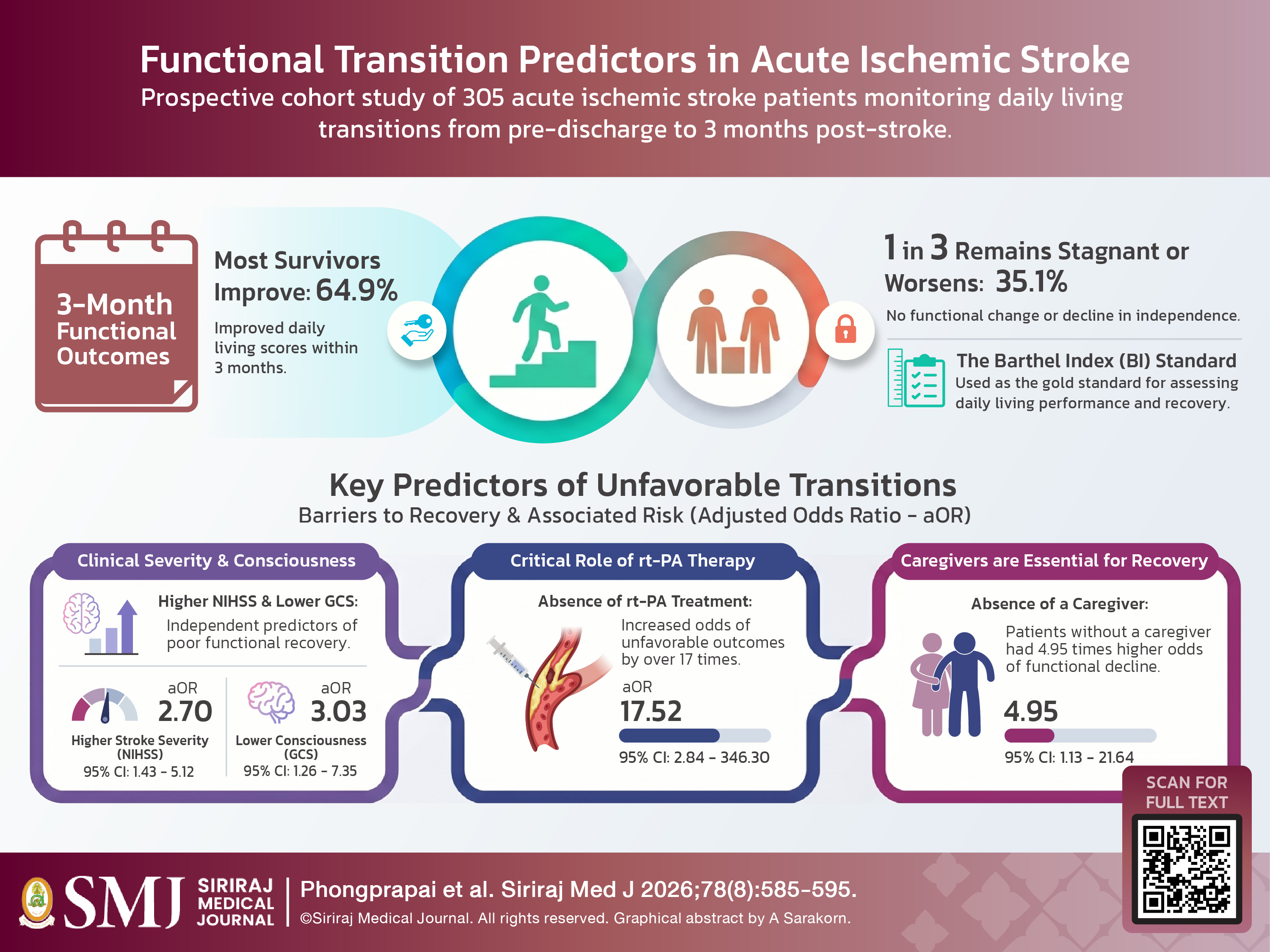
Results: A total of 305 patients were enrolled (mean age, 65 years; male, 55.4%). At 3 months, ADL improved in 64.9% of patients, remained unchanged in 28.2%, and worsened in 6.9%. Several independent prognostic factors for worse or unchanged ADL at 3 months were identified and included: higher NIHSS (aOR = 2.70, 95% CI: 1.43–5.12), lower GCS (aOR = 3.03, 95% CI: 1.26–7.35), absence of thrombolytic therapy with rt-PA (aOR =17.52, 95% CI:2.84-346.30), and absence of a caregiver (aOR =4.95, 95% CI, 1.13–21.64).
Conclusions: Stroke severity (NIHSS, GCS) and acute intervention (rt-PA), as well as social support (caregivers), are important determinants of functional evolution in ischemic stroke patients. These results support the need for early risk stratification and optimized post-discharge support to enhance long-term rehabilitation outcomes.
References
Winstein CJ, Stein J, Arena R, Bates B, Cherney LR, Cramer SC, et al. Guidelines for Adult Stroke Rehabilitation and Recovery: A Guideline for Healthcare Professionals from the American Heart Association/American Stroke Association. Vol. 47, Stroke. 2016. 98–169 p.
Taylor-Rowan M, Wilson A, Dawson J, Quinn TJ. Functional assessment for acute stroke trials: Properties, analysis, and application. Front Neurol. 2018;9(MAR):1–10.
Hsueh IP, Lin JH, Jeng JS, Hsieh CL. Comparison of the psychometric characteristics of the functional independence measure, 5 item Barthel index, and 10 item Barthel index in patients with stroke. J Neurol Neurosurg Psychiatry. 2002;73(2):188–90.
Dromerick AW, Edwards DF, Diringer MN. Sensitivity to changes in disability after stroke: A comparison of four scales useful in clinical trials. J Rehabil Res Dev. 2003;40(1):1–8.
Mungklang P, Puwarawuttipanich W, Pongthavornkamol K, Nilanont Y. The Effectiveness of Cognitive Flexibility Training Program on Cognitive Functions and Activities of Daily Living in Patients with Ischemic Stroke. Siriraj Med J. 2021;73(4):236-44.
Veerbeek JM, Kwakkel G, Van Wegen EEH, Ket JCF, Heymans MW. Early prediction of outcome of activities of daily living after stroke: A systematic review. Stroke. 2011;42(5):1482–8.
Meyer MJ, Pereira S, McClure A, Teasell R, Thind A, Koval J, et al. A systematic review of studies reporting multivariable models to predict functional outcomes after post-stroke inpatient rehabilitation. Disabil Rehabil. 2015;37(15):1316–23.
Petrea RE, Beiser AS, Seshadri S, Kelly-Hayes M, Kase CS, Wolf PA. Gender differences in stroke incidence and poststroke disability in the Framingham Heart Study. Stroke. 2009;40(4):1032–7.
Kongsawasdi S, Klaphajone J, Wivatvongvana P, Watcharasaksilp K. Prognostic Factors of Functional Outcome Assessed by Using the Modified Rankin Scale in Subacute Ischemic Stroke. J Clin Med Res. 2019;11(5):375–82.
Johnston KC, Connors AF, Wagner DP, Knaus WA, Wang XQ, Haley EC. A predictive risk model for outcomes of ischemic stroke. Stroke. 2000;31(2):448–55.
Dziedzic T, Slowik A, Szczudlik A. Serum albumin level as a predictor of ischemic stroke outcome. Stroke. 2004;35(6):10–2.
Barlas RS, Honney K, Loke YK, Mccall SJ, Bettencourt-Silva JH, Clark AB, et al. Impact of Hemoglobin Levels and Anemia on Mortality in Acute Stroke: Analysis of UK Regional Registry Data, Systematic Review, and Meta-Analysis. J Am Heart Assoc. 2016;5(8):1–16.
Wichianrat R, Sangpetngam B, Aurboonyawat T, Chankaew E, Churojana A, Withayasuk P. Clinical Outcomes and Predictive Factors in Acute Tandem Occlusion: A Single-Center Experience. Siriraj Med J. 2026;78(5):332-49.
Kientchockwiwat K, Thitisakulchai P, Tanvijit P. The Safety of Food and Drink Consistencies Based on a Fiberoptic Endoscopic Evaluation of Swallowing Study Results in Stroke Patients with Dysphagia. Siriraj Med J. 2022;74(6):395-400.
Jampathong N, Laopaiboon M, Rattanakanokchai S, Pattanittum P. Prognostic models for complete recovery in ischemic stroke: A systematic review and meta-analysis. BMC Neurol. 2018;18(1):1–11.
Schmülling S, Grond M, Rudolf J, Heiss WD. One-year follow-up in acute stroke patients treated with rtPA in clinical routine. Stroke. 2000;31(7):1552–4.
Wang TC, Tsai AC, Wang JY, Lin Y Te, Lin KL, Chen JJ, et al. Caregiver-mediated intervention can improve physical functional recovery of patients with chronic stroke: A randomized controlled trial. Neurorehabil Neural Repair. 2015;29(1):3–12.
Vogt G, Laage R, Shuaib A, Schneider A. Initial lesion volume is an independent predictor of clinical stroke outcome at day 90: An analysis of the Virtual International Stroke Trials Archive (VISTA) database. Stroke. 2012;43(5):1266–72.
Tong DC, Yenari MA, Albers GW, O’Brien M, Marks MP, Moseley ME. Correlation of perfusion- and diffusion-weighted MRI with NIHSS score in acute (<6.5 hour) ischemic stroke. Neurology. 1998;50(4):864–70.
Saver JL. Time is brain - quantified. Stroke. 2006;37(1):263-6.
Yong M, Kaste M. Dynamic of hyperglycemia as a predictor of stroke outcome in the ECASS-II trial. Stroke. 2008;39(10):2749–55.
Powers WJ, Rabinstein AA, Ackerson T, Adeoye OM, Bambakidis NC, Becker K, et al. Guidelines for the early management of patients with acute ischemic stroke: 2019 update to the 2018 guidelines for the early management of acute ischemic stroke a guideline for healthcare professionals from the American Heart Association/American Stroke A. Vol. 50, Stroke. 2019. 344–418 p.
Bakas T, Clark PC, Kelly-hayes M, King RB, Lutz BJ, Miller EL. AHA / ASA Scientific Statement Evidence for Stroke Family Caregiver and Dyad Interventions. 2014;2836–52.
Ruksakulpiwat S. Intervention Enhancing Medication Adherence in Stroke Patients: An Integrative Review. Siriraj Med J. 2021;73(7):429-44.
Riyapan S, Chantanakomes J, Ruangsomboon O, Chaisirin W, Limsuwat C, Prapruetkit N, et al. Assessment of Prehospital Management of Patients Transported to a Thai University Hospital. Siriraj Med J. 2020;72(4):287-95.
Published
How to Cite
Issue
Section
Categories
License
Copyright (c) 2026 Siriraj Medical Journal

This work is licensed under a Creative Commons Attribution-NonCommercial-NoDerivatives 4.0 International License.
Authors who publish with this journal agree to the following conditions:
Copyright Transfer
In submitting a manuscript, the authors acknowledge that the work will become the copyrighted property of Siriraj Medical Journal upon publication.
License
Articles are licensed under a Creative Commons Attribution-NonCommercial-NoDerivatives 4.0 International License (CC BY-NC-ND 4.0). This license allows for the sharing of the work for non-commercial purposes with proper attribution to the authors and the journal. However, it does not permit modifications or the creation of derivative works.
Sharing and Access
Authors are encouraged to share their article on their personal or institutional websites and through other non-commercial platforms. Doing so can increase readership and citations.