
The Efficacy of Combining Selective Tibial Nerve Block with Adductor Canal Block on Postoperative Pain Control After Total Knee Replacement: A Prospective Randomized Controlled Trial
DOI:
https://doi.org/10.33192/smj.v78i7.281148Keywords:
Adductor canal block, motor-sparing block, postoperative pain, tibial nerve block, total knee replacementAbstract
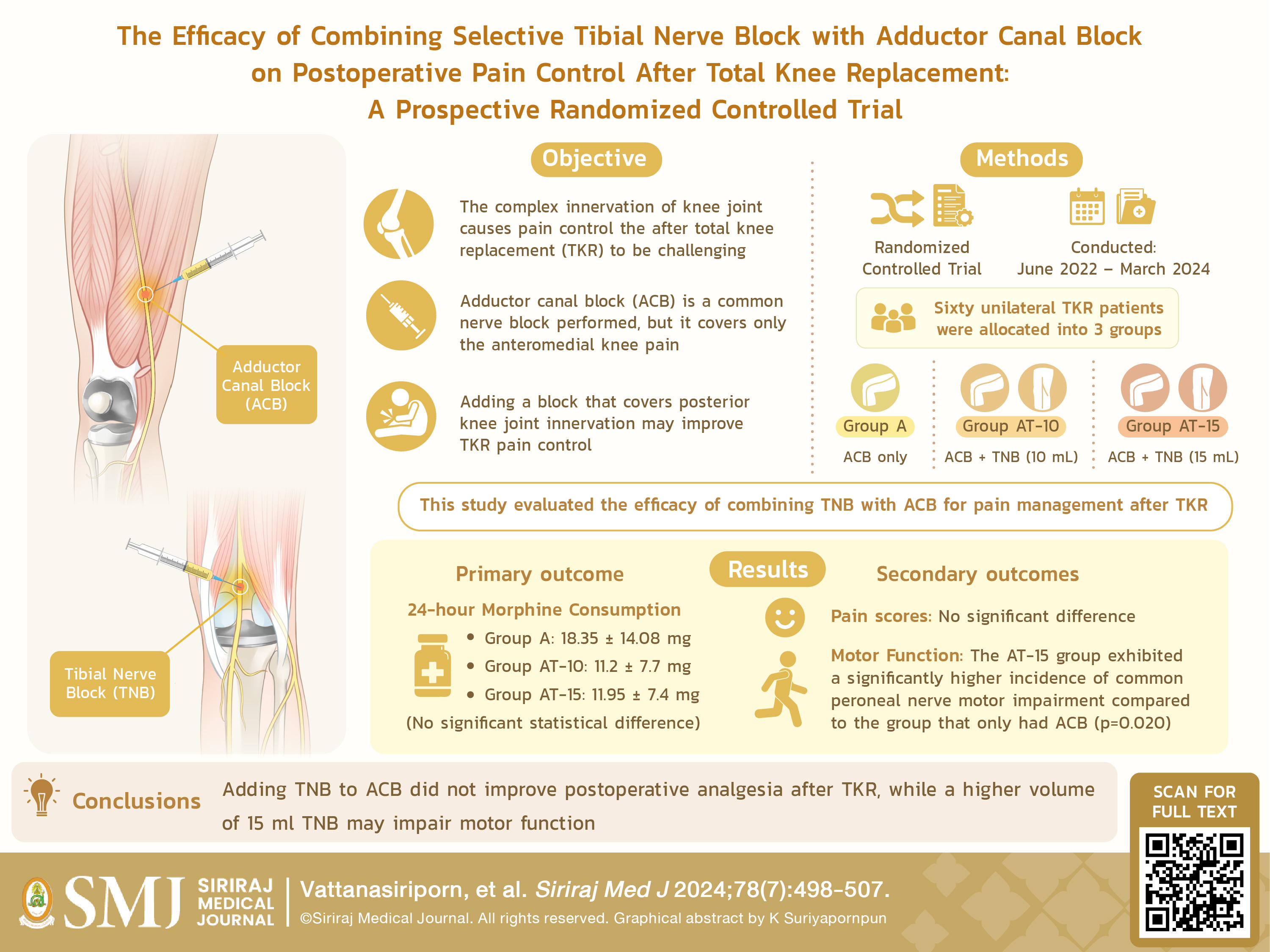
Objective: Pain control after total knee replacement (TKR) is crucial for early recovery but remains challenging. This study aimed to assess the analgesic efficacy of the combination of tibial nerve block (TNB) and adductor canal block (ACB), the motor-sparing block for TKR.
Material and Methods: This randomized controlled trial was performed from June 2022 to March 2024. Sixty patients undergoing unilateral TKR were recruited and randomly allocated to one of three groups. Group A received the ACB, group AT-10 received ACB and TNB using 10 ml of local anesthetic (LA), and group AT-15 received ACB and TNB using 15 ml of LA. The primary outcome was 24-hour total postoperative morphine consumption. Secondary outcomes included Numeric Rating Scale (NRS) pain scores, sensorimotor function, and adverse events.
Results: The 24-hour postoperative accumulated morphine consumption in groups A, AT-10, and AT-15 was 18.35 ± 14.08 mg, 11.2 ± 7.7 mg, and 11.95 ± 7.4 mg, respectively. There was no statistically significant difference in morphine consumption or NRS pain scores at any time point. Motor function of the common peroneal nerve (CPN) was significantly impaired in group AT-15 compared with group A (P = 0.020), with no significant differences
observed between group AT-10 and group A or in group AT-10 and group AT-15. No serious adverse event was observed in any group.
Conclusion: The addition of TNB to ACB does not improve analgesic efficacy following TKR, and 15 ml of TNB is also associated with CPN motor impairment that may delay ambulation.
References
Steinhaus ME, Christ AB, Cross MB. Total knee arthroplasty for knee osteoarthritis: support for a foregone conclusion? HSS J. 2017;13(2):207–10.
Chinachoti T, Attawattanakul J, Luansritisakul C. Quality of Life after Total Knee Replacement at Siriraj Hospital, Thailand. Siriraj Med J. 2016;68(2):72-78.
Iamaroon A, Siriussawakul A, Tangwiwat S, Saetang S, Rungwattanakit P. Moderate-to-severe pain after knee arthroplasty: a retrospective study of incidence and risk factors. Thai J Anesthesiol. 2020;46(2):71–9.
Momoli A, Giaretta S, Modena M, Micheloni GM. The painful knee after total knee arthroplasty: evaluation and management. Acta Biomed. 2017;88(Suppl 2):60–7.
Riga M, Altsitzioglou P, Saranteas T, Mavrogenis AF. Enhanced recovery after surgery (ERAS) protocols for total joint replacement surgery. SICOT J. 2023;9:E1.
Wylde V, Beswick A, Bruce J, Blom A, Howells N, Gooberman-Hill R. Chronic pain after total knee arthroplasty. EFORT Open Rev. 2018;3(8):461–70.
Soffin EM, Wu CL. Regional and multimodal analgesia to reduce opioid use after total joint arthroplasty: a narrative review. HSS J. 2019;15(1):57–65.
Drew JM, Neilio J, Kunze L. Contemporary perioperative analgesia in total knee arthroplasty: multimodal protocols, regional anesthesia, and peripheral nerve blockade. J Knee Surg. 2018;31(7):600–4.
Grevstad U, Mathiesen O, Valentiner S, Jaeger P, Hilsted KL, Dahl JB. Effect of adductor canal block vs femoral nerve block on quadriceps strength, mobilization, and pain after total knee arthroplasty: a randomized, blinded study. Reg Anesth Pain Med. 2015;40(1):3–10.
Sawhney M, Mehdian H, Kashin B, Ip G, Bent M, Choy J, et al. Pain after unilateral total knee arthroplasty: a prospective randomized controlled trial examining the analgesic effectiveness of a combined adductor canal peripheral nerve block with periarticular infiltration versus adductor canal nerve block alone versus periarticular infiltration alone. Anesth Analg. 2016;122(6):2040–6.
Abdallah FW, Chan VW, Gandhi R, Koshkin A, Abbas S, Brull R. The analgesic effects of proximal, distal, or no sciatic nerve block on posterior knee pain after total knee arthroplasty: a double-blind placebo-controlled randomized trial. Anesthesiology. 2014; 121(6):1302–10.
Sinha SK, Abrams JH, Arumugam S, D'Alessio J, Freitas DG, Barnett JT, et al. Femoral nerve block with selective tibial nerve block provides effective analgesia without foot drop after total knee arthroplasty: a prospective, randomized, observer-blinded study. Anesth Analg. 2012;115(1):202–6.
Chow SC, Shao J, Wang H, Lokhnygina Y. Sample size calculations in clinical research. 3rd ed. Boca Raton (FL): Chapman & Hall/CRC;2017.
Kim DH, Lin Y, Goytizolo EA, Kahn RL, Maalouf DB, Manohar A, et al. Adductor canal block versus femoral nerve block for total knee arthroplasty: a prospective, randomized, controlled trial. Anesthesiology. 2014;120(3):540–50.
Hasabo EA, Assar A, Mahmoud MM, Abdalrahman HA, Ibrahim EA, Hasanin MA, et al. Adductor canal block versus femoral nerve block for pain control after total knee arthroplasty: a systematic review and meta-analysis. Medicine (Baltimore). 2022; 101(34):e30110.
Abdallah FW, Chan VW, Gandhi R, Koshkin A, Abbas S, Brull R. The analgesic effects of proximal, distal, or no sciatic nerve block on posterior knee pain after total knee arthroplasty: a double-blind placebo-controlled randomized trial. Anesthesiology. 2014;121(6):1302-10.
Abdallah FW, Madjdpour C, Brull R. Is sciatic nerve block advantageous when combined with femoral nerve block for postoperative analgesia following total knee arthroplasty? A meta-analysis. Can J Anaesth. 2016;63(5):552-68.
Zorrilla-Vaca A, Li J. The role of sciatic nerve block to complement femoral nerve block in total knee arthroplasty: a meta-analysis of randomized controlled trials. J Anesth. 2018;32(3):341–50.
Tran DQH, Peng PWH. Overview of innervation of knee joint. Pain Med. 2021; 22(8):1701-14.
Lavand'homme PM, Kehlet H, Rawal N, Joshi GP; PROSPECT Working Group of the European Society of Regional Anaesthesia and Pain Therapy (ESRA). Pain management after total knee arthroplasty: procedure specific postoperative pain management recommendations. Eur J Anaesthesiol. 2022;39(9):743-57.
White L, Kerr M, Thang C, Pawa A. Motor-sparing regional anaesthesia for total knee arthroplasty: a narrative and systematic literature review. Br J Anaesth. 2025;134(2):510-22.
Laigaard J, Pedersen C, Rønsbo TN, Mathiesen O, Karlsen APH. Minimal clinically important differences in randomised clinical trials on pain management after total hip and knee arthroplasty: a systematic review. Br J Anaesth. 2021;126(5):1029-37.
Paulou F, Wegrzyn J, Rossel JB, Gonvers E, Antoniadis A, Kägi M, et al. Analgesic efficacy of selective tibial nerve block versus partial local infiltration analgesia for posterior pain after total knee arthroplasty: a randomized, controlled, triple-blinded trial. Anaesth Crit Care Pain Med. 2023;42(4):101223.
Sakai N, Adachi T, Sudani T, Taruishi C, Uematsu Y, Takada M. Popliteal plexus block compared with tibial nerve block on rehabilitation goals following total knee arthroplasty: a randomized non-inferiority trial. Sci Rep. 2024;14(1):23853.
Silverman ER, Vydyanathan A, Gritsenko K, Shaparin N, Singh N, Downie SA, et al. The anatomic relationship of the tibial nerve to the common peroneal nerve in the popliteal fossa: Implications for selective tibial nerve block in total knee arthroplasty. Pain Res Manag. 2017;2017:7250181.
Published
How to Cite
License
Copyright (c) 2026 Siriraj Medical Journal

This work is licensed under a Creative Commons Attribution-NonCommercial-NoDerivatives 4.0 International License.
Authors who publish with this journal agree to the following conditions:
Copyright Transfer
In submitting a manuscript, the authors acknowledge that the work will become the copyrighted property of Siriraj Medical Journal upon publication.
License
Articles are licensed under a Creative Commons Attribution-NonCommercial-NoDerivatives 4.0 International License (CC BY-NC-ND 4.0). This license allows for the sharing of the work for non-commercial purposes with proper attribution to the authors and the journal. However, it does not permit modifications or the creation of derivative works.
Sharing and Access
Authors are encouraged to share their article on their personal or institutional websites and through other non-commercial platforms. Doing so can increase readership and citations.