Effects of Nurse-Led Telehealth-Based DSMES on Health Literacy, Self-Management, and Glycemic Control in Patients with Poorly Controlled T2DM: A Quasi-Experimental Study
DOI:
https://doi.org/10.33192/smj.v78i8.281295Keywords:
nurse-led telehealth DSMES, health literacy, self-management, fasting blood glucose, HbA1c, type 2 diabetes mellitusAbstract
Objective: This study aimed to determine the effects of a nurse-led telehealth-based Diabetes Self-management Education and Support (DSMES) program on health literacy (HL), self-management (SM), and glycemic control (GC) in individuals with poorly controlled type 2 diabetes mellitus (T2DM).
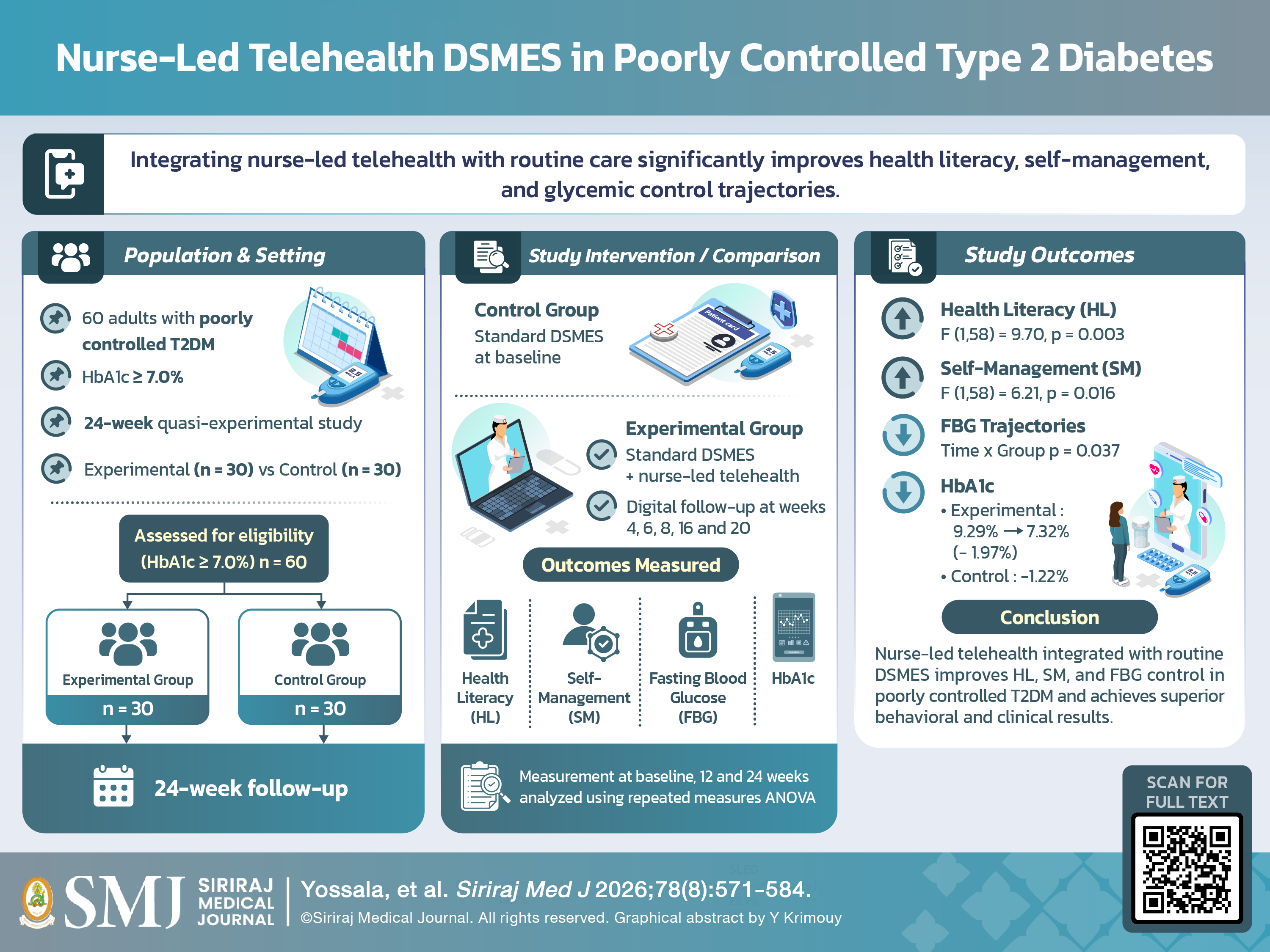
Materials and Methods: A 24-week quasi-experimental study with a non-equivalent control group design was conducted. Sixty adults (HbA1c ≥ 7.0%) were sequentially allocated to experimental (n = 30) or control (n = 30) groups. Both groups received standard DSMES at baseline. The experimental group additionally received structured, nurse-led telehealth sessions at Weeks 4, 6, 8, 16, and 20 via digital platforms. HL and SM were measured using validated Thai scales. Fasting blood glucose (FBG) and HbA1c were retrieved from medical records at baseline, 12, and 24 weeks. Data were analyzed using repeated measures ANOVA.
Results: Significant between-subject effects favored the experimental group for HL (F(1,58) = 9.70, p = .003) and SM (F(1,58) = 6.21, p = .016). A significant Time × Group interaction was found for FBG (p = .037), showing a more pronounced reduction trajectory in the experimental group. Although both groups achieved significant HbA1c reduction over time (p < .001), the experimental group demonstrated a clinically superior mean reduction of 1.97% (from 9.29% to 7.32%), compared to 1.22% in the control group.
Conclusion: Integrating nurse-led telehealth services with routine DSMES is effective for improving HL, SM, and FBG control in T2DM patients with poor GC. This intervention supports telehealth as a potent nursing strategy for enhancing patient empowerment and achieving superior behavioral and clinical results.
References
International Diabetes Federation. IDF Diabetes Atlas: 11th edition [Internet]. 2025. Available from: https://diabetesatlas.org/resources/idf-diabetes-atlas-2025/
Ekpalakorn V, Pakcharoen H, Sathiennoppakao W. The Sixth National Health Examination Survey of Thailand (NHES VI), 2019–2020 [Internet]. 2021. Available from: https://kb.hsri.or.th/dspace/handle/11228/5425
Nutbeam D. Health literacy as a public health goal: a challenge for contemporary health education and communication strategies into the 21st century. Health Promot Int. 2000;15(3):259–67.
Lorig KR, Holman HR. Self-management education: history, definition, outcomes, and mechanisms. Ann Behav Med. 2003;26(1):1–7.
Nopkarua J, Jintanawat R, Khamphonsiri T. Health literacy and self-management among older adults with type 2 diabetes mellitus. Thai Journal of Nursing. 2022;47(2):251-61.
Jamhom S, Silawan T, Lakampan S, Sillabutra J. Health literacy of diabetic patients with uncontrolled blood sugar levels in primary care units, Muang district, Singburi province. Thai Journal of Health Education. 2021; 44(1):75-86.
Songsin N, Kaiwong K, Wangfang P, Sojisirikul Y, Mamayamu H, Pianjing P, et al. Health literacy and associated factors patients with type 2 diabetes mellitus in rural Thailand. Natl J Community Med. 2025;16(04):375-81.
Chaimongkon S, Sakulwattana W, Ong-Artborirak P, Liyanage E, Seangpraw K. Health literacy and behaviors of patients and caregivers related to glycemic control among individuals with type 2 diabetes in Chiang Mai Province, Thailand. Patient Prefer Adherence. 2025;19:753-65.
Mikhael EM, Hassali MA, Hussain SA. Effectiveness of diabetes self-management educational programs for type 2 diabetes mellitus patients in Middle East Countries: A systematic review. Diabetes Metab Syndr Obes. 2020;13:117-38.
Chrvala CA, Sherr D. Ripman RD. Diabetes self-management education for adults with type 2 diabetes mellitus: A systematic review of the effect on glycemic control. Patient Educ Couns. 2016;99(6):926–43.
Royal College of Physicians of Thailand, Diabetes Association of Thailand, Endocrine Society of Thailand, Department of Medical Services, and National Health Security Office. Clinical Practice Guideline for Diabetes 2023 [Internet]. 2023. Available from https://www.dmthai.org/new/index.php/sara-khwam-ru/bukhlakr-thangkar-phaethy/cpg/naewthang-wech-ptibati-sahrab-rokh-bea-hwan-2567
Wiriyapong P, Pongsura S, Fuanchan A, Dhippayom T. The use of telemedicine to support type 2 diabetes care. J Med Health Sci. 2021;28(2):165-77.
Yingyaun K, Methakanjanasak N. Self-management telehealth innovation for patients with diabetes mellitus type 2 with dyslipidemia. Srinagarind Med J. 2016;31(6):365-71.
Yaagoob E, Hunter S, Chan S. The effectiveness of social media intervention in people with diabetes: An integrative review. J Clin Nurs. 2023;32:2419–32.
Chun Hospital. NCDs annual report [unpublished]. Phayao: Chun Hospital; 2023.
Dermkhuntod N, Kwanjaroen R, Chuantantikamol C, Phahonphak P, Suramorakul S. The effect of telehealth monitoring on glycemic control and medication adherence in patients with poorly controlled type 2 diabetes. Vajira Med J. 2021;65(Suppl):S75–90.
Ma Y, Zhao C, Zhao Y, Lu J, Jiang H, Cao Y, et al. Telemedicine application in patients with chronic disease: a systematic review and meta-analysis. BMC Med Inform Decis Mak. 2022;22(1):105.
Angboonta P, Pothiban L, Kosachunhanun N. Effects of a self-management supporting program on self-management behaviors and hemoglobin A1C level among elders with diabetes type 2. Nursing Journal. 2012;39(3):93-102.
American Diabetes Association Professional Practice Committee. Glycemic goals and hypoglycemia: standards of care in diabetes—2024. Diabetes Care. 2024;47(Suppl 1):S111–25.
Stratton IM, Adler AI, Neil HAW, Matthews DR, Manley SE, Cull CA, et al. Association of glycaemia with macrovascular and microvascular complications of type 2 diabetes (UKPDS 35): prospective observational study. BMJ. 2000;321(7258):405–12.
Lee PA, Greenfield G, Pappas Y. The impact of telehealth remote patient monitoring on glycemic control in type 2 diabetes: a systematic review and meta-analysis of systematic reviews of randomised controlled trials. BMC Health Serv Res. 2018;18(1):495.
Butayeva J, Ratan ZA, Downie S, Hosseinzadeh H. The impact of health literacy interventions on glycemic control and self-management outcomes among type 2 diabetes mellitus: a systematic review. J Diabetes. 2023,15(9):724–35.
Ran X, Chen Y, Jiang K, Shi Y. The effect of health literacy intervention on patients with diabetes: a systematic review and meta-analysis. Int J Environ Res Public Health. 2022;19(20):13078.
Dinh TTH, Bonner A. Exploring the relationships between health literacy, social support, self-efficacy and self-management in adults with multiple chronic diseases. BMC Health Serv Res. 2023;23:923.
Agastiya IMC, Kurianto E, Akalili H, Wicaksana AL. The impact of telehealth on self-management of patients with type 2 diabetes: a systematic review on intrventional studies. Diabetes Metab Syndr. 2022;16(5):102485.
Ye H, Lin L, Zhong D, Chen P, He X, Luo Z, et al. The impact of telehealth education on self-management in patients with coexisting type 2 diabetes mellitus and hypertension: A 26-week randomized controlled trial. J Endocrinol Invest. 2024;47:2361–69.
Wongmuan K, Thanaboonsutti N, Ketpan W, Uprarat S, Lapinee V, Preechasuk L. The effect of diabetes self-management education provided by certified diabetes educator compared to usual diabetes education on glycemic level and stage of behavior change in adult with types 2 diabetes mellitus. Siriraj Med J. 2024;76(2):61-68.
Robson N, Hosseinzadeh H. Impact of telehealth care among adults living with type 2 diabetes in primary care: a systematic review and meta-analysis of randomized controlled trials. Int J Environ Res Public Health. 2021;18(22):12171.
Bulto LN. The role of nurse-led telehealth interventions in bridging healthcare gaps and expanding access. Nurs Open. 2024;11:e2092.
Published
How to Cite
License
Copyright (c) 2026 Siriraj Medical Journal

This work is licensed under a Creative Commons Attribution-NonCommercial-NoDerivatives 4.0 International License.
Authors who publish with this journal agree to the following conditions:
Copyright Transfer
In submitting a manuscript, the authors acknowledge that the work will become the copyrighted property of Siriraj Medical Journal upon publication.
License
Articles are licensed under a Creative Commons Attribution-NonCommercial-NoDerivatives 4.0 International License (CC BY-NC-ND 4.0). This license allows for the sharing of the work for non-commercial purposes with proper attribution to the authors and the journal. However, it does not permit modifications or the creation of derivative works.
Sharing and Access
Authors are encouraged to share their article on their personal or institutional websites and through other non-commercial platforms. Doing so can increase readership and citations.