
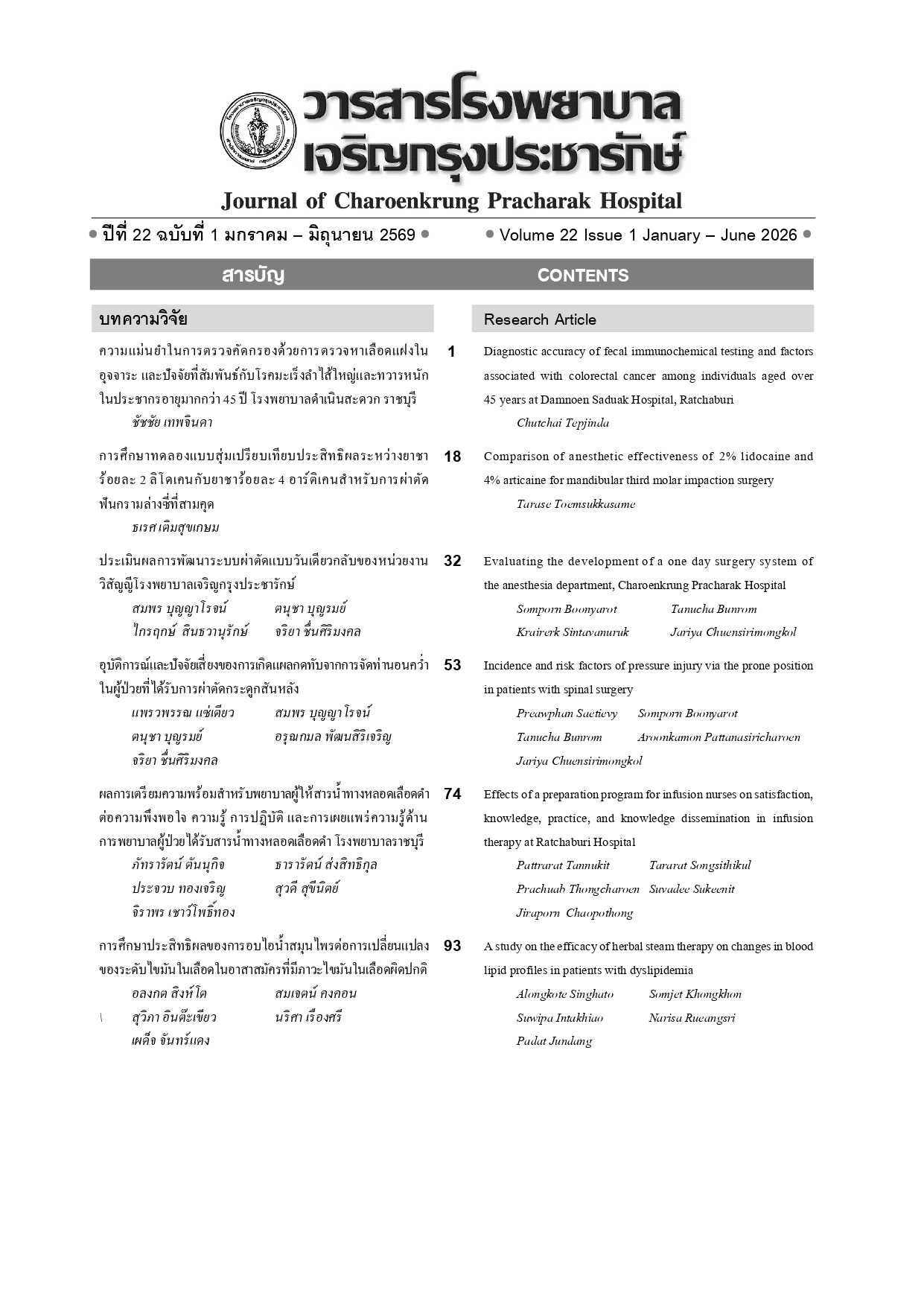
ความแม่นยำในการตรวจคัดกรองด้วยการตรวจหาเลือดแฝงในอุจจาระ และปัจจัยที่สัมพันธ์กับโรคมะเร็งลำไส้ใหญ่และทวารหนักในประชากรอายุมากกว่า 45 ปี โรงพยาบาลดำเนินสะดวก ราชบุรี
Article Sidebar
Main Article Content
บทคัดย่อ
วัตถุประสงค์: การวิจัยนี้ศึกษาความแม่นยำในการตรวจคัดกรองด้วยการตรวจหาเลือดแฝงในอุจจาระ (Fecal Immunochemical Test; FIT) และปัจจัยที่สัมพันธ์กับโรคมะเร็งลำไส้ใหญ่และทวารหนักของโรงพยาบาลดำเนินสะดวก ราชบุรี
วิธีดำเนินการวิจัย: การวิจัยนี้เป็นการศึกษาเชิงวิเคราะห์ภาคตัดขวาง ในผู้มีอายุมากกว่าหรือเท่ากับ 45 ปี ที่ตรวจ FIT และยืนยันด้วยการส่องกล้อง ระหว่าง 1 มี.ค.–31 ธ.ค. 2567 จำนวน 230 คน โดยสุ่มอย่างง่าย วิเคราะห์ด้วยสถิติพรรณนา chi-square test, independent t-test และ binary logistic regression เพื่อเปรียบเทียบ odds ratio ระหว่างกลุ่มที่พบและไม่พบโรค กำหนดระดับนัยสำคัญที่ p<0.05
ผลการวิจัย: การศึกษาพบว่า ความแม่นยำของ FIT ในการคัดกรองมะเร็งลำไส้ใหญ่และทวารหนักเท่ากับร้อยละ 35.65 โดยมีความไวร้อยละ 56.00 และความจำเพาะร้อยละ 33.17 กลุ่มที่พบมะเร็งมีอายุและคะแนน APCS สูงกว่ากลุ่มที่ไม่พบอย่างมีนัยสำคัญ ปัจจัยที่สัมพันธ์กับมะเร็ง ได้แก่ เบาหวาน (p=0.020) อาการถ่ายมีมูกเลือด (p<0.001) และภาวะซีด (p=0.046) ส่วนปัจจัยทำนายสำคัญ คือ คะแนน Asia-Pacific Colorectal Screening (APCS) (OR=1.57) และอาการถ่ายมีมูกเลือด (OR=9.96) ขณะที่เพศ ดัชนีมวลกายโรคความดันโลหิตสูง และอาการทางคลินิกอื่นไม่สัมพันธ์กับโรค
สรุป: การตรวจ FIT เป็นเครื่องมือที่มีประโยชน์ในการคัดกรองมะเร็งลำไส้ใหญ่และทวารหนักในประชากรที่เข้ารับการคัดกรอง โดยการพิจารณาร่วมกับปัจจัยทางคลินิก เช่น อาการถ่ายปนมูกเลือด และคะแนน APCS อาจช่วยเพิ่มความสามารถในการคัดกรองและการคัดเลือกผู้ป่วยที่ควรได้รับการส่องกล้องลำไส้ใหญ่ อย่างไรก็ตาม ปัจจัยเสี่ยงดังกล่าวไม่ได้จำเป็นต้องเกิดร่วมกันในผู้ป่วยทุกราย และควรใช้ประกอบการประเมินทางคลินิกโดยรวม
Article Details

อนุญาตภายใต้เงื่อนไข Creative Commons Attribution-NonCommercial-NoDerivatives 4.0 International License.
เอกสารอ้างอิง
Bray F, Ferlay J, Soerjomataram I, Siegel RL, Torre LA, Jemal A. Global cancer statistics 2018: GLOBOCAN estimates of incidence and mortality worldwide for 36 cancers in 185 countries. CA Cancer J Clin 2018;68(6):394-424.
National Cancer Institute Thailand. Annual report 2023 [Internet]. Bangkok: National Cancer Institute; 2023 [cited 2026 Feb 25]. Available from: https://www.nci.go.th/doc/report/report_doc_1768897041_111.pdf
O’Connell JB, Maggard MA, Ko CY. Colon cancer survival rates with the new American Joint Committee on Cancer sixth edition staging. J Natl Cancer Inst [Internet]. 2004 [cited 2022 Nov 26];96(19):1420-5. Available from: https://pubmed.ncbi.nlm.nih.gov/15467030/
Lauby-Secretan B, Vilahur N, Bianchini F, Guha N, Straif K; International Agency for Research onCancer Handbook Working Group. The IARC perspective on colorectal cancer screening. N Engl JMed [Internet]. 2018 [cited 2022 Dec 25];378(18):1734-40. Available from: https://NEJMsr1714643
Lee JK, Liles EG, Bent S, Levin TR, Corley DA. Accuracy of fecal immunochemical tests for colorectal cancer: systematic review and meta-analysis. Ann Intern Med [Internet]. 2014 [cited 2022 Nov 22];160(3):171. Available from: https://pubmed.ncbi.nlm.nih.gov/24658694/
Bray C, Bell LN, Liang H, Collins D, Yale SH. Colorectal cancer screening. WMJ 2017;116(1):27-33.
Levin B, Lieberman DA, McFarland B, Andrews KS, Brooks D, Bond J, et al; American Cancer Society Colorectal Cancer Advisory Group; US Multi-Society Task Force; American College of Radiology Colon Cancer Committee. Screening and surveillance for the early detection of colorectal cancer and adenomatous polyps, 2008: a joint guideline from the American Cancer Society, the US Multi-Society Task Force on colorectal cancer, and the American College of Radiology. Gastroenterology [Internet]. 2008 [cited 2022 Dec 27];134(5):1570-95. Available from: https://pubmed.ncbi.nlm.nih.gov/18384785/
Kavanagh AM, Giovannucci EL, Fuchs CS, Colditz GA. Screening endoscopy and risk of colorectal cancer in United states men. Cancer Causes Control [Internet]. 1998 [cited 2022 Dec 27];9(4):455-62. Available from: https://pubmed.ncbi.nlm.nih.gov/9794179/
Parra-Blanco A, Gimeno-Garcia AZ, Quintero E, Nicolas D, Moreno SG, Jimenez A, et al. Diagnostic accuracy of immunochemical versus guaiac faecal occult blood tests for colorectal cancer screening. J Gastroenterol [Internet]. 2010 [cited 2022 Dec 25];45(7):703-12. Available from: https://link.springer.com/article/10.1007/s00535-010-0214-8
Robertson DJ, Lee JK, Boland CR, Dominitz JA, Giardiello FM, Johnson DA, et al. Recommendations on fecal immunochemical testing to screen for colorectal neoplasia: a consensus statement by the US Multi-Society Task Force on colorectal cancer. Gastroenterology [Internet]. 2017 [cited 2022 Dec 27];152(5):1217-37.e3. Available from: https://pubmed.ncbi.nlm.nih.gov/27769517/
Yeoh KG, Ho KY, Chiu HM, Zhu F, Ching JYL, Wu DC, et al; Asia-Pacific Working Group on Colorectal Cancer. The Asia-Pacific colorectal screening score: a validated tool that stratifies risk for colorectal advanced neoplasia in asymptomatic Asian subjects. Gut [Internet]. 2011 [cited 2022 Dec 27];60(9):1236-41. Available from: https://pubmed.ncbi.nlm.nih.gov/21402615/
Sung JJY, Wong MCS, Lam TYT, Tsoi KKF, Chan VCW, Cheung W, et al. A modified colorectal screening score for prediction of advanced neoplasia: a prospective study of 5744 subjects. J Gastroenterol Hepatol [Internet]. 2018 [cited 2025 Feb 2];33(1):187-94. Available from: https://pubmed.ncbi.nlm.nih.gov/28561279/
He XX, Yuan SY, Li WB, Yang H, Ji W, Wang ZQ, et al. Improvement of Asia-Pacific colorectal screening score and evaluation of its use combined with fecal immunochemical test. BMC Gastroenterol [Internet]. 2019 [cited 2025 Feb 1];19(1):226. Available from: https://pmc.ncbi.nlm.nih.gov/articles/PMC6935212/
Rojanasiraprapa W. Accuracy of FIT test in screening colorectal cancer in Bang Bo Hospital, Samut Prakan Province. The Journal of Prapokklao Hospital Clinical Medical Education Center [Internet]. 2020 [cited 2025 Feb 2];37(1):35-43. Available from: https://he02.tci-thaijo.org/index.php/ppkjournal/article/view/218467/163669 (in Thai)
Imperiale TF, Ransohoff DF, Itzkowitz SH, Levin TR, Lavin P, Lidgard GP, et al. Multitarget stool DNA testing for colorectal-cancer screening. N Engl J Med [Internet]. 2014 [cited 2025 Feb 1];370(14):1287–97. Available from: https://www.nejm.org/doi/full/10.1056/NEJMoa1311194
Khan AA, Klimovskij M, Harshen R. Accuracy of faecal immunochemical testing in patients with symptomatic colorectal cancer. BJS Open [Internet]. 2020 [cited 2025 Feb 2];4(6):1180-8. Available from: https://pmc.ncbi.nlm.nih.gov/articles/PMC7709370/
Jin P, Wu Z, Meng M, Wang X, Wang X, Gong L, et al. Combined fecal transferrin test and immuno fecal cccult blood test for detecting colorectal cancer and advanced adenoma in asymptomatic and symptomatic populations. J Cancer Sci Ther [Internet]. 2012 [cited 2025 Feb 2];4(8):243-8. Available from: https://www.hilarispublisher.com/open-access/combined-fecal-transferrin-test-and-immuno-fecal-occult-blood-test-for-detecting-colorectal-cancer-and-advanced-adenoma-in-asymptomaticand-symptomatic-populations-1948-5956.1000149.pdf
Lue A, Hijos G, Sostres C, Perales A, Navarro M, Barra MV, et al. The combination of quantitative faecal occult blood test and faecal calprotectin is a cost-effective strategy to avoid colonoscopies in symptomatic patients without relevant pathology. Ther Adv Gastroenterol [Internet]. 2020 [cited 2025 Jan 28];13:1756284820920786. Available from: https://pubmed.ncbi.nlm.nih.gov/32523623/
Selby K, Levine EH, Doan C, Gies A, Brenner H, Quesenberry C, et al. Effect of sex, age, and positivity threshold on fecal immunochemical test accuracy: a systematic review and meta-analysis. Gastroenterology [Internet]. 2019 [cited 2025 Feb 2];157(6):1494-505. Available from: https://pubmed.ncbi.nlm.nih.gov/31472152/
Hijos-Mallada G, Saura N, Lue A, Velamazan R, Nieto R, Navarro M, et al. A point-of-care faecal test combining four biomarkers allows avoidance of normal colonoscopies and prioritizes symptomatic patients with a high risk of colorectal cancer. Cancers (Basel) [Internet]. 2023 [cited 2025 Jan 28];15(3):721. Available from: https://pubmed.ncbi.nlm.nih.gov/36765678/
Wu GH, Wang YM, Yen AM, Wong JM, Lai HC, Warwick J, et al. Cost-effectiveness analysis of colorectal cancer screening with stool DNA testing in intermediate-incidence countries. BMC Cancer [Internet]. 2006 [cited 2025 Feb 2];6:136. Available from: https://pubmed.ncbi.nlm.nih.gov/16723013/
Li W, Zhang L, Hao J, Wu Y, Lu D, Zhao H, et al. Validity of APCS score as a risk prediction score for advanced colorectal neoplasia in Chinese asymptomatic subjects: a prospective colonoscopy study. Medicine (Baltimore) [Internet]. 2016 [cited 2022 Dec 26];95(41):e5123. Available from: https://pubmed.ncbi.nlm.nih.gov/27741134/
Ze Y, Tu HM, Zhao YY, Zhang L. Developing a nomogram for predicting colorectal cancer and its precancerous lesions based on data from three non-invasive screening tools, APCS, FIT, and sDNA.
J Multidiscip Healthc 2024;17:2891-901.
Adelstein BA, Macaskill P, Turner RM, Katelaris PH, Irwig L. The value of age and medical history for predicting colorectal cancer and adenomas in people referred for colonoscopy. BMC Gastroenterol [Internet]. 2011 [cited 2025 Feb 2];11:97. Available from: http://www.biomedcentral.com/1471-230X/11/97
Olde Bekkink M, McCowan C, Falk GA, Teljeur C, Van de Laar FA, Fahey T. Diagnostic accuracy systematic review of rectal bleeding in combination with other symptoms, signs and tests in relation to colorectal cancer. Br J Cancer [Internet]. 2010 [cited 2025 Feb 2];102(1):48-58. Available from: https://pubmed.ncbi.nlm.nih.gov/19935790/
US Preventive Services Task Force. Screening for colorectal cancer: US PreventiveServices Task Force recommendation statement. JAMA [Internet]. 2021 [cited 2023 Jan 2];325(19):1965-77. Available from: https://jamanetwork.com/journals/jama/fullarticle/2779985
Cubiella J, Vega P, Salve M, Diaz-Ondina M, Alves MT, Quintero E, et al; COLONPREDICT study investigators. Development and external validation of a faecal immunochemical test-based prediction model for colorectal cancer detection in symptomatic patients. BMC Med [Internet]. 2016 [cited 2025 Feb 2];14(1)128. Available from: https://pubmed.ncbi.nlm.nih.gov/27580745/
Alatise OI, Ayandipo OO, Adeyeye A, Seier K, Komolafe AO, Bojuwoye MO, et al. A symptom-based model to predict colorectal cancer in low-resource countries: results from a prospective study of patients at high risk for colorectal cancer. Cancer [Internet]. 2018 [cited 2025 Feb 2];124(13):2766-73. Available from: https://pmc.ncbi.nlm.nih.gov/articles/PMC6005740/
Ng SC, Wong SH. Colorectal cancer screening in Asia. Br Med Bull [Internet]. 2013 [cited 2025 Feb 2];105:29-42. Available from: https://pubmed.ncbi.nlm.nih.gov/23299409/
