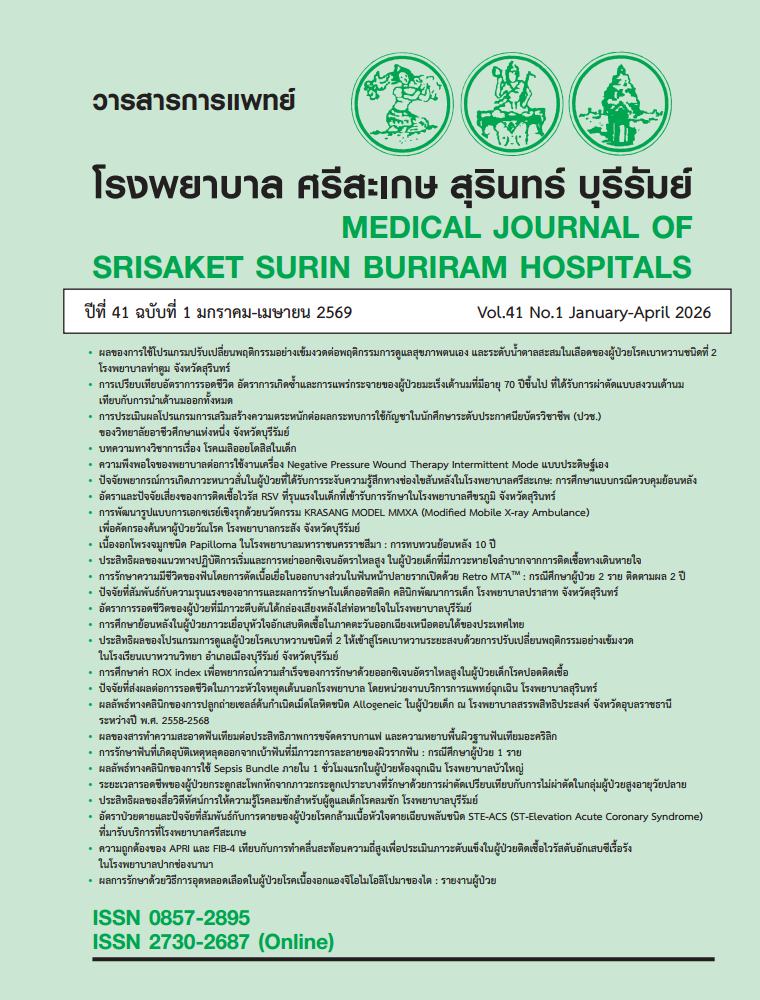
ผลของสารทำความสะอาดฟันเทียมต่อประสิทธิภาพการขจัดคราบกาแฟและความหยาบพื้นผิวฐานฟันเทียมอะคริลิก
Article Sidebar
Main Article Content
บทคัดย่อ
หลักการและเหตุผล: ปัจจุบันมีการผลิตสารทำความสะอาดฟันเทียมรูปแบบโฟมออกขายในท้องตลาด ถือเป็นทางเลือกใหม่ให้แก่ผู้ป่วย ผู้วิจัยจึงสนใจศึกษาประสิทธิภาพของสารดังกล่าวในการขจัดคราบสีและผลต่อความหยาบบนพื้นผิวฟันเทียม
วัตถุประสงค์ของการวิจัย: เปรียบเทียบประสิทธิภาพการกำจัดคราบกาแฟและความหยาบของพื้นผิวฐานฟันเทียม อะคริลิก หลังการทำความสะอาดโดยการแปรงร่วมกับน้ำประปา น้ำยาล้างจาน โพลิเดนท์ และสารทำความสะอาดฟันเทียมชนิดโฟมฟูล์สไมล์
วิธีการศึกษา: เตรียมอะคริลิก 48 ชิ้นแบ่งเป็น 4 กลุ่ม นำไปแช่กาแฟ 40 วัน จากนั้นนำไปแปรงทำความสะอาดร่วมกับน้ำประปา น้ำยาล้างจาน โพลิเดนท์และฟูล์สไมล์ ทำการวัดสีด้วยสเปคโทรคัลเลอร์ริมิเตอร์โปรก่อนและหลังแช่กาแฟ และหลังทำความสะอาด แล้วคำนวณค่า △E1 (ก่อนและหลังแช่กาแฟ) และ △E2 (หลังแช่กาแฟและหลังทำความสะอาด) การวัดความหยาบพื้นผิววัดด้วยเครื่องวัดความหยาบพื้นผิวแบบสัมผัส โดยวัดก่อนแช่กาแฟและหลังทำความสะอาด วิเคราะห์ข้อมูลด้วยการวิเคราะห์ความแปรปรวนแบบจำแนกทางเดียวที่ระดับนัยสำคัญ 0.05
ผลการศึกษา: พบว่าฟูล์สไมล์ให้ค่าความต่างสีมากที่สุด รองลงมาคือโพลิเดนท์ น้ำยาล้างจานและน้ำประปา พบความแตกต่างอย่างมีนัยสำคัญระหว่างกลุ่มยกเว้นฟูล์สไมล์กับโพลิเดนท์ สำหรับความหยาบพื้นผิวพบว่าโพลิเดนท์เกิดความหยาบมากที่สุด รองลงคือน้ำยาล้างจาน น้ำประปาและฟูล์สไมล์ แต่ไม่พบความแตกต่างอย่างมีนัยสำคัญ
สรุป: สารทำความสะอาดฟันเทียมรูปแบบโฟมมีประสิทธิภาพในการขจัดคราบสีและมีต่อความหยาบพื้นผิวน้อย สามารถเป็นทางเลือกหนึ่งในการทำความสะอาดฟันเทียมอะคริลิก
Article Details

อนุญาตภายใต้เงื่อนไข Creative Commons Attribution-NonCommercial-NoDerivatives 4.0 International License.
เอกสารอ้างอิง
Ergün G, Mutlu-Sagesen L, Ozkan Y, Demirel E. In vitro color stability of provisional crown and bridge restoration materials. Dent Mater J 2005;24(3):342-50. doi: 10.4012/dmj.24.342.
Dhamande MM, Pakhan AJ, Thombare RU, Ghodpage SL. Evaluation of efficacy of commercial denture cleansing agents to reduce the fungal biofilm activity from heat polymerized denture acrylic resin: An in vitro study. Contemp Clin Dent 2012;3(2):168-72. doi: 10.4103/0976-237X.96820.
Nursyahbani NW, Yunisa F, Sari N, editors. Changes in the Color of the Denture Elements After Immersion in Coffee and Denture Cleaning. Proceedings of the International Conference on Sustainable Innovation on Health Sciences and Nursing (ICOSI-HSN 2022). USA : Atlantis Press ; 2022.
Kaypetch R, Rudrakanjana P, Tua-Ngam P, Tosrisawatkasem O, Thairat S, Tonput P, et al. Effects of two novel denture cleansers on multispecies microbial biofilms, stain removal and the denture surface: an in vitro study. BMC Oral Health 2023;23(1):852. doi: 10.1186/s12903-023-03535-5.
Ayaz EA, Ustun S. Effect of staining and denture cleaning on color stability of differently polymerized denture base acrylic resins. Niger J Clin Pract 2020;23(3):304-309. doi: 10.4103/njcp.njcp_330_19.
Peracini A, Davi LR, de Queiroz Ribeiro N, de Souza RF, Lovato da Silva CH, de Freitas Oliveira Paranhos H. Effect of denture cleansers on physical properties of heat-polymerized acrylic resin. J Prosthodont Res 2010;54(2):78-83. doi: 10.1016/j.jpor.2009.11.004.
R M G, S AK. Influence of Tea, Coffee, and Turmeric Solutions on the Color Stability of Denture Base Acrylic Resins and Silicone Soft Lining Material: An In Vitro Study. Cureus 2025;17(8):e89653. doi: 10.7759/cureus.89653.
AGRAWAL SS, KUKDE MM, LAHOTI KKS, GADE JR, BANKAR NJ. Colour Stability of Two Different Denture Base Resins and the Efficacy of Two Denture Cleansing Agents after Tea and Coffee Staining: An In-vitro Study. J Clin Diagn Res 2024;18(4). DOI:10.7860/JCDR/2024/66964.19334
Noie F, O'Keefe KL, Powers JM. Color stability of resin cements after accelerated aging. Int J Prosthodont 1995;8(1):51-5. PMID: 7710625
Moore TC, Smith DE, Kenny GE. Sanitization of dentures by several denture hygiene methods. J Prosthet Dent 1984;52(2):158-63. doi: 10.1016/0022-3913(84)90087-8.
Shen Y, Li P, Chen X, Zou Y, Li H, Yuan G, et al. Activity of Sodium Lauryl Sulfate, Rhamnolipids, and N-Acetylcysteine Against Biofilms of Five Common Pathogens. Microb Drug Resist 2020;26(3):290-9. doi: 10.1089/mdr.2018.0385.
Moon A, Powers JM, Kiat-Amnuay S. Color stability of denture teeth and acrylic base resin subjected daily to various consumer cleansers. J Esthet Restor Dent 2014;26(4):247-55. doi: 10.1111/jerd.12109.
Amornopparattanakul N, Pitaksuteepong T. Development of novel retainer cleansing products for during the day usage. AHSTR 2017;25(1):32-43.
Halea G, Yaseminb ÖK. Cleaning efficiency of alkaline peroxide type denture cleansers on silicone-based soft lining materials colonized with Candida albicans. Bakj J Stom 2009;13:35-40.
Gökay G, Özkır S, Biçer M, Karakaya K. The Efficacy of Denture Cleansing Solutions in Stain Removal of Artificial Teeth. J Dent Mater Tech 2022;11(4):213-9. https://doi.org/10.22038/jdmt.2022.59432.1463
Paranhos Hde F, Peracini A, Pisani MX, Oliveira Vde C, de Souza RF, Silva-Lovato CH. Color stability, surface roughness and flexural strength of an acrylic resin submitted to simulated overnight immersion in denture cleansers. Braz Dent J 2013;24(2):152-6. doi: 10.1590/0103-6440201302151.
Gopalakrishnan S, Kashinath K, Mathew P. Evaluation of destaining property of denture cleansers on heat-cured denture base resins using common Indian food stains. IJOPRD 2017;7(2):53-9. 10.5005/jp-journals-10019-1177.
Sudswad P, Arksornnukit M, Chumprasert S. Effect of Brushing with Different Cleansing Solutions on Surface Roughness of Two Denture Base Materials. Khon Kaen Dent J 2022;25(1):74-83.
Fung H-k, Wibowo C, Ng KM. Chapter 8 - Product-centered Process Synthesis and Development: Detergents. Comput Aided Chem Eng 2007;23:239-74. https://doi.org/10.1016/S1570-7946(07)80011-3.
Cheng KC, Khoo ZS, Lo NW, Tan WJ, Chemmangattuvalappil NG. Design and performance optimisation of detergent product containing binary mixture of anionic-nonionic surfactants. Heliyon 2020;6(5):e03861. doi: 10.1016/j.heliyon.2020.e03861.
Budtz-Jørgensen E. Materials and methods for cleaning dentures. J Prosthet Dent 1979;42(6):619-23. doi: 10.1016/0022-3913(79)90190-2.
Thaworanunta S, Sriprasert N, Nanarong C, Dittaratchaphong P, Momin T, Krisanawong T. A Denture Cleansing Solution and Household Agents Differentially Affect the Surface Roughness of Acrylic Resin. J DENT ASSOC THAI 2023;73(1):29-36. doi: 10.14456/jdat.2023.4
Rodrigues Garcia RC, Joane Augusto de S Jr, Rached RN, Del Bel Cury AA. Effect of denture cleansers on the surface roughness and hardness of a microwave-cured acrylic resin and dental alloys. J Prosthodont 2004;13(3):173-8. doi: 10.1111/j.1532-849X.2004.04028.x.
Sharma P, Garg S, Kalra NM. Effect of Denture Cleansers on Surface Roughness and Flexural Strength of Heat Cure Denture Base Resin-An In vitro Study. J Clin Diagn Res 2017;11(8):ZC94-ZC97. doi: 10.7860/JCDR/2017/27307.10483.
Bollen CM, Lambrechts P, Quirynen M. Comparison of surface roughness of oral hard materials to the threshold surface roughness for bacterial plaque retention: a review of the literature. Dent Mater 1997;13(4):258-69. doi: 10.1016/s0109-5641(97)80038-3.
