
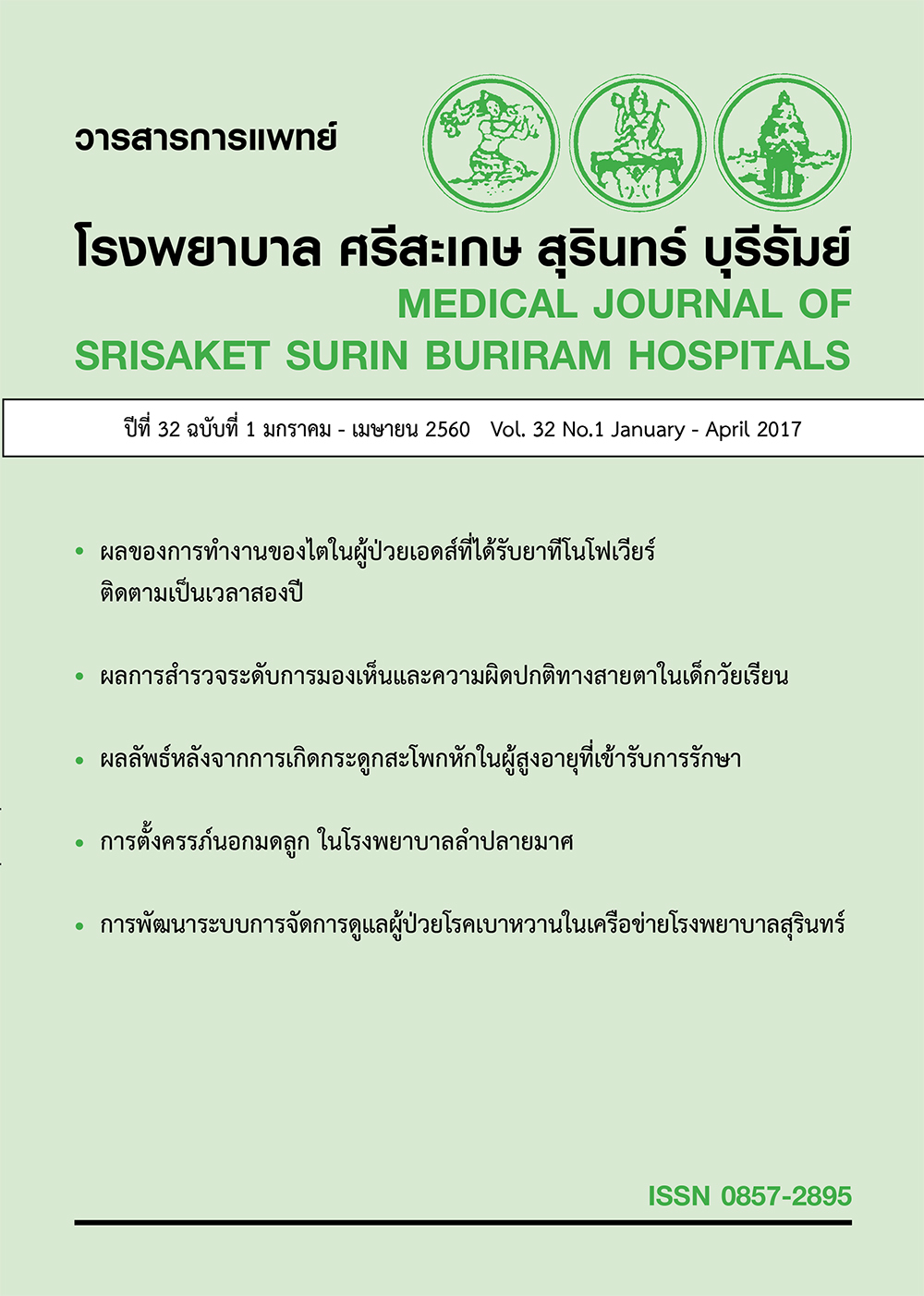
Survey of Visual Acuity and Refractive Error Among School Children
Article Sidebar
Main Article Content
Abstract
Objective: To survey of visual acuity and refractive error among school children in Prasat district, Surin, Thailand
Study design: Descriptive study
Methods: A descriptive study on a survey of visual acuity and refractive error in grade I school children age between 6 to 7 years old which conducted in Prasat district, Surin, Thailand. This study was started in May 2016 and ended in September 2016,1,858 children were screened of visual acuity and general eye examination. Children who had a visual acuity of 20/30 and lower or found abnormal ocular anomaly were undergone cycloplegic refraction, anterior segment examination, fundus examination and subjective refraction by an ophthalmologist.
Results: From 76 schools in Prasat district, Surin, Thailand, 99.2% of children achieved visual acuity of 20/20. 0.8% had visual acuity of 20/30 and lower. Visual acuity below normal caused by refractive error 0.6% and developmental delay 0.2%. There also found other eye disorders such as congenital ptosis 0.4%, strabismus 0.2%, and 1 case of optic nerve hypoplasia.
Conclusions: The study found that 0.8% of children have a vision disorder and most common causes of vision disorder caused by refractive error, 0.6%. Visual screening in school children is important. Resolving of refractive error in children will be able to make a better quality of vision.
Article Details
References
2. Milton K. The Human Eye as an Optical System. In: Duanne TD, Jaeger EA, editors. Clinical ophthalmology. Philadelphia: Haper & Row; 1986. p.1-52.
3. Flitcroft Dl. Ophthalmologists should consider the cause of myopia and not simply treat its consequences. Br J Ophthalmol 1998;82:210-11.
4. American Academic of Ophthalmology. Basic and Clinical Science Course, Section 6 Pediatric Ophthalmology and Strabismus. LEO: San Francisco 2015-2016.
5. Tananuvat N, Worapong, A, Kupat J, Aree P. Survey of refractive errors among school children in Chiang Mai municipal areas. Chiang Mai Med Bull 2003;42(2):53-60.
6. Tansirikongkol V, Konyama K. Survey of visual function among school children. Transactions APAO 1981;8:800-10.
7. Mahachaiyakul A, Sinpornchai N, Kunavisarut S. The study of refractive state and Strabismic prevalence in school children. Thai J Ophthalmol 1997;11:1-8
8. Zhao J, Pan X, Sui R, Munoz SR, Sperduto RD, Ellwein LB. Refractive Error study in Children: results from Shunyi District, China. Am J Ophthalmol 2000;129:427-35.
