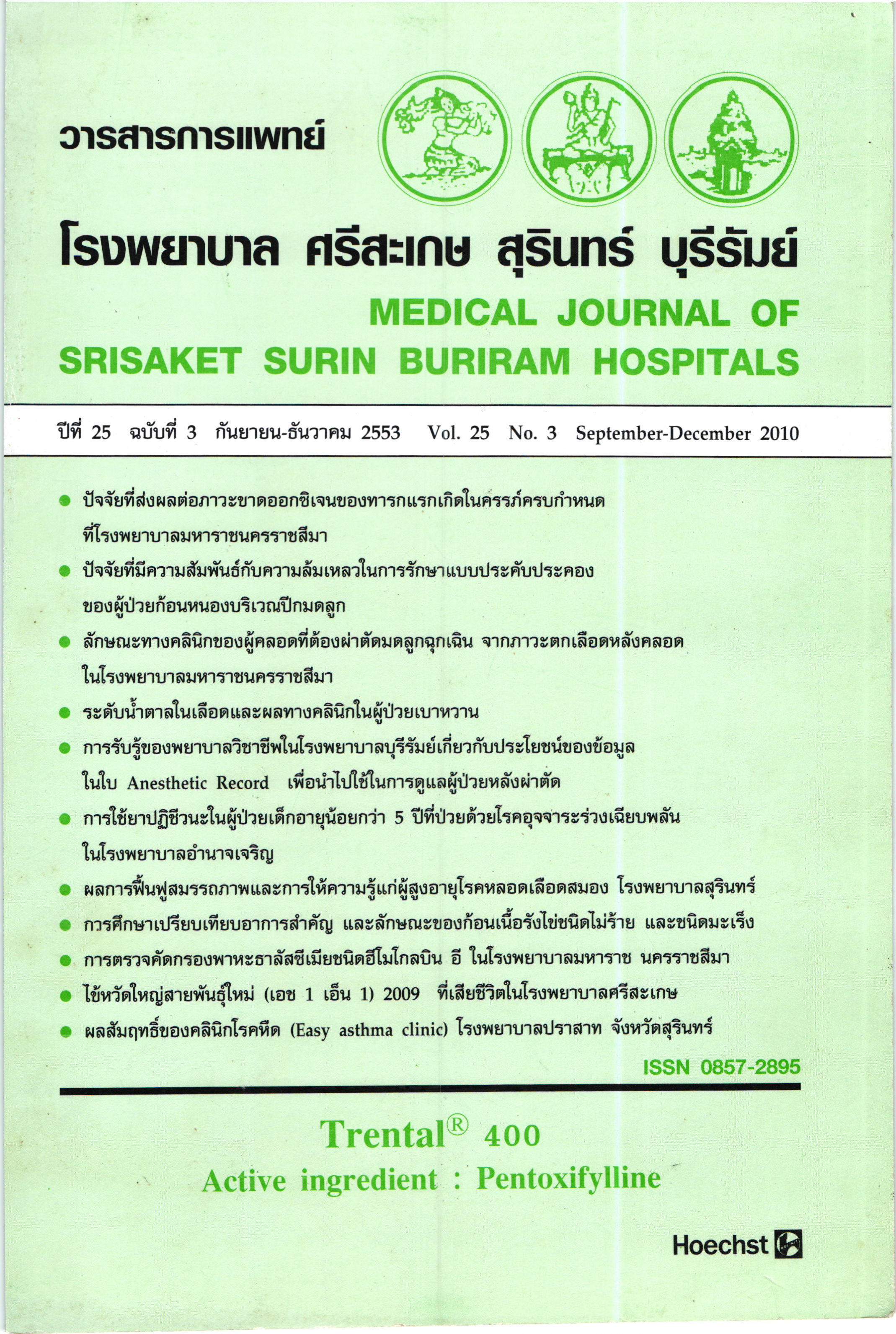
Factors Influenced Birth Asphyxia in Term Pregnancies at Maharat Nakhon Ratchasima Hospital
Article Sidebar
Main Article Content
Abstract
Background: Birth asphyxia is an important cause of neonatal mortality and morbidity. The identification of factors influenced birth asphyxia and effective antenatal, intrapartum care, and newborn resuscitation could reduce morbidity and mortality.
Objective: To determine the incidence and factors influenced birth asphyxia in term neonate at Maharat Nakhon Ratchasima hospital.
Setting: Obstetric and gynecology department of Maharat Nakhon Ratchasima hospital.
Study design: Retrospective hospital-based analytical study.
Method: This study was conducted in Maharat Nakhon Ratchasima Hospital from January 2009 to December 2009. Term neonate who were delivered with low apgar score (at 1 minute 7) were diagnosed as birth asphyxia and were included in to study. Multiple logistic regression was used to analyze the variables that were associated with birth asphyxia.
Results: A total of 7,158 newborns were delivered during the study period. From these, 315 had birth asphyxia, which estimated to be 44.0/1,000 live births. The influenced factors that had statistic significant were maternal age 35 years, primiparity, referred case, the first stage of labor
8 hours , the second stage of labor > 30 minutes, vaginal breech delivery, operative vaginal delivery, moderate to thick meconium stained amniotic fluid, male infant gender, and unspecified birth attendant.
Conclusion: The incidence of birth asphyxia in term pregnancies was 44.0 per 1,000 live births. The factor influenced birth asphyxia in term pregnancies included maternal age 35 years, primiparity, refered case, the first stage of labor
8 hours, the second stage of labor > 30 minutes , vaginal breech delivery, operative vaginal delivery, moderate to thick meconium stained amniotic fluid, male infant gender, and unspecified birth attendant.
Article Details
References
Apgar V. Proposal for a new method of evaluation of newborn infants. Anesth Anal 1953; 32:260-7.
Drage JS, Kennedy c, Schwarz BK. The Apgar scores as an index of neonatal mortality. A report form collaborative study of cerebral palsy. Obstet Gynecol 1964; 24:222-30.
สุนทร อ้อเผ่าพันธุ . Defining the scope of perinatal asphyxia. ใน : สุนทร อ้อเผ่าพันธุ, บรรณาธิการ. Neonatology 2007. กรุงเทพฯ: ธนาเพรส จำกัด; 2550 : หน้า 76-97.
World Health Organization. International statistical classification of diseases and related health problems.l0th revision, 1993.
ตัวชี้วัดและเป้าหมายงานอนามัยแม่และเด็ก ประจำปี 2552. สำนักส่งเสริมสุขภาพ กรมอนามัย กระทรวงสาธารณสุข.
Milsom I, Ladfors L.Thiringer K, Nilelasson A, Odeback A, Thomberg E. Influence of maternal, obstetric and fetal risk factors on the prevalence of birth asphyxia at term in a Swedish Urban population.Acta Obstet Gynecol Scand 2002 ; 81: 909-17.
Thorngren-Jerneck K, Herbst A. Low 5-minute Apgar score: a population-based register study of 1 million term births. Obstet Gynecol. 2001 Jul;98(1):65-70.
ฐิติพร สิริวชิรชัย, อรวรรณ รุจิรกุล, บานเย็น แสนเรียน, ทัศนีวรรณ โพธิหนู. การขาดออกซิเจนของทารกแรกคลอดในโรงพยาบาลขอนแก่น.ว.ส่งเสริมสุขภาพและอนามัยสิง แวดล้อม กระทรวงสาธารณสุข 2543 ; 4 : 74-81.
Kolatat T, Vanprapar N, Thitadilok W. Perinatal asphyxia: multivariate analysis of risk factors. Journal of the Medical Association of Thailand 2000 ; 83(9) : 1039-44.
Berglund S, Grunewald C, Pettersson H, Cnattingius S. Risk factors for asphyxia associated with substandard care during labor. Acta Obstet Gynecol Scand 2010 ; 89(1) : 39-48.
ชาญ พานิชวัฒนะ, สุจินต ธรรมดี, เต็มดวง เข้มแข็ง,ประภาภรณ์ เลี้ยงเชื้อ. ปัจจัยที่ส่งผลต่อภาวะขาดออกซิเจนของทารกแรกคลอด ในโรงพยาบาลอุตรดิตถ์.วารสารแพทย์เขต 8 2543 ; 2-3 : 53-66.
Kovavisarach E, Juntasom C.Risk factor of delivery of low Apgar scores newborn below 7 at 1 minute : acase-control study. J med AssocThai. 1999; 82:660-5.
ลาวัลย์ ปัจจักขภัติ. 2545. ปัจจัยเสี่ยงทางสูติศาสตร์ต่อการเกิดคะแนน Apgar ต่ำกว่า หรือเท่ากับ 7 ที่หนึ่งนาทีหลังคลอดและผลกระทบที่มีต่อทารกครบกำหนดของโรงพยาบาลสุราษฎร์ธานี. วารสารวิชาการแพทย์เขต 11. 2545;16:21-33.
สุธิต คุณประดิษฐ์. สาเหตุและแนวทางในการแก้ไขปัญหาภาวะขาดออกซิเจนในทารก แรกเกิดโรงพยาบาลลำพูน จังหวัดลำพูน ปี 2540-2542 .ว.ส่งเสริมสุขภาพและอนามัย สิ่งแวดล้อม กระทรวงสาธารณสุข 2543 : 4 : 74-81.
สำนักส่งเสริมสุขภาพ กรมอนามัย. สถานการณ์งานอนามัยแม่และเด็กปี พ.ศ. 2545-2549. นนทบุรี: สำนักส่งเสริมสุขภาพ กรมอนามัย กระทรวงสาธารณสุข.
สถิติและรายงานประจำปี ห้องคลอด โรงพยาบาลมหาราชนครราชสีมา.
Hannah ME, Hannah WJ, Hewson SA, Hodnett ED, Saigal S, Willan AR. Planned caesarean section versus planned vaginal birth for breech presentation at term : a randomised multicentre trial. Term Breech Trial Collaborative Group. Lancet 2000 ; 21;356(9239):1375-83.
Su M, Hannah WJ, Willan A, Ross S, Hannah ME ; Planned caesarean section decreases the risk of adverse perinatal outcome due to both labour and delivery complications in the Term Breech Trial .BJOG 2004; 111(10) : 106574.
Vaginal delivery of breech presentation J Obstet Gynaecol Can.2009 Jun ; 31(6) : 557-66,567-78.
Bailit JL, Gregory KD, Reddy UM, et al. Maternal and neonatal outcomes by labor onset type and gestational age. Am J Obstet Gynecol 2010;202:245.e1-12.
