
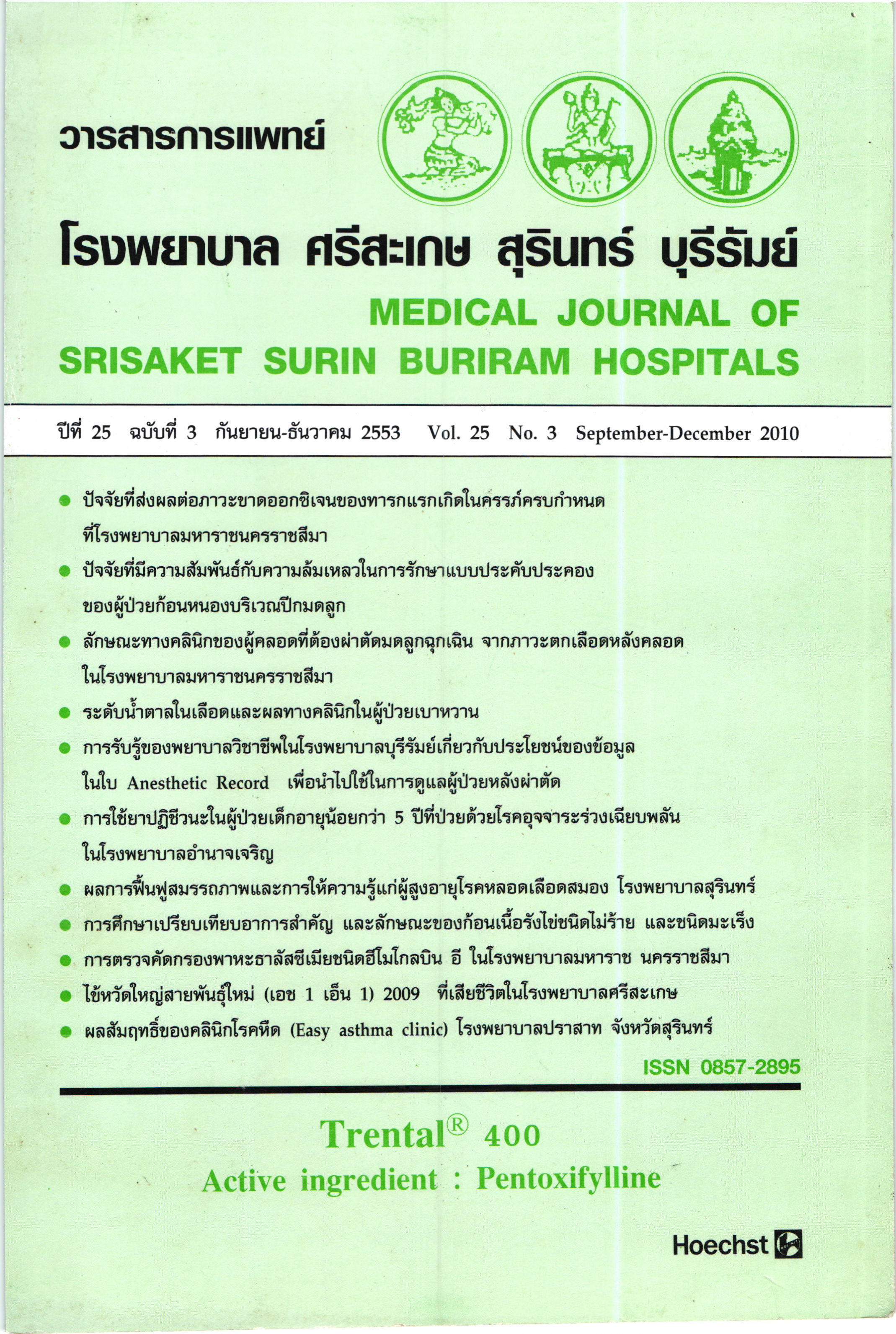
Fasting blood sugar and clinical outcomes in diabetic patients
Article Sidebar
Main Article Content
Abstract
Background: Diabetes mellitus is a group of metabolic diseases in which a person has high blood sugar, because the body dose not produce enough insulin or cell do not respond to the insulin that is produced, result from insulin resistance. Fasting blood sugar is the standard measure used for the diagnosis of diabetes and there is evidence that elevated fasting blood sugar may be risk to cardiovascular disease.
Objective: To evaluate the fasting blood sugar and clinical outcomes in diabetic patient.
Method: A retrospective descriptive study of diabetic patients was conducted by reviewing medical record from January 2009 to December 2009 at Nangrong Hospital. Two groups of subjects included men and women aged over 18 years old. The patients had fasting blood sugar above 126 mg/dl, or plasma glucose 2 hours after a 75 g oral glucose load as in a glucose tolerance test above 200 mg/dl, or had symptoms of hyperglycemia with causal plasma glucose above 200 mg/dl. Patients with other causes of diabetes, or gestational diabetes or who had serious complicating illness such as terminal stage of cancer, chronic renal failure, chronic liver disease. congestive heart failure, stroke were not included.
Result: Among the total of 50 patients, the diabetic patient group (n=30) had lower fasting blood sugar and HbAlc than the group of the diabetic with cardiovascular disease (n=20). The average ages of patients in diabetic group and the group of diabetic with cardiovascular disease were 60.56 years and 57.75 years, respectively. The level of fasting blood sugar and HbAlc were higher than normal level in both group. The rate of hospitalization in the group of diabetic patients with cardiovascular disease is higher than the group of diabetes and the cause of admission were hyperglycemia and chest pain.
Conclusion: The level of fasting blood sugar is the standard measure used for the diagnosis and monitoring clinical of diabetes. The well-controlled blood sugar decrease mortality rate, health-care cost and improve the quality of life in diabetic patients.
Article Details
References
Adeghate E.Schattner P.Dunn E.An update on the etiology and epidemiology of Diabetes mellitus.In: Adeghte, Saadi H. Adem A.Obineche E, editors. Diabetes Mellitus and its complication: molecular mechanisms, epidemiology and clinical Medicine. Ann NY Acad Sci 2006;1084:1-29
ธิติ สนับบุญ. ระบาดวิทยาของโรคเบาหวาน. ใน:ธิติ สนับบุญ, วราภณ วงส์ถาวรรัตน์ (บรรณาธิการ).การดูแลเบาหวานแบบองค์รวม. พิมพ์ครั้งที่ 1. กรุงเทพมหานคร: โรงพิมพ์แห่ง จุฬาลงกรณ์มหาวิทยาลัย; 2549. หน้า 25-32
American Diabetes Association,Standards of medical care in diabetes 2009. Diabetes Care 2009;32:Suppl 1:S13-S61
The artherosclerosis Risk in Communities (ARIC) Study: design and objectives. Am J epidemiol 1989;129:687-702
Rohlfing C. Wiedmeyer HM, Little R, et al. Biological variation of glycohemoglobin . Clin Chem 2002;48:1116-1118
Chobanian AV.Bakris Gl, Black HR, Cushman WC, Green LA.Izzo JL Jr et al. The Seventh report of the joint national committee cm prevention,detection, evaluation and treatment of high blood pressure:The JNC 7 Report.JAMA 2003;289(19):2560-72
The Expert Committee on the Diagnosis and Classification of Diabetes Mellitus: Follow-up report on the diagnosis of diabetes mellitus.Diabetes Care 2003;26:3160-7
Selvin E. Crainiceanu CM, Brancati FL, Coresh J.Short-term variability in measures Of Glycemia and implications for the classification of diabetes. Arch Intern Med 2007;167:1545-51
Arauz-Pacheco C,Parrott MA, Raskin P.(ADA) Hypertension management in adults with diabetes.Diabetes Care. 2004 Jan ; 27 Suppl l:S65-7
Sowers JR.Treatment of hypertension in patients with diabetes.Arch Intern Med. 2004 Sep 27 ;164(17):1850-7
