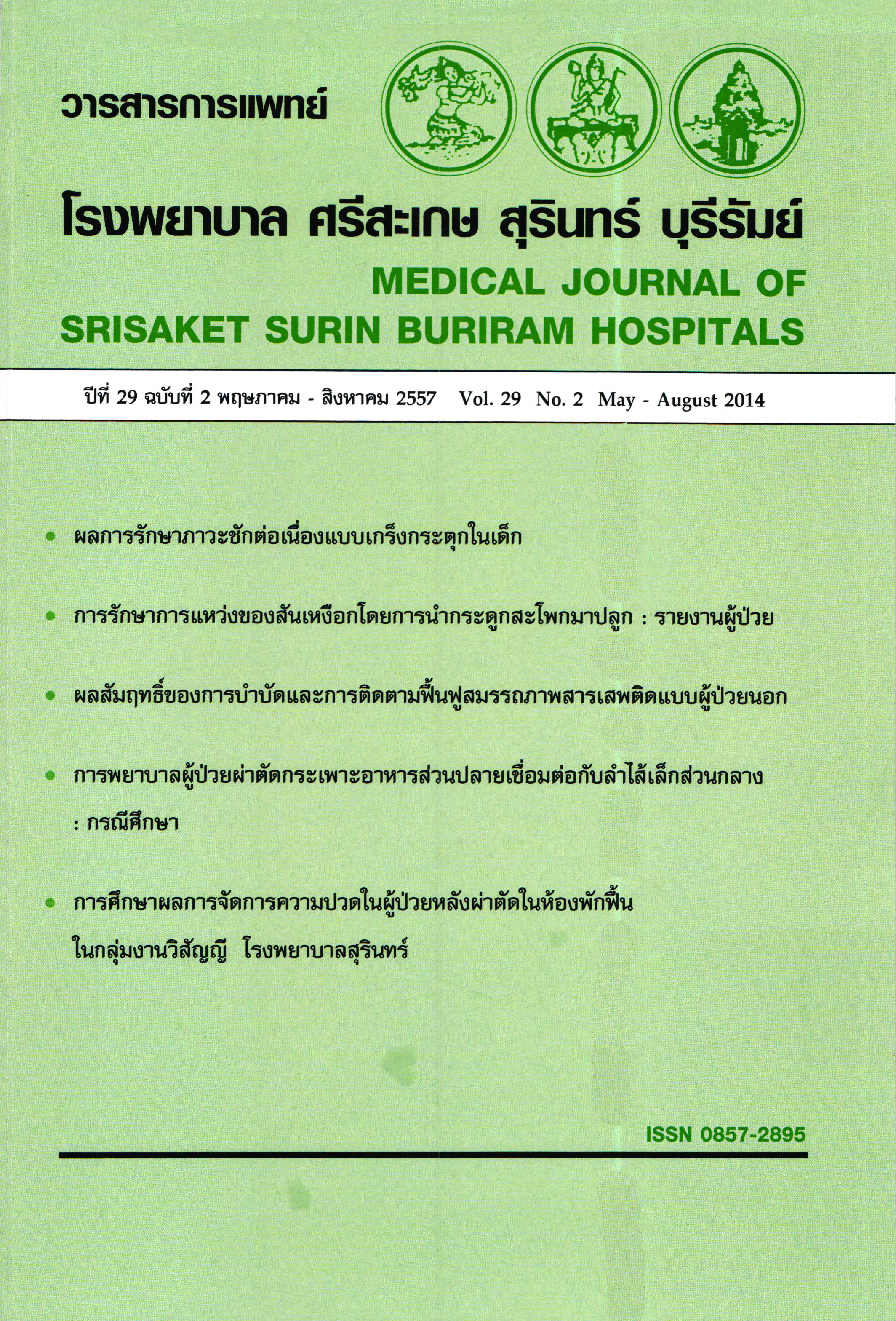
Outcome of Convulsive Status Epilepticus in Children
Article Sidebar
Main Article Content
Abstract
Background: Status epilepticus is considered as common neurological emergency in children.Morbidity and mortality are high and associated with seizure duration, inappropriate treatment and underlying disease.
Objective: To determine the mortality rate in children with convulsive status epilepticus (CSE) and factors that affect mortality rate.
Medthod: A retrospective study was conducted at Surin hospital. Eligible patients were infants or children diagnosed with convulsive status epilepticus (CSE) during January 1st 2009 to December 31st 2011. Research data included demographic data, etiology, treatment and clinical course were retrieved from patient medical database. Descriptive analysis and Fisher’s exact test were applied for data analysis.
Results: There were 37 patients (25 boys(67.7%) and 12 girls(32.4%)) with mean age of 4.3 yearsincluded in the study. Etiologies of CSE were remote symptomatic (37.8%), acute symptomatic (27%), febrile (21.6%) and cyptogenic (13.5%). Overall mortality was 13.5%. The mortality rate related to improper treatment (p = 0.01) and prolonged seizure duration (p = 0.02). Subsequent epilepsy was found in 6 patients (16.2%) and delayed development was found in 2 patients (5.1%).
Conclusions: Mortality rate from convulsive status epilepticus in children was 13.5% and causality was related to seizure duration before treatment and inappropriate treatment. The result hereby suggests prompt and appropriate termination of seizure may reduce mortality rate.
Article Details
References
2. Commission on epidemiology and prognosis, international League Against Epilepsy: Guideline for epidemiologic studies on epilepsy. Epilepsia 1993;34:592-6.
3. สมาคมโรคลมชักแห่งประเทศไทย. การดูแลรักษาภาวะชักต่อเนื่อง. ใน: แนวทางการรักษาโรคลมชัก Epilepsy; clinical practice guideline (ฉบับที่ 2) 2549. หน้า 35 - 40.
4. Novorol CL, Chin RF, Scott RC. Outcome of convulsive status epilepticus: A review. Arch Dis Child 2007; 92:938-51.
5. Saz EU, Karapinar B, Ozcetin M, Polat M, Tosun A, Serdaroglu G, et al. Convulsive status epilepticus in children: etiology, treatment protocol and outcome. Seizure: the journal of the British Epilepsy Association 2011;20:2:115-8.
6. Raspall-Chaure M, Chin RF M, Neville BGR, Scott RC. Outcome of pediatric convulsive status epilepticus: a systematic review. Lancet Neurol 2006;5:769-79.
7. Visudtibhan A, Limhirun J, Chiemchanya S, Visudhiphan P. Convulsive status epilepticus in Thai children at Ramathibodi Hospital. J Med Assoc Thai ; 2006:89:6:803-8.
8. Tiamkao S, Suko P, Mayurasakorn N. Srinagarind Epilepsy Research Group. Outcome of status epilepticus in Srinagarind Hospital. J Med Asooc Thai 2010;93:20-3.
9. Shinnar S, Pellock JM, Moshe SL, Maytal J, O’Dell C, Driscoll SM, et al. In : Whome does status epilepticus occur: age-related differences in children. Epilepsia 1997;38:907-14.
10. Singh RK, Stephens S, Berl MM, Chang T, Brown K, Vezina LG, et al. Prospective study ofnew-onset seizures presenting as status epilepticus in childhood. Neurology 2010;23:74:8:636-42.
11. Maegaki Y, Kurozawa Y, Hanaki K, Ohno K, Risk factors for fatality and neurological sequelae after status epilepticusinchildren. Neuropediatrics 2005;36:186-92.
12. Lowenstein DH, Bleck T, Macdonald RL. It’s time to revise the definition of status epilepticus. Epilepsia 1999;40:1:120-2.
13. Lowenstein DH. The management of refractory status epilepticus: an update. Epilepsia 2006;47 Suppl1:35-40.
14. Komur M, Arslankoylu AE, Okuyaz C, Keceli M, Derici D. Management of patients with status epilepticus treated at a pediatric intensive care unit in Turkey. Pediatr Neurol 2012;46:6:382-6.
15. Chen JW, Wastertain CG. Status epilepticus: pathophysiology and management in adults. Lancet Neurol 2006;5:3:246-56.
16. Sahin M, Menache CC, Holmes GL, Riviello JJ. Outcome of severe refractory status epilepticus in children. Epilepsia 2001;42:1461-7.
17. Berg AT, Shinnar S, Levy SR, Testa FM. Status epilepticus in children with newly diagnosed epilepsy. Ann Neurol 1999;45:618-23.
18. Novorol CL CR, Scott RC. Outcome of convulsive status epilepticus: A review. Arch Dis Child. 2007;92:938-51.
19. Neville B, Chin RF, Scott RC. Childhood convulsive status epilepticus: Epidemiology, management and outcome. Acta Neurol Scand 2007;186:21-5.
20. Lin KL, Lin JJ, Hsia SH, Wu CT, Wang HS. Analysis of convulsive status epilepticus in children of Taiwan. Pediatr Neurol 2009;41:6:413-8.
