
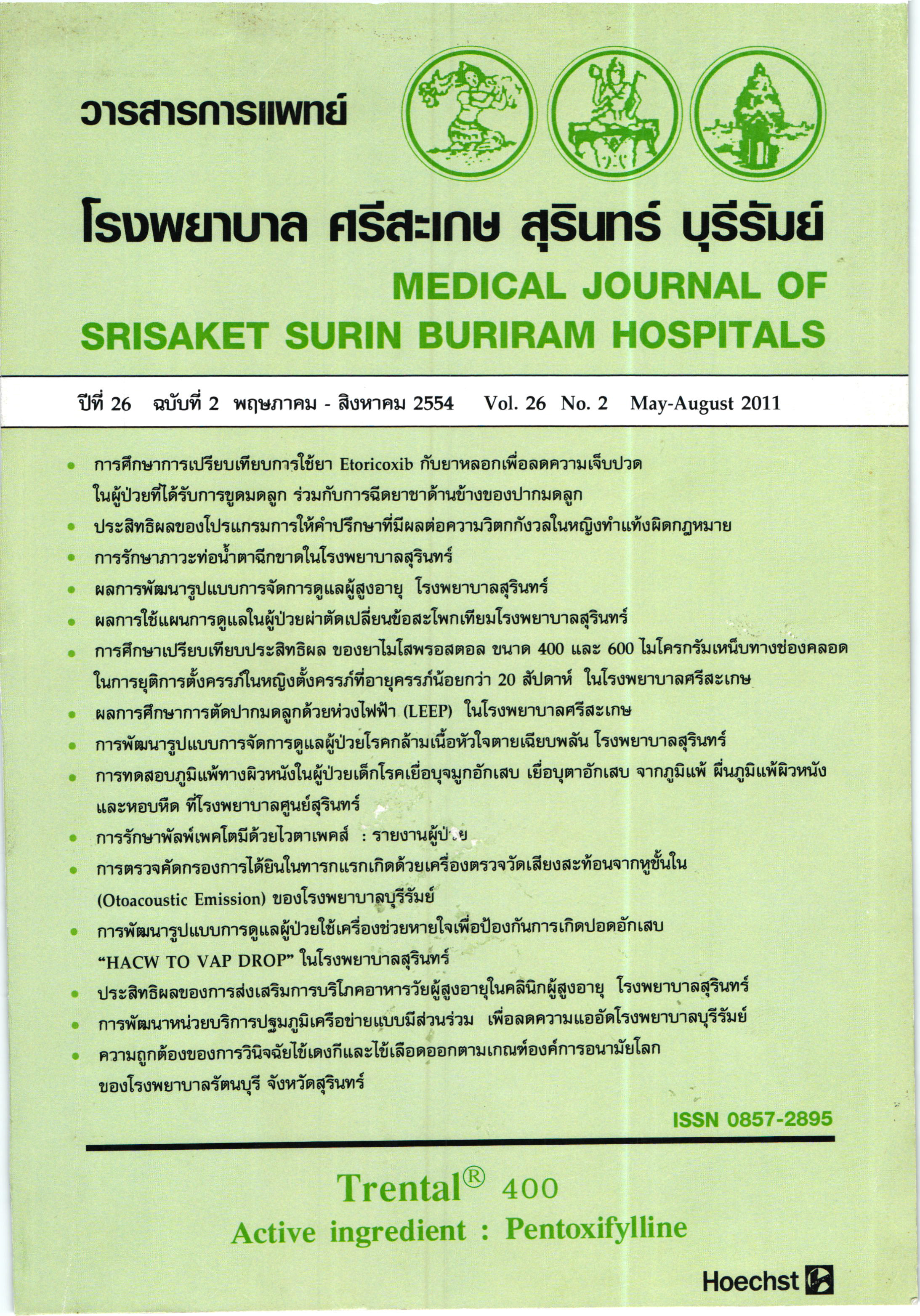
Treatment of Canaliculi Laceration at Surin Hospital
Article Sidebar
Main Article Content
Abstract
Background: Canaliculi laceration is a common problem associated with maxillofacial and eyelid trauma which need prompt and proper management to prevent epiphora and irritation. There are many operation techniques and many kinds of stent for treatment canaliculi laceration.
Objectives: To evaluate surgical results in treatment of canaliculi lacerations at Surin hospital.
Study design: descriptive retrospective study.
Method: The medical records of patients who had canaliculi laceration at Surin hospital during 1 January 2008 - 31 December 2010 were reviewed. The demographic data, age, sex, cause of injury, duration before repairing, surgical technique, duration of stent replacement, surgical result and complications were analyzed.
Results: Among 95 patients, 84.21% were male. Mean age was 42±21.1 years (ranges 1 to 94 years) Cause of injury from motorcycle accidents were 56.84%. All patients were treated with pigtail probe and using nylon 3-0 as stent. At the final follow up, they had good results, only 5 patients had epiphora and one had cicatricial ectropion.
Conclusion: Treatment of canaliculi laceration by using pigtail probe and nylon 3-0 as stent had good surgical result.
Article Details
References
Marshak H, Dresner SC. Lacrimal trauma. In: Cohen AJ, Mercandetti M, Brazzo BG, editors. The lacrimal system ; 2006 : p119-26.
Jordan DR, Ziai S, Gilberg SM. Pathogenesis of canalicular lacerations. Ophthal Plast Reconstr Surg 2008;24:394-8.
Nerad JA. Oculoplastic surgery the requisites in ophthalmology 2001. p312-347.
Ho T, Lee V. National survey on the management of lacrimal canalicular injury in the United Kingdom. Clin Experiment Ophthalmol 2006;34:39-43.
MacGillivray RF, Stevens MR. Primary surgical repair of traumatic lacerations of the lacrimal canaliculi. Oral Surg Oral Med Oral Pathol Oral Radiol Endod 1996;81:157-63.
Smit TJ, Mourits MP. Monocanalicular lesions.To reconstruct or Not. Ophtha- mology 1999;106:1310-12.
Forbes BJ, Katowitz WR, Binenbaum G. Pediatric canalicular tear repairs - revisiting the pigtail probe. J AAPOS 2008; 12(5):518-20.
Liang T, Zhao GQ, Li YL, Yang SS, Zhang LY, Wu Y. Efficiency and therapeutic effect of modified pigtail probe in anastomosing lacerated lacrimal canaliculus. Chin J Traumatol 2009;12(2):87-91.
Fayet B, Ruban JM. Monocanalicular lacrimal pathway intubation with a stable punctal attachment.In: Guthoff R, Katoeitz JA, editors. Essential in ophthalmology oculoplastic and orbit ;2006: p83-8.
Naik MN, Kelapure A, Rath S, Flonavar SG. Management of canalicular lacerations: Epidemiological aspects and experience with Mini-Monoka monocanalicular stent. Am J Ophthalmol 2008;145:375-80.
Della Rocca DA, Ahmad S, Preechawi P, Schaefer SD. Nasolacrimal System Injuries. In: Weber RK, Keeri R, Schaefer SD, Della Rocca RC ; editors. Atlas of lacrimal surgery; 2007:p91-103.
Wu S, Ma L, Chen RJ, Tsai Y, Chu Y. Analysis of bicanalicular nasal intubation in the repair of canalicular lacerations. Jap J Ophthalmol 2010;54:24-31.
Xiao-jing P, Mao A, Gui-qui Z, Xu-xia M, Shan-Shan Y. Clinical effects of three types of silicone intubations in repairing lacerations of canaliculus. Chin J Trau-matol 2009;12(3)173-6.
วีระศักดิ์ อนุตรอังกูร. ผลการผ่าตัดรักษาท่อน้ำตาฉีกขาดในโรงพยาบาลขอนแก่น. ขอนแก่นเวชสาร 2551;32:139-46.
Kriangsak Sirirak. A simple lacrimal drainage repair by three - stitch technique without stent in 28 patients at Prapokklao Hospital. Siriraj Med J 2009;61:139-42.
Landy JS, Slonim CB, Older JJ. Surgery of the punctum and canaliculus. In: Cohen AJ, Mercandetti M, Brazzo BG, editors. The lacrimal system ; 2006: p110-8.
Orhan M, Govsa F, Saylam C. Anatomical details used in the surgical reconstruction of the lacrimal canaliculus: cadaveric study. Surg Radiol Anat 2009;31:745-53.
