
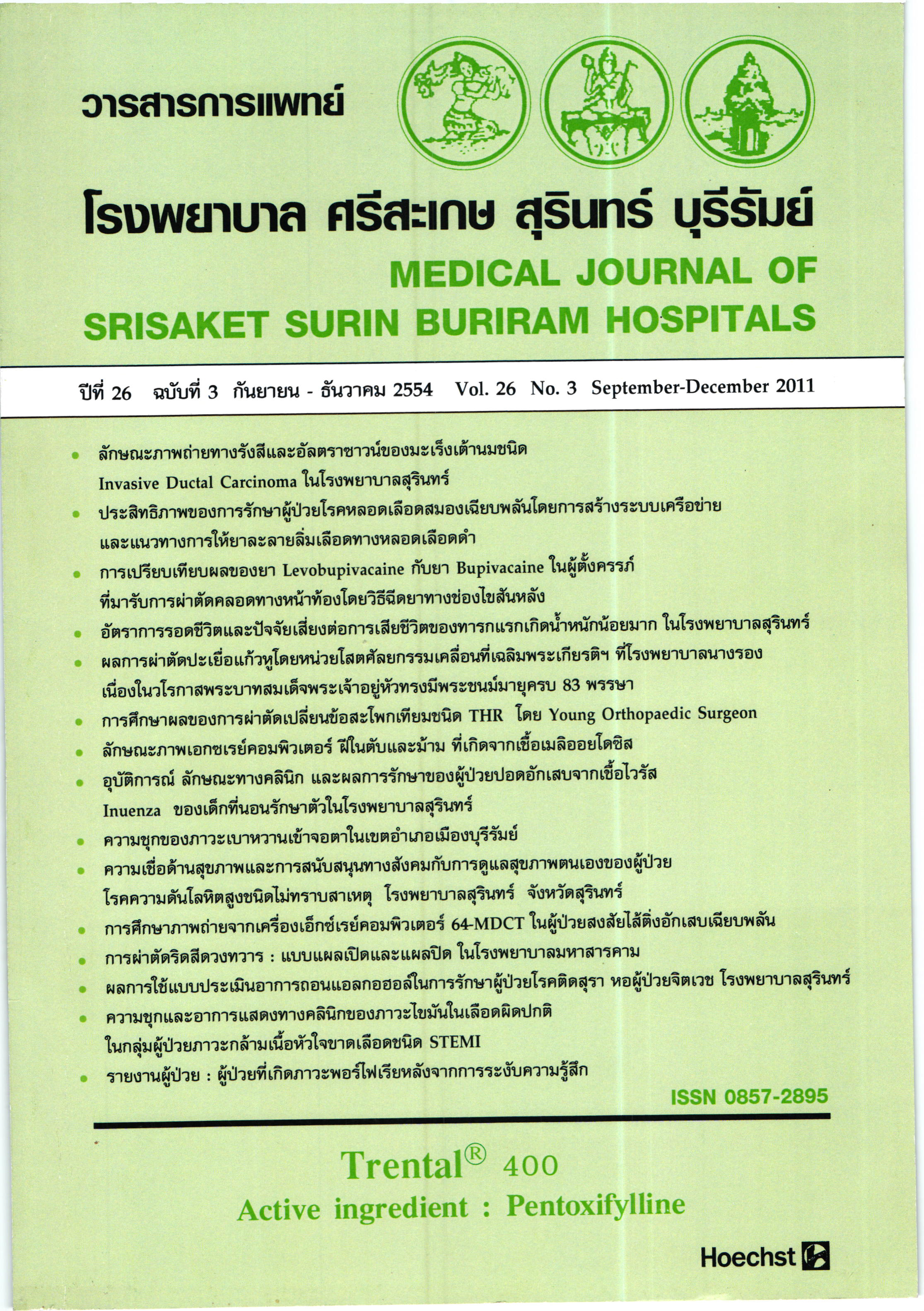
Survival and Perinatal Risks of Death of Very Low Birth Weight Infants in Surin Hospital
Article Sidebar
Main Article Content
Abstract
Background: Survival of low birth weight preterm infants has increased since the improvement of advance neonatal intensive care and management. These infants demand on high technology health care and this care consumes a large amount of resources. The very low birth weight infants (VLBW) have higher mortality and morbidity than normal newborns and more likely to suffer some types of long term handicap.The informations obtained will be useful in developing the standard care in these patients.
Objective: To determine the survivals and perinatal risks of death among VLBW infants in Surin Hospital.
Study design: Retrospective analytical study
Method: Data were collected from medical charts of all neonates with a birth weight of less than 1500 grams, who were admitted in Surin Hospital between October 1st, 2008 and September 30th, 2010. Antenatal history, perinatal data and neonatal outcome until hospital discharge were extracted and analyzed.
Results: A total of 157 VLBW infants were analyzed. Survival rate of very-low-birth- weight (VLBW) infants and extremely-low-birth-weight (ELBW) infants were 66.2% and 36.4% respectively. Respiratory distress syndrome (RDS) was the major cause of death(58.5%), Sepsis(20.8%), Pneumonia(9.4%), Immaturity (5.7%), Severe birth asphyxia(3.8%) and Congestive heart failure(1.9%). Perinatal risk factors of mortality were birth weight <1,000 g (p = 0.000), Gestational age 28 weeks (p=0.000), APGAR score at 1 minute <5(p=0.008), APGAR score at 5 minute <5(p=0.003), first temperature at NICU<36.5°c (p=0.023), and needed endotracheal intubation in the delivery room (p=0.000).
Conclusion: Overall survival rate among VLBW infants in this study is comparable to the other reports in Thailand but remains low as compared to the studies from developed countries. Perinatal risk factors of mortality were birth weight<1,000 g, Gestational age 28 weeks, APGAR score at 1 and 5 minute <5, first temperature at NICU<36.5°c and needed endotracheal intubation in the delivery room.
Article Details
References
Courtney SE, Duran DJ, Asselin JM. et al. High-Fre-quency Oscillatory Ventilation versus Conventional Mechanical Ventila- tionfor Very-Low-Birth--Weight Infants. N Eng J Med 2002;347:643-52.
Shankaran S, Fanaroff AA, Writht LL, et al. Risk factors for early death among extremely low-birth-weight infants. Am J Obstet Gynecol 2002; 186:796-802.
Engle WA; American Academy of Pediatrics, Committee on Fetus and Newborn. Surfactant-replacement therapy for respiratory distress in the preterm and term neonate. Pediatrics 2008; 121:419-32.
Eichenwald EC, Stark AR. Management and Outcomes of Very Low Birth Weight. N Engl J Med 2008;358:1700-11.
Behrman RE, Stith Butler A, eds. Preterm birth: causes, consequences, and pre- vention.Washington, DC: National Academies Press; 2007.
Fanaroff AA, Stoll BJ, Wright LL, et al.Trends in neonatal morbidity and mortality for very low birthweight infants. Am J Obstet Gynecol 2007; 196:2:147.el-147.e8.
Neil Marlow, Dieter Wolke, Melanie A, et al. Neurologic and Developmental Disability at Six Years of Age after Extremely Preterm Birth. N Engl J Med 2005;352:9-19.
Kliegman RM : Neonatal necrotizing enterocolitis :bridging the basic science with the clinical diseasej Pediatr 1990;117:836.
Garner A : International classification of retinopathy of prematurity. Pediatrics 1984;74:127.
Flack M, Fanaroff AA, Outcomes of children of extremely low birth weight and gestational age in the 1990s. Semin Neonatal 2000; 5:2:89-106.
Tsou Kl, Tsao PN. The morbidity and survival of Very-low-birth-weight infants in Taiwan. Acta Paediatr Taiwan. 2003; 44 :349-55.
Crowley P. Prophylactic corticosteroids for preterm birth. Cochrane Database Syst Rev 2006;3:CD000065.
American Academy of Pediatrics, Committee on Fetus and Newborn. Postnatal corticosteroids to treat or prevent chronic lung disease in preterm infants. Pediatrics 2002; 109: 330-8.
Miksch R, Armbrust S, Pahnke J, Fusch C. Outcome of very low birth weight infants after introducing a new standard regimen with the early use of nasal CPAP. Eur J Pediatric 2008; 167: 909-16.
Thaithumyanon P, Punnahitananda S. Neonatal mortality and morbidity of very low birth weight infants at King Chulalongkorn Memorial Hospital. Chula Med J 2008; 52: 255-64.
Forsblad K, Kallen K, Marsal K, Hell- strom-Westas L. Apgar score predicts short-term outcome in infants born at 25 gestational weeks. Acta Paediatr. 2007; 96:166-71.
Thorngren-Jerneck K, Herbst A. Low 5 minute APGAR score: a population-base register study of 1 million term births. Obstet Gynecol 2001; 98:1: 65-70.
Basu S, Rathore P, Bhatia BD. Predictors of mortality in very low birth weight neonates in India. Singapore medical journal 2008; 49: 556-60.
Laptook AR, Salhab W, Bhaskar B. Admission temperature of low birth weight infants: predictors and associated morbidities. Pediatrics 2007; 119:e643-9.
