
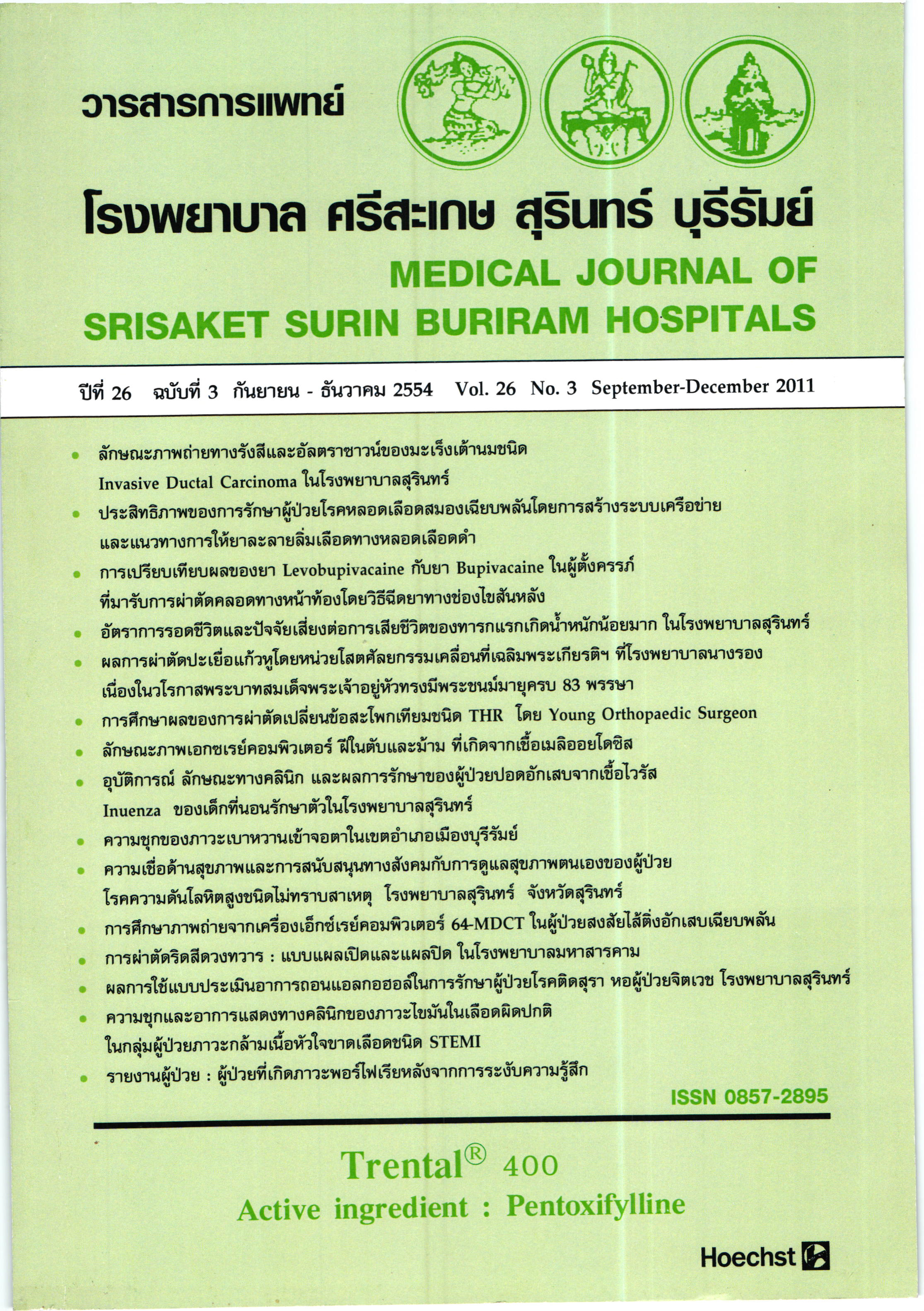
Clinical Outcome and Prevalence of Dyslipidemia in Patients with Acute STEMI from Buriram Registry
Article Sidebar
Main Article Content
Abstract
Background: Acute coronary syndrome (ACS) represents a continuum of acute myocardial ischemia included ST-segment elevation myocardial infarction (STEMI), non-ST-segment elevation myocardial infarction (NSTEMI) and unstable angina. Thus, ACS included heterogeneous spectrum of conditions that result in major cause of morbidity and mortality worldwide. In general risk factor of coronary artery disease are age, male gender, hypertension, smoking, diabetes mellitus and dyslipedemia.
Objective: 1. to study clinical outcome of dyslipidemia in acute STEMI patients 2. to study of prevalence dyslipidemia in patients with acute STEMI. Retrospective
Design: descriptive study
Patients: The patients who were diagnosed with acute STEMI and complete register
Methods: All data in this study from medical record, ACS pathway record, lipid profile (after NPO), case report form: clinical presentation esp. Killips classification, heart failure condition, arrhythmia event, cardiogenic shock, cardiac arrest event and EKG during 1 January 2009 to 31 March 2011 were collected.
Results: This study included 85 patients (72male) median age was 62 year. The previous diagnostic of dyslipidemia had about 10 percentage (8case), On the other hand dyslidemia prevalence from lipid profile had found 67 percents (57cases) but no relationship between dyslidemia and increased risk for heart failure, arrhythmia, worst Killips classification and cardiac arrest.
Conclusions: Therefore clinical outcome of dyslipidemia patients are not increase morbidity and mortality. But the considerable proportion of patients who developed acute STEMI have dyslipidemia.
Article Details
References
De Backer G, Ambrosioni E, Borch-Johnsen K, Brotons C, Cifkova R, Dallongeville J. et al. European guidelines on cardiovascular disease prevention in clinical practice: third joint task force of European and other societies on cardiovascular disease prevention in clinical practice (constituted by representatives of eight societies and by invited experts). Eur J Cardiovasc Prev Rehabil 2003;10:S1-S78.
Boonsom W, Ratanasumawong K., Hutayanon P, Tungasabutra W. Implications of diabetes mellitus in patients with STEMI from Thai ACS registry. J Med Assoc Thai 2007;90:12-20.
Sanguanwong S, Srimahachota S, Tungsubutra W, Srichaiveth B, Kiatchoo- sakun S. predictors of in-hospital mortality in thai ACS registry. J Med Assoc Thai 2007;90:91-7
The GUSTO investigators. An international randomized trial comparing four thrombolytic strategies for acute myocardial infarction. N Engl J Med 1993; 329: 673-82
Jose VJ, Gupta SN. Mortality and morbidity of acute ST segment elevation myocardial infarction in the current era. Indian Heart J 2004; 56: 210-4.
Braunwald E, Antman EM, Beasley JW, Califf RM, Cheitlin MD, Hochman JS, et al. ACC/AHA 2002 guideline update for the management of patients with unstable angina and non-ST segment elevation myocardial infarction-summary article: a report of the American College of Cardiology/American Heart Association task force on practice guidelines (Committee on the Management of Patients With Unstable Angina). J Am Coll Cardiol 2002;40:1366-74
Eagle KA, Lim MJ, Dabbous OH, Pieper KS, Goldberg RJ, Van de WF, et al. A validated prediction model for all forms of acute coronary syndrome: estimating the risk of 6-month postdischarge death in an international registry. JAMA 2004;291:2727-33.
Fox KA, Goodman SG, Klein W, Brieger D, Steg PG, Dabbous O, et al. Management of acute coronary syndromes. Variations in practice and outcome; findings from the Global Registry of Acute Coronary Events (GRACE). Eur Heart J 2002;23:1177-89.
Steg PG, Goldberg RJ, Gore JM, Fox KA, Eagle KA, Flather MD, et al. Baseline characteristics, management practices and in-hospital outcomes of patients hospitalized with acute coronary syndromes in the Global Registry of Acute Coronary Events (GRACE). Am J Cardiol 2002;90:358-63.
Bundhamcharoen K, Teerawatananon Y, Vos T, Begg T, editors. Burden of Disease and Injuries in Thailand: Priority Setting For Policy. The Thai Working Group on Burden of Disease and Injuries. Ministry of Public Health, Bangkok, Thailand: Printing House of the War Veterans Organization of Thailand; 2002
Reiner Z, Catapano AL. ESC Guideline for management of dyslpidemia. Europian heart journal; 2011:1769-1818.
Pyorala K, De Backer G, Graham I, Poole-Wilson P,Wood D. Prevention of coronary heart disease in clinical practice: recommendations of the Task Force of the European Society of Cardiology European Atherosclerosis Society European Society of Hypertension. Atherosclerosis 1994;110:121-61.
Wood D, De Backer G, Faergeman O, Graham I, Mancia G, Pyorala K. Prevention of coronary heart disease in clinical practice. Recommendations of the Second Joint Task Force of European and other Societies on coronary prevention. Eur Heart J 1998;19:1434-503.
De Backer G, Ambrosioni E, Borch- Johnsen K, Brotons C, Cifkova R, Dallongeville J. et al. European guidelines on cardiovascular disease prevention in clinical practice: third joint task force of European and other societies on cardiovascular disease prevention in clinical practice (constituted by representatives of eight societies and by invited experts). Eur J Cardiovasc Prev Rehabil 2003;10:S1-S78.
Eagle KA, Goodman SG, Avezum A, Budaj A, Sullivan CM, Lopez-Sendon J. Practice variation and missed opportunities for reperfusion in STsegment- elevation myocardial infarction: findings from the Global Registry of Acute Coronary Events(GRACE). Lancet 2002; 359: 373-7.
Multicentral Collaborative Group on Chinese Registry of Acute Coronary Events. Comparison Registry of Acute Coronary Events. Comparison of current clinical practice and guideline application in therapies of ACS: findings from the Multicentral Collaborative Group on Chinese registry of acute coronary events Zhonghua Xin Xue Guan Bing Za Zhi 2005; 33:789-92
The Thai ACS registry: what have we learned? Final Program and Abstracts of the 15 The ASEAN Congress of Cardiology: New Horizon in Cardiology. Bangkok, October 23-26, 2004: 99.
Yusuf S, Hawken S, Ounpuu S, Dans T, Avezum A, Lanas F, et al. Effect of potentially modifiable risk factors associated with myocardial infarction in 52 countries (the INTERHEART study): case-control study. Lancet 2004; 364: 937-52.
Aekplakorn W, Stolk RP, Neal B, Suriya- wongpaisal P, Chongsuvivatwong V, Cheepudomwit S, et al. The prevalence and management of diabetes in Thai adults: the international collaborative study of cardiovascular disease in Asia. Diabetes Care 2003; 26: 2758-63.
Gottlieb SS, McCarter RJ, Vogel RA. Effect of beta-blockade on mortality among high-risk and low-risk patients after myocardial infarction. N Engl J Med 1998; 339: 489-97
Zuanetti G, Latini R, Maggioni AP, Franzosi M, Santoro L, Tognoni G. Effect of the ACE inhibitor lisinopril on mortality in diabetic patients with acute myocardial infarction: data from the GISSI-3 study. Circulation 1997; 96: 4239-45.
