
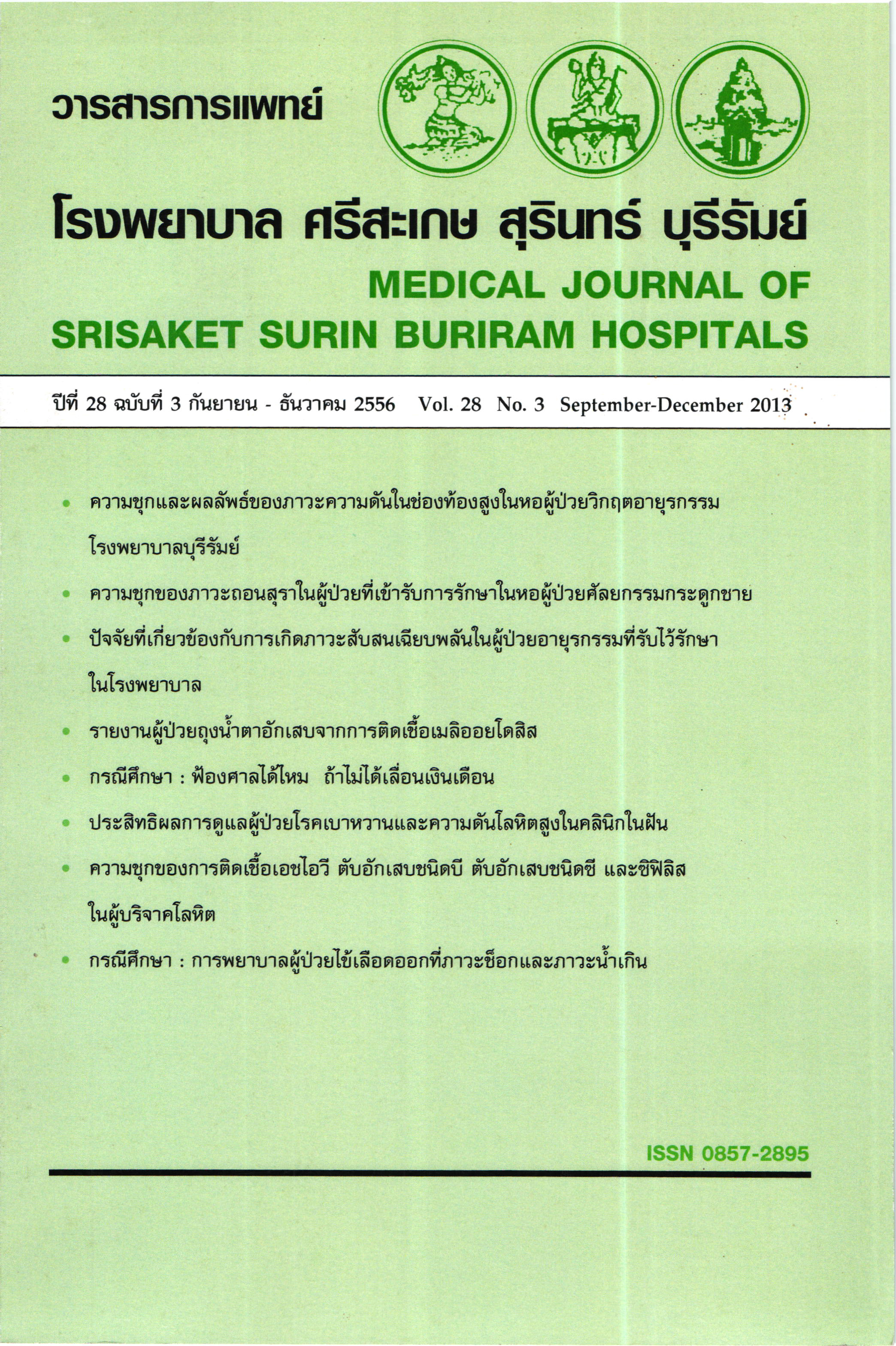
ปัจจัยที่เกี่ยวข้องกับการเกิดภาวะสับสนเฉียบพลันในผู้ป่วยอายุรกรรม ที่รับไว้รักษาในโรงพยาบาล
Article Sidebar
Main Article Content
บทคัดย่อ
ความเป็นมา: ภาวะสับสนเฉียบพลัน พบได้บ่อยในผู้สูงอายุ โดยพบว่ามีความสัมพันธ์กันกับอัตรา การเกิดภาวะแทรกซ้อนและอัตราการเสยชีวิตถ้าหากหาสาเหตุได้!ม่ครอบคลุมหรือ ไม่ได้ตระหนักถึงปัจจัยที่เกี่ยวข้องนั้น และยังส่งผลให้การรักษามีผลลัพธ์ทางคลินิก ที่ไม่ดี
วัตถุประสงค์: เพื่อศึกษาหาปัจจัยที่เกี่ยวข้องกับการเกิดภาวะสับสนเฉียบพลันในผู้ป่วยอายุรกรรม
ที่รับไว้รักษาในโรงพยาบาล
สถานที่ทำการศึกษา: หอผู้ป่วยอายุรกรรมโรงพยาบาลลังฃะ
รูปแบบการศึกษา: การศึกษาเซิงวิเคราะห์แบบ case-control study
กลุ่มเป้าหมาย: ผู้ป่วยอายุรกรรมที่รับไว้รักษาในโรงพยาบาลลังฃะที่เข้าเกณฑ์การคัดเลือก
วิธีการศึกษา: รวบรวมข้อมูลลักษณะทั่วไปของผู้ป่วย อายุ เพศ, สถานภาพสมรส, โรคประจำตัว,
การสูบบุหรี่, การดื่มสุรา, การติดเชื้อ, ยาที่ได้รับขณะอยู่โรงพยาบาล, การใส่สายสวนปัสสาวะ, ประวัติเคยได้รับการผ่าตัด, มีความเจ็บปวด, มีภาวะซึมเศร้า และผลการตรวจทางห้องปฏิบัติการ ส่วนภาวะสับสนเฉียบพลัน ใช้เกณฑ์การวินิจฉัยโดย Confusion Association Method วิเคราะห์ข้อมูลด้วยโปรแกรม SPSS
ผลการศึกษา: ผู้ป่วยอายุรกรรมที่รับไว้รักษาในโรงพยาบาลสังขะ จำนวน 181 คนโดยแบ่งเป็นกลุ่ม
ทมีภาวะสบสนเฉียบพลันมีจำนวน 53 คน และกลุ่มที่ไม่มีภาวะสับสนเฉียบพลน จำนวน 128 คน พบว่าอายุเฉลียของผู้ป่วยทีมีภาวะสับสนเฉียบพลัน (75.75±10.64 ปี) มากกว่าผู้ป่วยที่ไม่มีภาวะสับสนเฉียบพลัน (57.7±15.8ปี) อย่างมีนัยสำคัญทางสถิติ (p-value = 0.00) จากการวิเคราะห์โดยพหุตัวแปรกลุ่มผู้ป่วยที่มีภาวะสับสนเฉียบพลันพบว่าปัจจัยได้แก่ อายุมากกว่าหรือเท่ากับ 65 ปี (p-value 0.00, OR = 9.23, 95% Cl 3.89-21.85), การได้รับยา benzodiazepine (p-value 0.002, OR = 3.45, 95% Cl 1.85-7.52) และการใส่
สายสวนปัสสาวะ (p-value = 0.003, OR = 19.18, 95% Cl 2.8-130.94) มีจำนวนมากกว่ากลุ่มที่ไม่มีภาวะสับสนเฉียบพลันอย่างมีนัยสำคัญทางสถิติ
สรุป: ปัจจัยที่เกี่ยวข้องกับการเกิดภาวะสับสนเฉียบพลันอย่างมีนัยสำคัญทางสถิติ คืออายุมากกว่า 65 ปี ส่วนการได้รับยา benzodiazepinett ละการใส่สายสวนปัสสาวะควรเฝ็าระวังการเกิดภาวะสับสนเฉียบพลัน โดยภาวะนี้ควรให้การรักษาตามเหตุหรือปัจจัยที่เกี่ยวข้องโดยเร็ว เพื่อผลลัพธ์ที่ดีในการดูแลผู้ป่วย
คำสำคัญ: ภาวะสับสนเฉียบพลัน, ผู้ป่วยใน, หอผู้ป่วยอายุรกรรม
Article Details
เอกสารอ้างอิง
2. Inouye SK. Delirium in older persons. N Engl J Med 2006; 354: 1,157-65.
3. Fong TG, Tulebaev SR, Inouye SK. Delirium in elderly adults: diagnosis, prevention and treatment. Nat Rev Neurol 2009;5:210-20.
4. Inouye SK. The dilemma of delirium: clinical and research controversies regarding diagnosis and evaluation of delirium in hospitalized elderly medical patients. Am J Med 1994;97:278-88.
5. Meagher DJ. Delirium: optimizing management. BMJ 2001; 322: 144-9.
6. Kakuma R, du Fort GG, Arsenault L, Perrault A, Platt RW, Monette J. Delirium in older emergency department patients discharge home: effect on survival. J Am Geriatr Soc 2003;51:443-50.
7. Sharma A, Malhotra S, Grover S, Jindal SK. Incidence, prevalence, risk factor and outcome of delirium in intensive care unit: a study from India. General Hospital Psychiatry 2012; 34:639-46.
8. Chang YL, Tsai YF, Lin PJ, Chen MC, Liu CY. Prevalence and risk factors for postoperative delirium in a cardiovascular intensive care unit. American Journal of Critical Care 2008; 17:567-75
9. Van Rompaey B, Schuurmans MJ, Shortridge-Baggett LM, Truijen S, Bossaert L. Risk factors for intensive care delirium. Intensive and Critical Care Nursing 2008;24:98-107
10. Inouye SK, Charpentier PA. Precipitating factors for delirium in hospitalized elderly persons. Predictive model and interrelationship with baseline vulnerability. JAMA 1996;275: 11:852-7.
11. Parikh SS, Chung F. Postoperative delirium in the elderly. Anesth Analg 1995;80:1223-32.
12. Inouye SK. Delirium in hospitalized older patients: recognition and risk factors. J Geriatr Psychiatry Neurol 1998; 11: 118-25.
13. Limpawattana P, Sutra S, Thavornpitak Y, Sawanyawisuth K, Chindaprasirt J, Mairieng P. Delirium in hospitalized elderly patients of thailand; is the figure underrecognized?. J Med Assoc Thai 2012;95:Suppl7:S224-8.
14. Pandharipande P, Cotton BA, Shintani A, Thompson J, Pun BT, Morris JA Jr, Prevalence and risk factors for development of delirium in surgical and trauma intensive care unit patients. J Trauma 2008;65:1:34-41.
15. Milisen K, Abraham IL, Broos PLO. Postoperative variation in neurocognitive and functional status in elderly hip fracture patients. J Adv Nurs 1998;27:59-67.
16. Jackson JC, Gordon SM, Ely EW, Burger C, Hopkins RO. Research issues in the evaluation of cognitive impairment in intensive care unit survivors. Intensive Care Med 2004;30:2009-16.
17. Inouye SK, Van Dyck CH, Alessi CA, Balkin S, Siegal AP, Horwitz Rl. Clarifying confusion: the confusion assessment method. A new method for detection of delirium. Ann intern med 1990 ;113:941-8.
18. Tsuruta R, Nakahara T, Miyauchi T, Kutsuna S, Ogino Y, Yamamoto T, et al. Prevalence and associated factors for delirium in critically ill patients at a Japanese intensive care unit. Gen Hosp Psychiatry 2010;32:6:607-11.
19. Bohner H, Hummel TC, Habel U, Miller C, Reinbott S, Yang Q, et al. Predicting delirium after vascular surgery: a model based on pre-and intraoperative data. Ann Surg 2003; 238:1:149-56.
