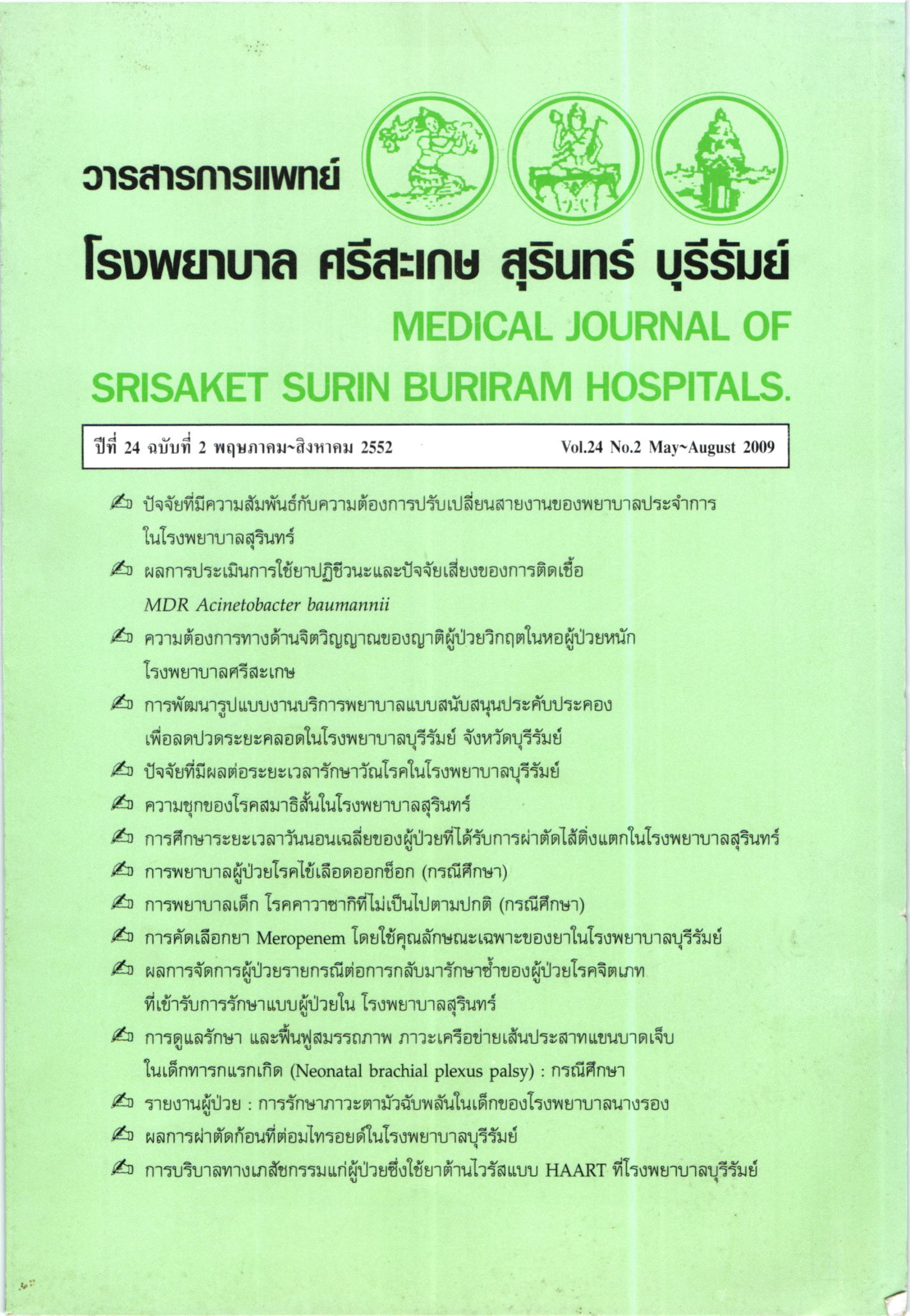
Factors Related to Tuberculosis Treatment Duration in Buriram Hospital
Article Sidebar
Main Article Content
Abstract
Background: Tuberculosis (TB) was a global public health emergency, recognizing its enormous, rising and far-reaching burden of disease. Treatment duration was about 6-12 months, longer than another infectious diseases.
Objective: To study the factors that related to tuberculosis treatment duration.
Research design: Retrospective Descriptive Study.
Patients: The patients who were diagnosed with tuberculosis and registered in cure or completed treatment at the Department of Medicine, Buriram Hospital.
Methods: Data from medical records during lsi October 2006 to 30th September 2008 were collected, then demographic data and radiological findings of all patients were analyzed.
Results: This study included 331 tuberculosis patients (male 217 cases, female 114 cases). The median age was 46.99 years (range 3 months to 92 years). There were 29 diabetes mellitus and 27 HIV infection. Patients pulmonary TB, extrapulmonary TB and both pulmonary and extrapulmonary TB were diagnosed in 88.52%, 10.27% and 1.21% of the patients, respectively. Most were farmers (60.73%), and laborers (22.96%). In pulmonary TB group, we treated with Category-I regimen about 89.6%. We treated for 6 months about 54.88% and more than 6 months about 45.12% in which the aging group, bilateral pulmonary lesions, involvement more than 2 lung-zones and cavitation from chest x-ray (P value = 0.000). But we had not found statistical significance in diabetes mellitus and HIV infection groups.
Conclusions: The factors that determined the treatment duration were depended on WHO category. The aging group, bilateral pulmonary lesions, involvement more than 2 lung-zones and cavitation in chest x-ray were also significant factors to increase treatment duration more than standard treatment protocol. But we had not found statistical significance in diabetes mellitus and HIV infection groups.
Key words: Pulmonary tuberculosis. Treatment duration, DM, HIV
Article Details
References
2. Resolution WHA44.8. Tuberculosis control programme. In: Handbook of resolutions and decisions of the World Health Assembly and the Executive Board. Volume III, 3rd ed. (1985-1992). Geneva, World Health Organization, 1993 (WHA44/1991/REC/1):116.
3. Raviglione MC, O'Brien RJ. Tuberculosis. In: Fauci Anthony S, Kasper Dennis L, Longo Dan L, Braunwald Eugene, Hauser Stephen L, Larry Jameson J, [et al.], editors. Harrison's Principles of Internal Medicine 17th ed. Singapore : McGraw Hill, 2008:1006-20.
4. World Health Organization. Global tuberculosis control. Annex 1-profiles of high-burden countries. World Health Organization, 2008. Availble from: URL: https://www.who.int/tb/publications/ global_report/2008/annex_l_download/ en/index.html
5. วรวุฒิ เจริญศิริ. วัณโรค. Availble from: URL: https://www.bangkokhealth.com/sitesearch_detail.asp?Number=9481.
6. สถานการณวัณโรคในประเทศไทย. Availble from: URL: https://origin.www.voanews.com/thai/archive/2008-03/2008-03-25-voa3.cfm?CFID=211746197&CFTOKEN=62491472&jsessionid=00307017289a9529235f474f7d5bc3247714.
7. ยุทธิชัย เกษตรเจริญ, เพชรวรรณ พึ่งรัศมี. Management of Tuberculosis modified WHO modules of managing tuberculosis at district level. กรุงเทพฯ : โรงพิมพ์ชุมนุมสหกรณ์การเกษตรแห่งประเทศไทย, 2540.
8. Centers for Disease Control and Prevention. Prevention and Treatment of Tuberculosis Among Patients Infected with Human Immunodeficiency Virus: Principles of Therapy and Revised Recommendations. MMWR 1998; 47(20):1-51.
9. Wang JY, Lee LN, Hsueh PR. Factors changing the manifestation of pulmonary tuberculosis. Int J Tuberc Lung Dis 2005; 9:777-83.
10. Jeon CY, Murray MB. Diabetes Mellitus Increases the Risk of Active Tuberculosis: A Systematic Review of 13 Observational Studies. PLoS Medicine 2008;5(7):1091-101.
11. Nissapatorn V, Kuppusamy I, Josephine FP, Jamaiah I, Rohela M, Khairul A. TUBERCULOSIS: A RESURGENT DISEASE IN IMMUNOSUPPRESSED PATIENTS. Southeast Asian J Trop Med Public Health 2006;37(3):153-60.
12. Pulido F, Pena J-M, Rubio R, Moreno S, Gonzalez J, Guijarro C, et al. Relapse of tuberculosis after treatment in human immunodeficiency virus-infected patients. Arch Intern Med 1997;157:227-32.
13. Kassim S, Sassan-Morokro M, Ackah A, Abouya LY, Digbeu H, Yesso G, et al. Two-year follow up of persons with HIV-l-and HIV-2-associated pulmonary tuberculosis treated with short-course chemotherapy in West Africa. AIDS 1995;9:1185-91.
14. Perriens JH, St. Louis ME, Mukadi YB, Brown C, Prignot J, Pouthier F, et al. Pulmonary tuberculosis in HIV-infected patients in Zaire: a controlled trial of treatment for either 6 or 12 months. N Engl J Med 1995;332:779-84.
15. American Thoracic Society Documents. American Thoracic Society/Centers for Disease Control and Prevention/Infectious Diseases Society of America: Treatment of Tuberculosis. Am J Respir Crit Care Med 2003; 167:603-62.
16. Storla DG, Yimer S, Bjune GA. A systematic review of delay in the diagnosis and treatment of tuberculosis. BMC Public Health 2008, 8:15.doi:10.1186/ 1471-2458-8-15 Availble from: URL: https://www.biomedcentral.com/1471-2458/8/15.
17. Lee JH, Han DH, Song JW, Chung HS. Diagnostic and Therapeutic Problems of Pulmonary Tuberculosis in Elderly Patients. J Korean Med Sci 2005;20:784-9.
18. Sterling TR, Alwood K, Gachuhi R, Coggin W, Blazes D, Bishai WR, Chaisson RE. Relapse rates after short-course (6-month) treatment of tuberculosis in HIV-infected and uninfected persons. AIDS 1999;13:18991904.
