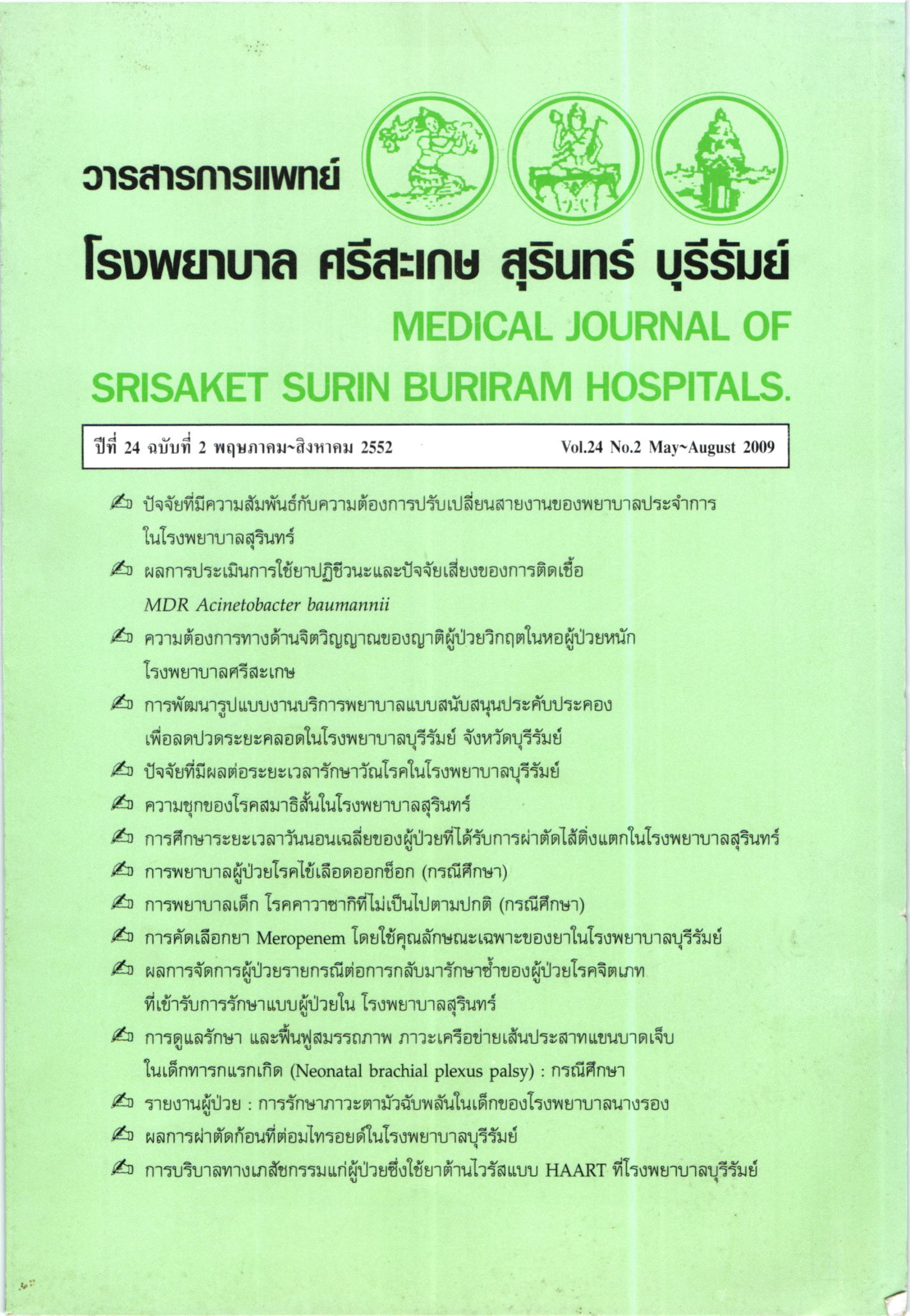
The Pharmaceutical Care of Patients Using HAART (Highly Active Antiretroviral Therapy) at Burirum Hospital
Article Sidebar
Main Article Content
Abstract
Background: HIV and AIDS are important global public health problems. Thai Government had declared a policy to provide medical care to patients with triple combination therapy called highly active antiretroviral therapy (HAART). These therapy decrease viral load and restore patient immune function- However these treatments also cause of adverse drug reaction and drug related problems. This study therefore assesses the outcome of pharmaceutical care in adult patients of Buriram hospital.
Objective: To study drug related problems of HAART regimen in Buriram hospital
Study Design: Descriptive prospective study.
Method: Sample was 406 of HIV/AIDS patients aged between 15-70 years which were treated in Buriram hospital during March 1st 2003 to April 1st 2009.
Results: It was found that 64.04% of patients were continually treated with started HAART regimen. There was 30.05% of patient had to change the regimen according to adverse drug reactions and 0.74% from drug resistance. Average CD4 before treatment (Mean+SD) was 91.00+102.93 and gradually increased by treatment throughout the study. There were 188 patients (46.31%) developed opportunistic infections before treatment, while 12 patients (2.96%) had opportunistic infection after treatment. There was 83.38% of patient had very good adherence at level of 100%-95% and 59.60% of drug related problem found in this study was adverse drug reactions.
Conclusion: Pharmaceutical care in patients received HAART regimen at Burirum hospital presented increasing of average CD4, reduction of opportunistic infections but found adverse drug reactions which should be closely monitored and promote patient adherence to decrease viral load and reduce the antiretroviral drug resistance which benefit for reserving alternative regimens to patient.
Article Details
References
Annual epidemiological surveillance Report 2009. Available at https://epid.moph.go.th
Mocoft A, Vella S, Benfield TL. Ghanging patterns of mortality across Europe in patients infected with HIV-1. Euro SIDA Study Group. Lancet 1998;352:1725-30
Palella FJ Jr, Delaney KM, Moorman AC. Declining morbidity and mortality among patients with advanced HIV infections. HIV Outpatients Study Investigators. N Engl J Med 1998;338:853-60
เฉลิมศรี ภุมมางกูร, ปรีชา มนทกานติกุล. การสื่อสารในการบริบาลทางเภสัชกรรมปฏิบัติ. การให้บริบาลทางเภสัซกรรมอย่างเป็นระบบ. ใน: โอสถกรรมศาสตร์. กรุงเทพฯ : นิวมิตรไทยการพิมพ; 2543. หน้า 21-35
กระทรวงสาธารณลุข.แนวทางการดูแลรักษาผู้ติดเชื้อเอชไอวีและผู้ป่วยโรคเอดสํในประเทฅไทยปี 2549/2550. กรุงเทพ : โรงพิมพ์ชุมนุมสหกรณ์การเกษตรแห่งประเทศไทย; 2550.
World Health Organization. Fact sheet on antiretroviral drugs. Available at https://www.who.int/hiv/mediacenter.
CDC Guidelines. Available at https://www.cdc.gov/hiv/resourses/guidelines.
วรรณสิทธิ์ เธียระวิบูลย์. การศึกษาอุบัติการณ์ของการเปลี่ยนสูตรยาด้านไวรัสเอดส์ สาเหตุของการเปลี่ยนสูตรยาและปัจจัยที่แตกต่างกันระหว่างกลุ่มที่เปลี่ยนและไม่เปลี่ยนสูตร ยาต้านไวรัสของผู้ป่วยติดเชื้อ HIV/AIDS โรงพยาบาลปทุมธานี. วารสารโรงพยาบาลแพร่ 2549 ; ปีที่ 14 ฉบับที่ 1: 40-7.
จิตรา จำละคร. ผลการรักษาและอาการอันไม่พึงประสงค์จากการใช้ยาต้านไวรัสในผู้ป่วยติดเชื้อเอซไอวี โรงพยาบาลแม่เมาะ. วารสารเภสัชกรรมคลินิก 2551; ปีที่ 15 ฉบับที่ 4:369-378.
Smith Collectte J, Sabin Caroline A, Lampe Fiona, et al. The potential for CD4 cell increasing in HIV-positive individuals who control viraemia with highly active antiretroviral therapy. AIDS 2003 ;17(7):963-9.
ปิยะวรรณ กุวลัยรัตน์. การเฝ้าระวังการเกิดอาการไม่พึงประสงค์จากยาต้านไวรัสเอดส์ อย่างเข้มงวด. วารสารเภสัชกรรมคลินิก 2551; ปีที่ 15 ฉบับทึ่ 3:297-306.
Cardiology Unit, Department of Medicine Pathophysiology, university la sapienza, Rome, Italy. Visceral fat as target of highly active antiretroviral therapy-associated metabolic syndrome. Curr Pharm Des. 2007;13(21):2208-13.
