
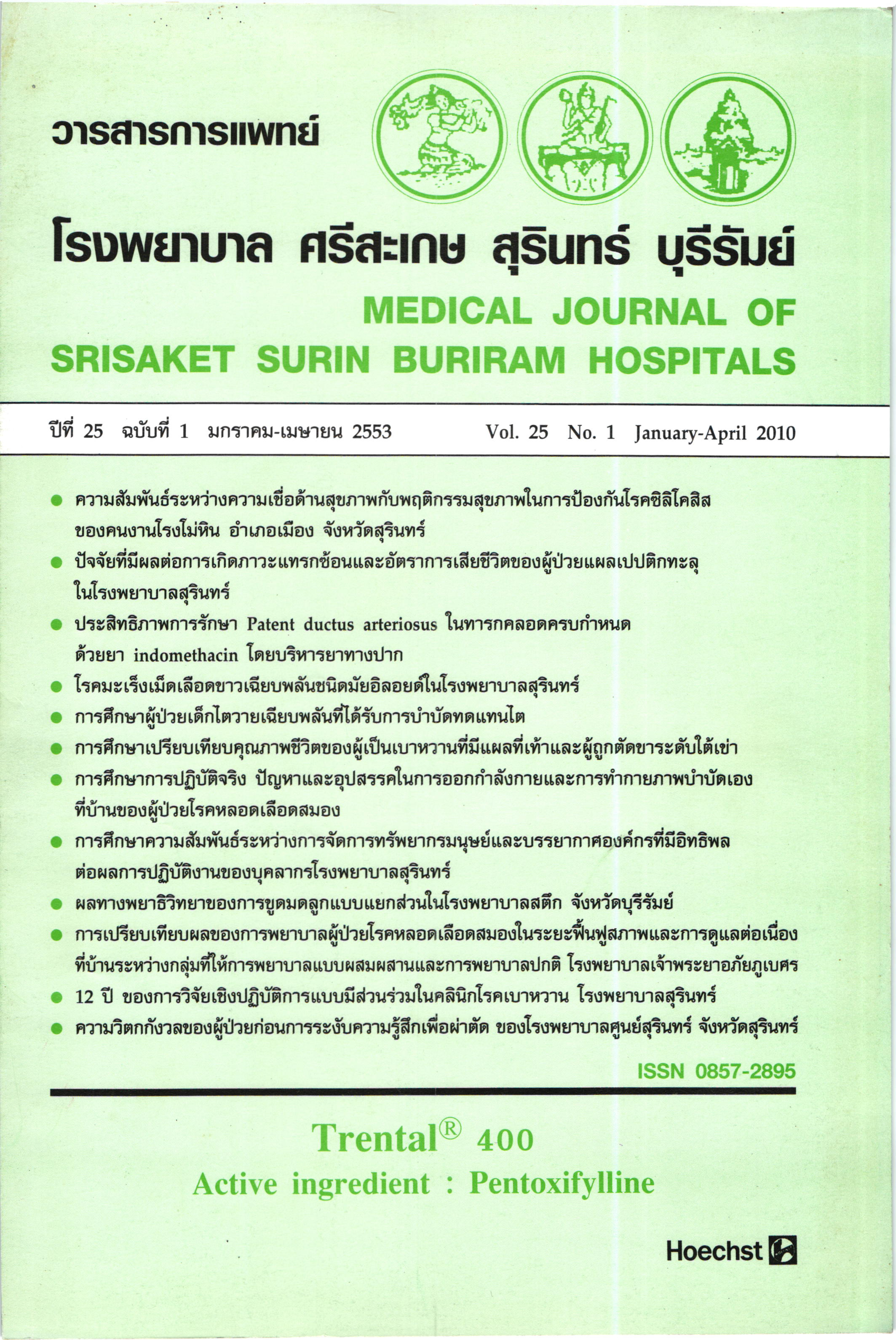
Usefulness of Oral Indomethacin for Patent Ductus Arteriosus in Full-Term Neonates
Article Sidebar
Main Article Content
Abstract
Background: Indomethacin is an effective treatment to close patent ductus arteriosus (PDA) in preterm neonates, and has been used for many years. Management of patent ductus arteriosus (PDA) in full-term neonates remain controversial. Recently, usefulness of indomethacin for patent ductus arteriosus in full-term neonates was reports
Objective: To evaluated the effectiveness of oral indomethacin for patent ductus arteriosus (PDA) in full-term neonates.
Setting: Surin hospital
Study design: Descriptive retrospective study
Method: Review of pediatric patient data admitted during 1st January to 31th December 2009.
Result: The patient were 43 full-term neonates with PDA . All neonates were > 2 days-old and has a gestation age > 37 weeks. Patient with ductus-dependent congenital heart disease, severe pulmonary hypertension (gradient > 40 mmHg), respiratory failure or sepsis were excluded. The echocardiography evaluation was done confirm the diagnosis. The patient received indomethacin suspension (0.2mg/kg/dose. 3 dose 12 hours apart). Of the 43 neonates, 33 (76.7%) showed complete closure, and 10 (23.3%) showed no closure. Statistical analysis revealed no difference between the two groups regarding GA, Birth weight, Apgar score at 1 minute, minimum diameter of the DA before treatment, the average age at the initiation of treatment. There was no significant difference in blood urea nitrogen, creatinine levels or thrombocyte counts in either group before and after treatment with indomethacin (p > 0.05). No serious adverse reaction was observed in all neonates.
Conclusion: This study showed the efficacy medical treatment of oral indomethacin for earlier closure of PDA in full-term neonates.
Keywords: Patent ductus arteriosus, oral indomethacin, Gestational age. Echocardiography, Full-term neonates
Article Details
References
Mitchell SC, Korones SB, Berendes HW. Congenital heart disease in 56109 births. Incidence and natural history. Circulation 1971; 43:323-32.
Fyler DC. Patent ductus arteriosu In : Fyler DC (ed) Nadas’ Pediatric Cardiology. Hanley & Belfus : Philadelphia ; 1992 : 525-34.
Rudolph AM. The ductus arteriosus and persistent patency of the ductus arteriosus. In: Rudolph AM. (ed) Congenital diseases of the heart. 2nd ed. Armonk, Futura, NY ; 2001 : 155-96.
Clymann RI, Chan CY, Mauray F, et al. Permanent anatomic closure of ductus arteriosus in newborn baboons : the roles of postnatal constriction, hypoxia and gestation, Pediatr Res 1999 ; 45 : 19-29.
Slassi I, Ghosh P, Lubliner J. et al. Prospective analysis of one consecutively bom infant. Incidence and clinical lectures for PDA in preterms. Pediatrics 1976; 57:347-51.
Jones RW, Pickering D. Persistent ductus arteriosus complicating the respiratory distress syndrome. Arch Dis Child 1977 ; 52:274-81
Hiraishi S, Horiguchi Y, Misawa H, et al. Noninvasive Doppler echocardiographic evaluation of shunt flow dynamics of the ductus arteriosus. Circulation 1987;75: 1146-53.
Mandoria S. The ductus arteriosus in healthy newborn infants studied by continuous Doppler guided by twodimensional Doppler color echocardiography. G Ital Cardiol 1990; 20: 705-12.
Weiss H, Cooper B, Brook M, Schleuter M Clyman R. Factors determining reopening of the ductus arteriosus after successful clinical closures with indomethacin. J Pediatr 1995; 127: 466-71
Heymann MA, Rudolph AM, Silverman NH. Closure of the ductus arteriosus in premature infants by inhibition of prostaglandin synthesis. N Engl J Med 1976; 295: 530-3.
McCarthy JS, Zies LG, Gelband H. Age-dependent closure of the patent ductus arteriosus by indomethacin. Pediatrics 1978 ; 62:706-12.
McCarthy JS, Zies LG, Gelband H Age-dependent closure of the patent ductus arteriosus by indomethacin. Pediatrics 1978 ; 62:706-712.
Van Bel F, Van de Bor M, stijnen T, Baan J, Ruys JH. Cerebral blood flow velocity changes in preterm infants after a single dose of indomethacin: duration of its effect. Pediatrics 1989; 84: 802-7.
Van Bel F, Guit GL, Schipper J, Van de Bor M, Baan J. Indomethacin-induced changes in renal blood flow velocity waveform in premature infants investigated with color Doppler imaging. J Pediatr 1991; 118: 621-6.
Lai TH, Soong WJ, Hwang B. Indomethacin for the prevention of symptomatic patent ductus arteriosus in very low birth weight infants (Abstract). Zhonghua Min Guo Xiao Er Ke Yi Xue Hui Za Zhi 1990; 31: 17-23.
Van Overmeire B, Van de Broek H, Van Laer P, Weyler J, Vanhaesebrouck P. Early versus late indomethacin treatment for patent ductus arteriosus in premature infants with respiratory syndrome. J Pediatr 2001; 138: 205-11.
Lai TH, Soong WJ, Hwang B. Indomethacin for the prevention of symptomatic patent ductus arteriosus in very low birth weight infants (Abstract). Zhonghua Min Guo Xiao Er Ke Yi Xue Hui Za Zhi 1990; 31: 17-23.
McCarthy JS, Zies LG, Gelband H. Age-dependent closure of the patent ductus arteriosus by indomethacin. Pediatrics 1978; 62:706-12
Watanabe K, Tomita H, Ono Y, et al. Intravenous indomethacin therapy in infants with a patent ductus arteriosus complicating other congenital heart defects. Circ J 2003; 67:750-752
Sheng-Ling Jan et al. Prediction of ductus arteriosus closure by neonatal screening echocardiography. The International Journal of Cardiovascular Imaging 2004; 20: 255-62.
Park MK. Pediatric Cardiology for Practitioners. 4th ed. Mosby elserier ; 2008; 2002:141-44.
Takeshi T, Hitoshi Y, Tadashi K, Hideshi Y, Toshio N, Makoto N. et al. Usefulness of indomethacin for PDA in full-term infants. Pediatr Cardiol 2007; 28: 46-50.
Amooagar H. Ghodsteh M. Pishva N. Oral Ibuprofen and Ductus Arteriosus Closure in Full-Teim Neonates: A Prospective Case-Control Pediatr Cardiol 2010 ; 31: 40-3.
