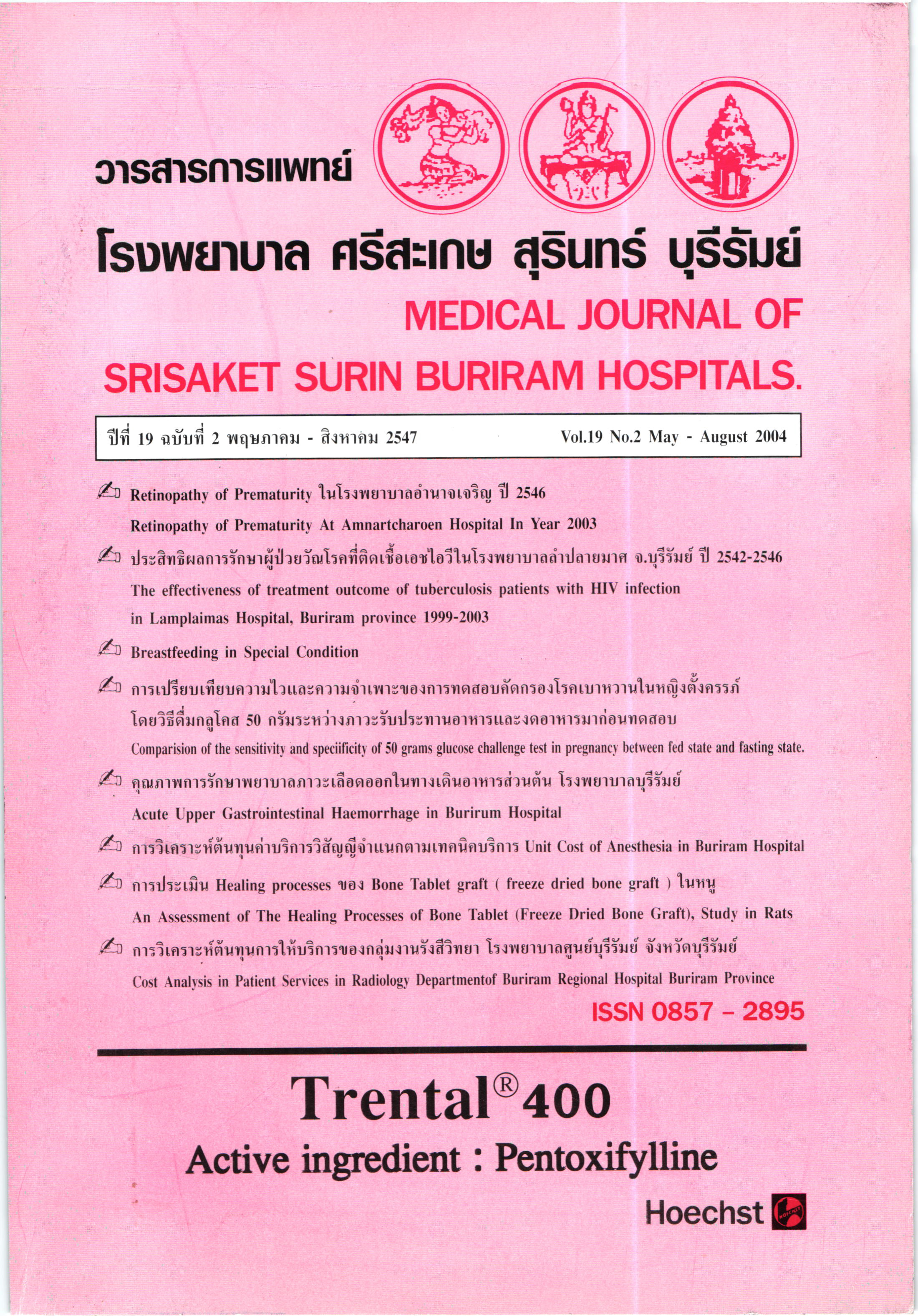
Acute Upper Gastrointestinal Haemorrhage in Burirum Hospital
Article Sidebar
Main Article Content
Abstract
Introduction: Acute upper gastrointestinal haemorrhage is a common emergency condition. Its severity has been vary from spontaneous recovery to death. The factors associated with its severity are aging, male, uremia, hypotension and other comorbidity diseases. The study about mortality rate and these factors would be benefit in effective care.
Objective: To determine the mortality rate and risk factors of acute upper gastrointestinal haemorrhage in Burirum hospital.
Materials and Methods: Descriptive retrospective study from inpatients medical records during October lsl 2002 to September 30lh 2003 were studied by using simple random sampling and descriptive statistics method (mean, 95% CI)
Results: There were totally 547 records, mean aged 57.12 years, 67.5% of them were male. The most diagnosis of patient were Gastrointestinal haemorrhage, non specified 60.7%, Total mortality rate was 13.53%. The mortality rates were increased in rebleeding group (33.33%), inpatient group (24.12%) and operative group (16.67%).
Conclusion: The mortality rate of acute upper gastrointestinal haemorrhage in Burirum hospital were not different from other studies. The factors associated with mortality rate were male, complicated upper gastrointestinal haemorrhage during admission, rebleeding and operation. But in young patients, the mortality rate were high.
Article Details
References
2. Blatchford O, Davidson LA, Murray WR, ed all. Acute upper gastrointestinal haemorrhage in west of Scotland case ascertainment study.
3. Czemichow P, Hochain P, Nousbaum JB.Epidemiology and course of acute gastrointestinal haemorrhage in four French geographical areas. Eur J Gastroenterol Hepatol 2000;12(2):175-81.
4. Rockall TA, Logan RF, Devlin HB. Incidence of and mortality from acute upper gastrointestinal haemorrhage in the United Kingdom. BMJ 1995;311:222-6.
5. โรงพยาบาลบุรีรัมย์ สำนักงานสาธารณสุข จังหวัดบุรีรัมย์. รายงานประจำปี โรงพยาบาลบุรีรัมย์ ปีงบประมาณ 2546: 23-30.
6. Longstreth GF, Feitelberg SP. Successful outpatient management of acute upper gastrointestinal haemorrhage use of practice guidelines in a large patient series. Gastrontest Endosc 1998;47(3):219-22.
7. Supe AN.Soonawala PF, Martor SK. Prognostic markers in upper gastrointestinal haemorrhage. Indian J Gastroenterol 1989;8(4):233-6.
8. Zimmerman J, Siguencia J, Tsvang E, Berri R, Arnon R. Predictors of mortality in patients admited to hospital for acute upper gastrointestinal hemorrhage. Scand J Gastroenterol 1995;30(4):327-31.
9. Silverstein FE, Feld AD, Gilbert DA. Upper gastrointestinal tract bleeding predisposing factors diagnosis and therapy. Arch Intern Med 1981;141(3Spec NO):322-27.
