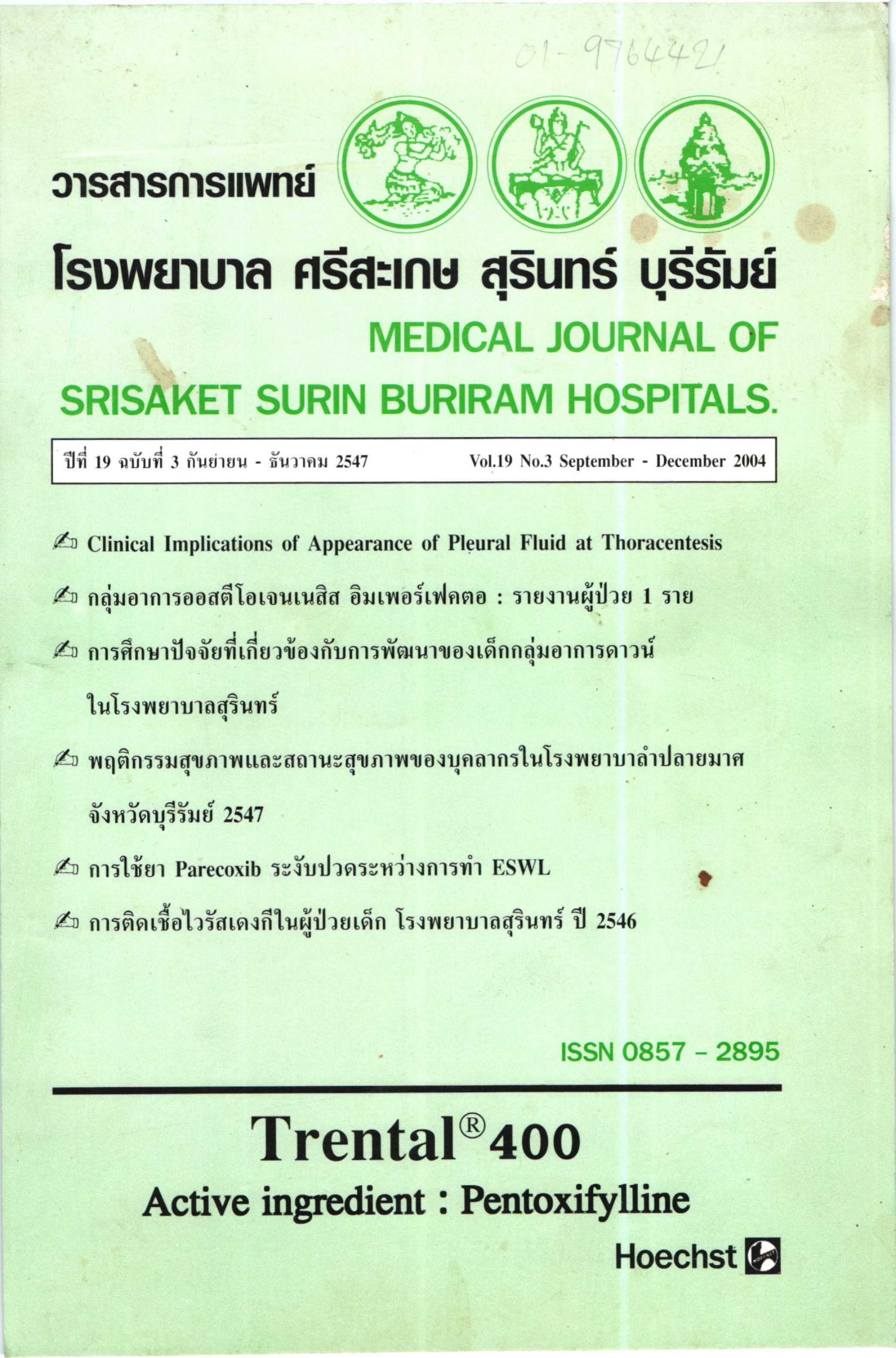
การใช้ยา Parecoxib ระงับปวดระหว่างการทำ ESWL
Article Sidebar
Main Article Content
บทคัดย่อ
การให้ยาระงับความรู้สึกสำหรับการสลายนิ่วด้วยวิธี extracorporeal shock wave litrotripsy (ESWL) ต้องการให้ผู้ป่วยรู้สึกสบาย หลับและไม่ปวด ยา parecoxibs มีประสิทธิภาพในการระงับปวดขณะผ่าตัดและหลังผ่าดัดโดยไม่มีผลข้างเคียง
วิธีการศึกษา: เป็นการศึกษา Double-blind randomizied controlled trail ผู้ป่วยนิ่วในไตที่มารับการรักษาด้วยวิธี ESWL อายุ 15-70 ป ASA I-II หลังได้ยา acetaminophen 100 mg. และ benzodizipine 5 มิลลิกรัม ก่อนทำหัตถการ แบ่งผู้ป่วยเป็น 2 กลุ่มโดยวิธีสุ่ม กลุ่มที่1 ได้รับยาหลอก (placebo) กลุ่มที่2 ได้รับยาฉีด parecoxib 40 มิลลิกรัม บันทึกข้อมูลทั่วไปสัญญาณชีพและคะแนนความเจ็บปวด (Visual Analog Scale) ผลข้างเคียงที่เกิดขึ้นตลอดระยะเวลาทำหัตถการ
สถิติ: ใช้ค่าเฉลี่ย ส่วนเบี่ยงเบนมาตรฐาน 95% CI และ Repeated measure ANOVA
ผลการศึกษา: คะแนนความเจ็บปวด (VAS) กลุ่มที่ 1 (ควบคุม) เฉลี่ย 1.42-4.60 กลุ่มที 2 (ศึกษา) เฉลี่ย 1.60-4.60 ไม่แตกต่างอย่างมีนัยสำคัญทางสถิติ
สรุป: การใช้ยา parecoxibs ฉีดไม่มีประสิทธิภาพในการระงับปวดขณะทำ ESWL
Article Details
เอกสารอ้างอิง
2. Malhotra V, Long CW, Meister MJ. Intercostal blocks with local infiltration anesthesia for extracorporeal lithotripsy. Anesth Analg 1987;66:85-8
3. Madsen KE, Stowe DF, Mc Doniald DD. A comparison of epidural narcotics with and without a test dose to epidural lidocaine for extracorporeal shock wave lithotripsy. Reg Anesth 1990;15:288-94.
4. Cook RJ, Neerhut R, Thomas DG. Does combined epidural lignocaine and fentanyl provide better anaesthesia for ESWL than lignocaine alone? Anaesth Intersive Care 1991;19:357-64
5. Lau WC, Green CR, Foerber GY, Talt AR, Golembiewski JA. Intrathecal sufentanil for ESWL provides earlier discharge of the outpatient than intratecal lidocaine. Anesth Analg 1997; 84:1227-31.
6. Wickham JE. Treatment of urinary tract stones. BMJ 1993; 307(6916):1414-7.
7. Hosking MP, Morris SA, Klein FA. Dobmeyer-Ditrich c. Anesthetic management of patients receiving calculus therapy with a third generation extracorporeal lithotripsy machine. J Endourol 1997;11:309-11.
8. Geszresi Z, SO Rego MM, White PF, The comparative effectiveness of fentanyl and its newer analogs during extracorporeal shock wave lithotripsy under monitored anesthesia care. Anesth Analg 2000;90:567-70.
9. Aybek Z. Turan T, Yonguc T, Bozbay C, Atahan O, Tuncay OL. Requirement of analgesia for extracorporeal shock wave lithotripsy and efficacy of nonsteroidal anti-inflammatory drug: piroxicam. Eur Urol 1998; 34: 207-9.
10. Monk TG, Boure B, White PF, Meretyk S, dayman RV. Comparison of intravenous sedative-analgesic techniques for outpatient immersion lithotripsy. Anesth Analg 1991; 24: 163-8.
11. Ortiz TC, Blanco RL, Vicente DF, Satue GC, Perez M.Extracorporeal shock wave lithotripsy anxiety and pain perception. Acta Uro Esp 2000;24:163-8.
12. Burden J, Edwards JE, McLeay HS, Moore RA. Oral valecoxib and injected parecoxibs for acute postoperative pain a quantitative systematic review. BMC anesthesiology 2003;3:1-8.
13. Reube SS, Connelly NR. Postoperative analgesic effects of celecoxib or rofecoxib after spinal fusion surgery. Aneth Analog 2000;91:1221-5.
14. Thomas V. Martin, R. Ernest Sosa. Shock wave Lithotripsy. In Campbell’s Urology Seventh Edition ; 92:2735-52
15. Extracorpral shock wave lithotripsy; anxiety and pain perception. Acta Urol Esp 2000;24:163-8. Tauzin-Fin P, Delort-Laval S, Krol-Houdek MC, Maurette P, Bannwarth B: Effect if balanced analgesia with buprenorphine on pain response and general anaesthesia requirement during lithotripsy procedures. Eur J Anaesthesiol 1998;15:147-52.
16. Sa Rego Mm, Jnagaki Y, White PF. Remifentanil administration during monitored anesthesia care: Are intermittent boluses an effective alternative to a continuous infusion? Anesth Anenalg 1999;85:518-22.
17. Issa Mm, EL Galley R, NicNamaro DE, Segall S. Analgesia during extracorporal shock wave lithotripsy using the Meds tone STS lithotriptor: a randomized prospective study. Urology 1999;54:625-8.
18. Ozcan S, Yilmaz E , Buyukkocak U, Basar H, Apan A. Comparison of three aralgesics for extracorporeal shock wave lithotripsy. Scand J Urol Nephrol 2002;36:281-5.
