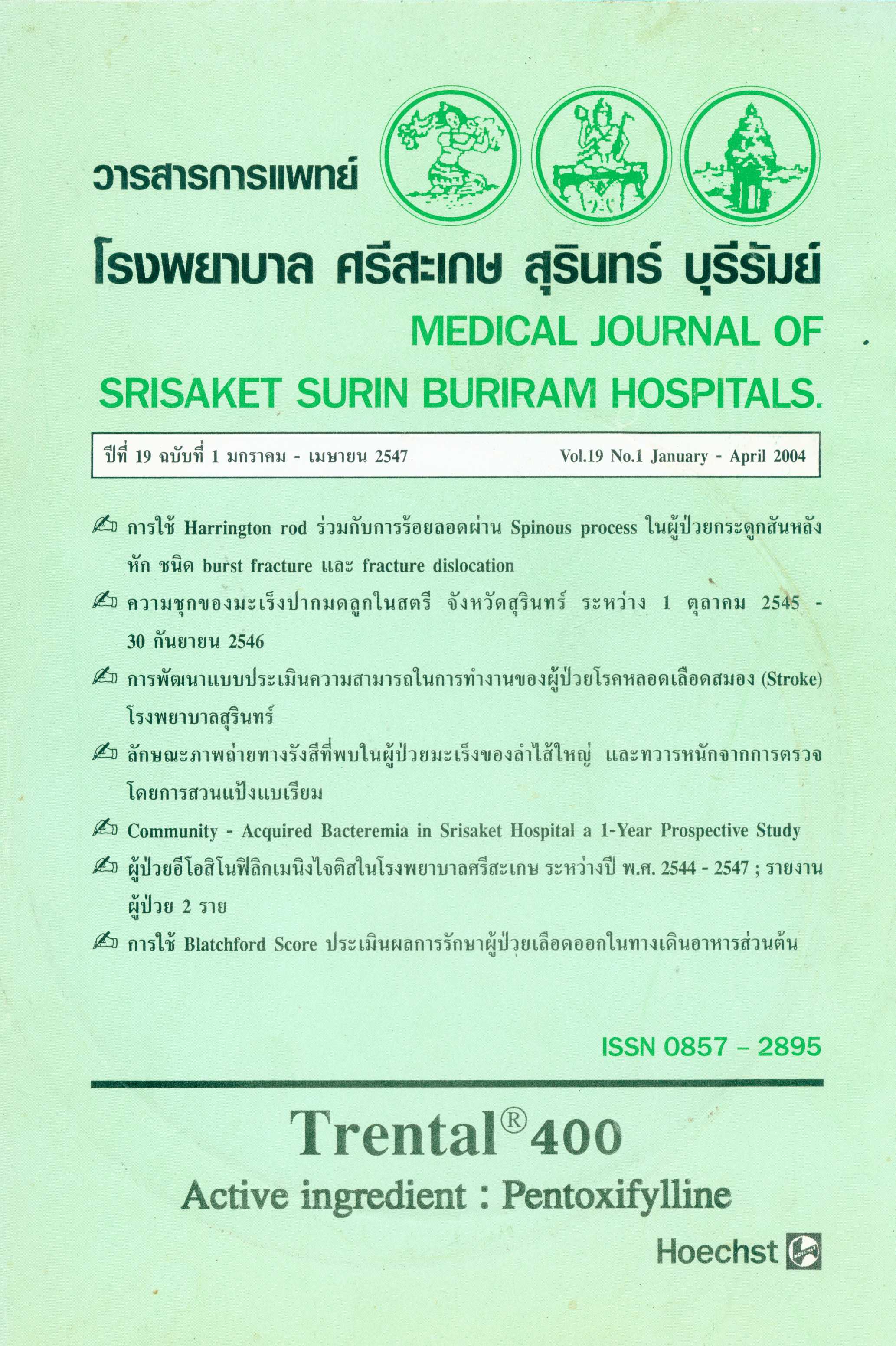
The Development of Functional Assessment Questionnaire for Stroke Patients, Surin Hospital
Article Sidebar
Main Article Content
Abstract
Back ground: According to stroke patients who admitted and underwent the rehabilitation programs in Surin Hospital for a short perion had difficulties in follow up and assessed their progression. This questionnaire therefore developed for assess the functional ability of this patient group.
Objective: To develop the functional assessment questionnaire for stroke patients in Surin Hospital for better reliability.
Study design: This research is prospective descriptive study. The questionnaire which was modified from Barthel Index was designed. It consists of 2 parts, 4 topics about function of paralysed of hemiplegic part and 12 topics about the ability to perform daily- life activity. Each topic was rated into 3 levels. The questionnaire was test to the 30 community-dweller stroke patient samples who underwent the rehabilitation program at department of rehabilitation, Surin Hospital from December 2003 to January 2004. It was assessed 7 times for cach sample; by 1 caregiver,1 physiatrist, 2 physiotherapists and 2 occupational therapists for 210 times totally. Statistic methods used for analyzing the data were percentage for general information, IOC for content validity, Pearson’s relative coefficient for concurrent validity and inter-rater reliability. A p-value less than 01 was considered as significant result.
Result: The questionnaire was assessed and tested by experts for the content accuracy which the homogeneity was 0.62-1.00. The concurrent accuracy had relative coefficient range between 0.70 – 0.78 and the confidence between the assessor group had relative coefficient range from 0.74-0.88
Conclusion: This functional assessment questionnaire for stroke patient was accurated in both content and concurrent validity. The questionnaire also provided explicit scoring, appropriate structure and convenience to use.
Keywords: Stroke, Functional assessment questionnaire
Article Details
References
2. สำนักงานปลัดกระทรวงสาธารณสุข
3. นิพนธ์ พวงวรินทร์. โรคหลอดเลือดสมอง กรุงเทพฯ : โรงพิมพ์เรือนแก้ว, 2534
4. สำนักสถิติแห่งชาติ กระทรวงเทคโนโลยีสารสนเทศและการสื่อสาร
5. Aneshensel CS, Frerichs RR, Clark VA, Yokopenic PA. Telephone versus in-person surveys of community health status. Am J Public Health 1982;72:1017-21
6. Siemiatycki J. A comparison of mail, telephone, and home interview strategies for househole health surveys. Am J Public Health 1979;69:238-45
7. Henson R, Cannell CF, Roth A Effects of interview mode on reporting of moods, symptoms and need for social approval. J Soc Psychol 1978;105:123-9
8. Miller PV. Alternative question forms for attitude scale questions in telephone interviews. Public Opin O 1984;48:766-78
9. De Leeuw ED, Van der Zouwen J Data quality in telephone and face to face surveys : A comparative meta- analysis In: Groves RM, Biemer PP, Lyberg LE, Massey JT, Nicholls WL II, etal, editors. Telephone survey methodology. New York: Wiley,1998.
10. อุทุมพร จามรมาน การสร้างและพัฒนาเครื่องมือวัดลักษณะผู้เรียน. กรุงเทพมหานคร : ฟันนี่พับลิชซิ่ง, 2532.
