
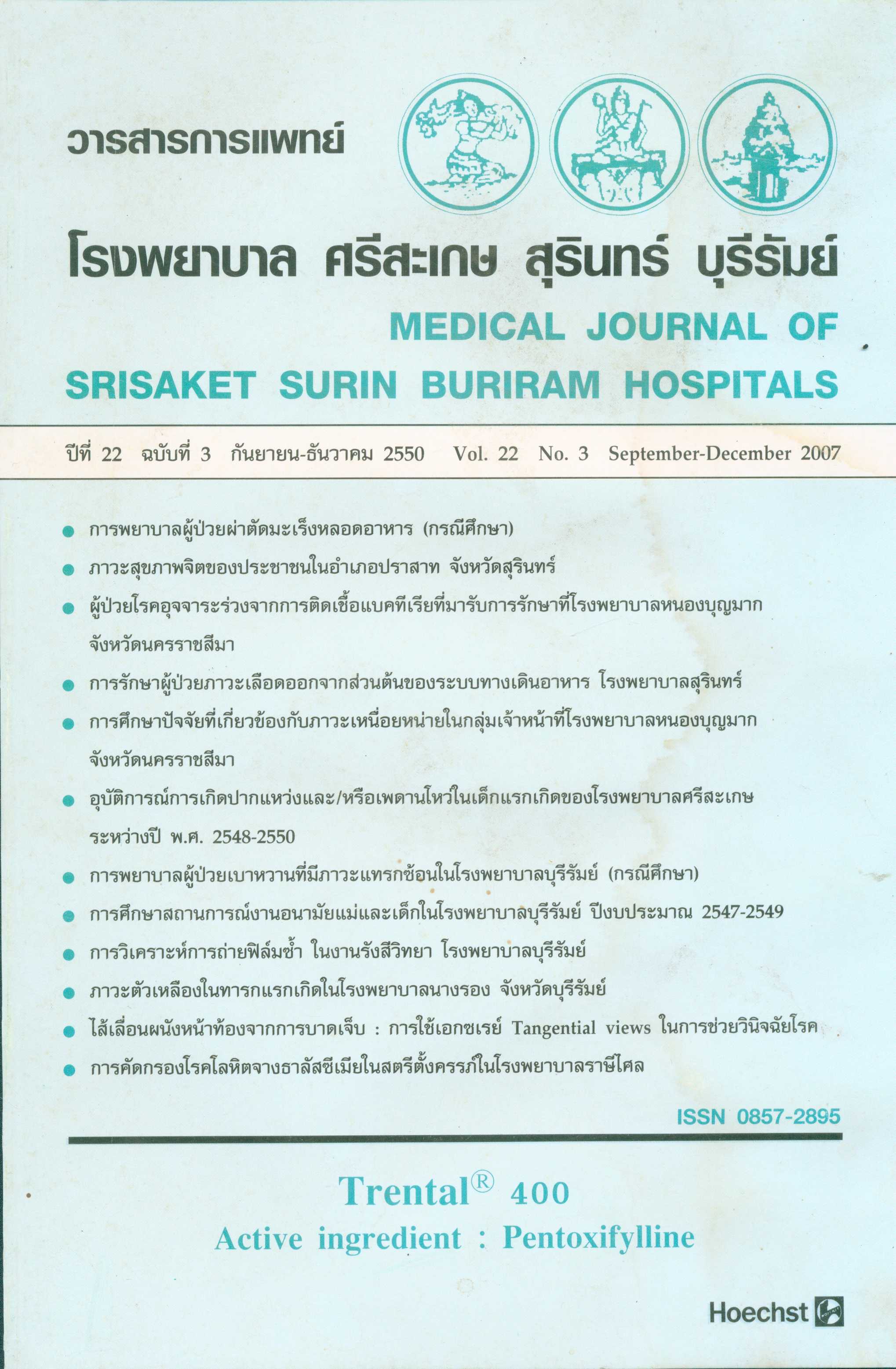
The prevalence of burnout subscales, and factors influencing burnout among health worker at Nongboonmak Hospital, Nakornrachasima.
Article Sidebar
Main Article Content
Abstract
Objective: To study the prevalence of burnout subscales, and to carry out factors influencing burnout among health worker at Nongboonmak Hospital, Nakornrachasima.
Method: A questionnaire was distributed to all health worker who worked in 2007. The self reporting instruments were general demographic survey questionnaires. Maslach burnout inventory and Thai General Heath Qutionnaire-30 (Thai GHQ-30). The Data was analytized by SPSS to study the prevalence of burnout subscales and to carry out factors influencing buenout among health worker in Nongboonmak Hospital.
Result: The response rate was 78.57%. There were 32.58% of health worker in Nongboonmak hospital experienced high emotional exhaustion, 4.55% of heath worker experienced high depersonalization exhaustion and 5.30% of health worker in Nongboonmak Hospital experienced high personal accomplishment.
Conclusion: score of Thai GHQ-30 and working hour associated with the high emotional exhaustion, rate of excerise per week associated with the difference of high emotional exhaustion and depersonalization. All those factors were statistical significant at p < 0.05.
Keyword: Burnout
Article Details
References
2. Wolf GA. Nursing turn over some causes and solutions. Nursing outlook 1981 : 233-6.
3. Maslach C. Burnout: The cost of caring. 1982.
4. Deery S, Iverson R, Walsh J. Work Relationships in Telephone Call Centres: Understanding Emotional Exhaustion and Employee Withdrawal. Journal of Management Studies 2002;39 (4):471-96.
5. Jackson SE, Schwab RL, Schuler RS. Toward an Understanding of the Burnout Phenomenon. Journal of Applied Psychology 1986;71(4):630-40.
6. Lee RT, Ashforth BE. A meta-analytic examination of the correlates of the three dimensions of job burnout. Journal of Applied Psychology 1996; 81(2):123-33.
7. Moore JE. Why is this happening? A causal attribution approach to work exhaustion consequences. Academy of Management Review 2000;25(2):335-49.
8. Wharton AS. The Affective Consequences of Service Work: Managing Emotions on the Job. Work and Occupations 1993; 20(2):205-32.
9. Maslach C. Burnout : the cost of Caring. 1986.
10. Jackson SE, Maslach C. After-effects of job related stress: Families as victims. Journal of Occupational 1982:63-77.
11. Schwab RL. Teacher burnout: Moving beyond psychobabble. Theory Into Practice 1983;22(l):21-7.
12. Maslach C, Schaufeli WB, Leiter M. JOB BURNOUT. Annual Review of Psychology 2001;52:397-422.
