
Predictors of Depressive Symptoms in Patients with Chronic Obstructive Pulmonary Disease: A Cross- Sectional Study
DOI:
https://doi.org/10.33192/smj.v78i8.281935Keywords:
Ability to perform activities of daily living, chronic obstructive pulmonary disease, depressive symptoms, number of acute exacerbations, perceived stress related to COVID-19Abstract
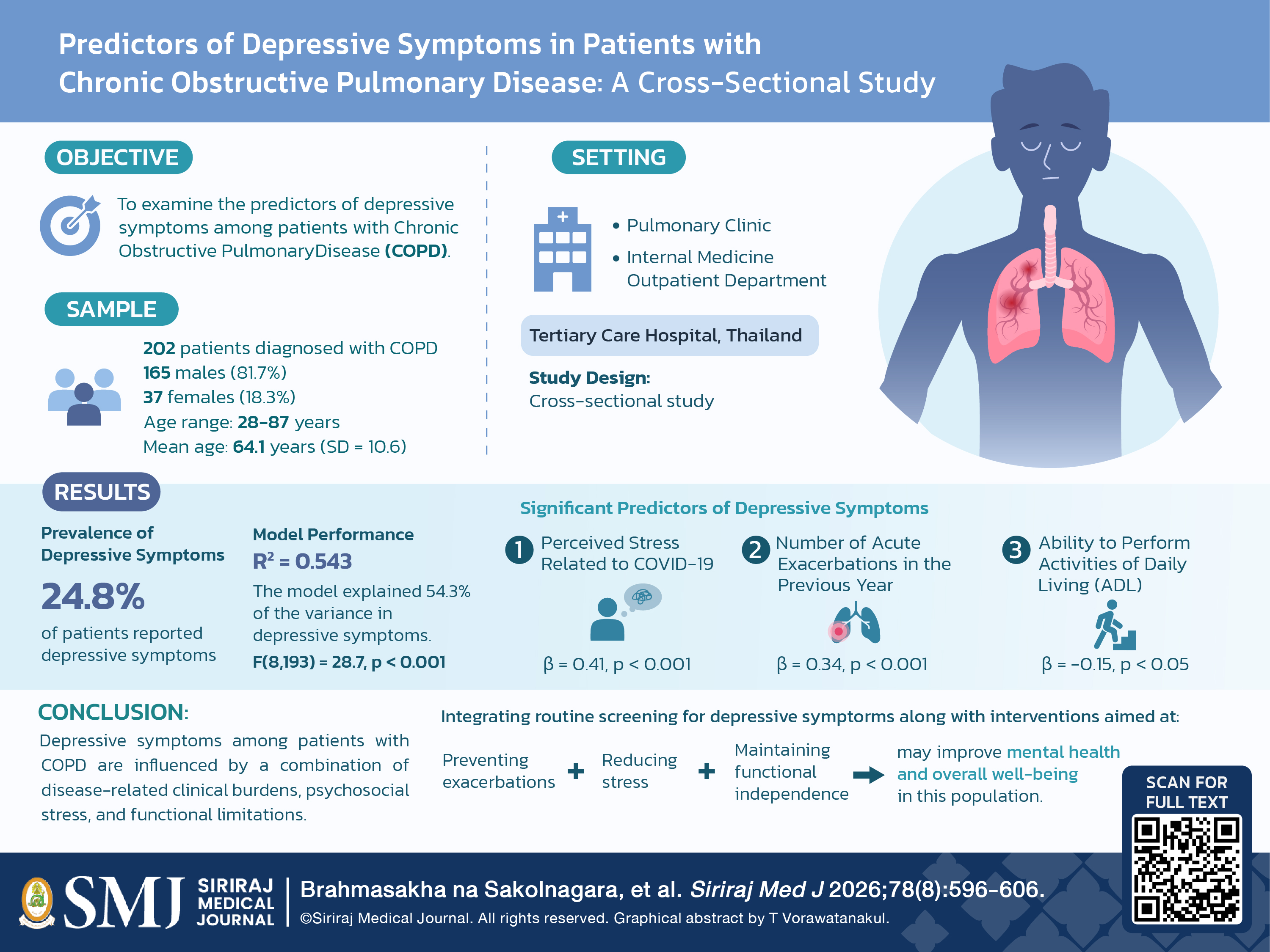
Objective: This study aimed to examine predictors of depressive symptoms among patients with chronic obstructive pulmonary disease (COPD).
Materials and Methods: A cross-sectional study was conducted among 202 patients diagnosed with COPD, with dyspnea severity ranging from stage 0 to 3 according to the modified Medical Research Council Dyspnea Scale. Participants were recruited from the pulmonary clinic and internal medicine outpatient department of a tertiary care hospital in Thailand. The majority of participants were male (81.7%), with ages ranging from 28 to 87 years. Data were collected using demographic and standardized questionnaires assessing depressive symptoms, perceived stress to COVID-19, functional ability in activities of daily living, social support, coping strategies, duration of illness, and severe acute exacerbation. Descriptive statistics and multiple linear regression were used for data analysis.
Results: Overall, 24.8% of participants reported having depressive symptoms. The regression model explained 54.3% of the variance in depressive symptoms (R² = 0.543; F(8,193) = 28.7, p < 0.001). Three variables were identified as significant predictors: perceived stress related to COVID-19 (β = 0.41, p < 0.001), number of acute exacerbations in the previous year (β = 0.34, p < 0.001), and ability to perform activities of daily living (β = −0.15, p < 0.05).
Conclusions: Depressive symptoms among patients with COPD are influenced by a combination of disease-related clinical burdens, psychosocial stress, and functional limitations. Integrating routine screening for depressive symptoms along with interventions aimed at preventing exacerbations, reducing stress, and maintaining functional independence may improve mental health and overall well-being in this population.
References
World Health Organization. Chronic obstructive pulmonary disease (COPD) [Internet]. Geneva: World Health Organization; 2024 [cited 2025 Jun 17]. Available from: https://www.who.int/news-room/fact-sheets/detail/chronic-obstructive-pulmonary-disease-(copd)
Xie H, Jiang Y, Liu L, Peng H, Li J, Chen Z. Global prevalence and risk factors of depression in patients with chronic obstructive pulmonary disease: a systematic review and meta-analysis from 2000 to 2022. J Psychosom Res. 2023;175:111537.
Pieruccini-Faria F, Muir-Hunter SW, Montero-Odasso M. Do depressive symptoms affect balance in older adults with mild cognitive impairment? Results from the “gait and brain study”. Exp Gerontol. 2018;108:106-11.
Husain MO, Chaudhry IB, Blakemore A, Shakoor S, Husain MA, Lane S, et al. Prevalence of depression and anxiety in patients with chronic obstructive pulmonary disease and their association with psychosocial outcomes: a cross-sectional study from Pakistan. SAGE Open Med. 2021;9:1-10.
Miravitlles M, Molina J, Quintano JA, Campuzano A, Pérez J, Roncero C. Factors associated with depression and severe depression in patients with COPD. Respir Med. 2014;108:1615-25.
Yohannes AM, Müllerová H, Lavoie K, Vestbo J, Rennard SI, Wouters E. The association of depressive symptoms with rates of acute exacerbations in patients with COPD: results from a 3-year longitudinal follow-up of the ECLIPSE cohort. J Am Med Dir Assoc. 2017;18(11):955-59.
Hometowska H, Klekowski J, Swiatoniowska-Lonc N, Jankowska-Polanska B, Chabowski M. Fatigue, depression, and anxiety in patients with COPD, asthma and asthma-COPD overlap. J Clin Med. 2022;11:7466.
Gretler C. Smoking helps open gateway to coronavirus infection, study shows [Internet]. New York: Bloomberg; 2020 [cited 2021 May 22]. Available from: https://www.bloomberg.com/news/articles/2020-04-08/smoking-helps-open-gateway-to-coronavirus-infection-study-shows
Leung JM, Yang CX, Tam A, Shaipanich T, Hackett TL, Singhera GK, et al. ACE-2 expression in the small airway epithelia of smokers and COPD patients: implications for COVID-19. Eur Respir J. 2020;55(5):2000688.
Department of Medical Services, Ministry of Public Health. Global statistics summary and situation report on COVID-19 worldwide [Internet]. Bangkok: Ministry of Public Health; 2022 [cited 2023 Apr 11]. Available from: https://covid19.anamai.moph.go.th/en/
Malai C, Chaiyoyingyong R, Dangdomyouth P, Cheaplamp S. Factors related to depression among older adults in community, Ratchaburi Province. Songklanagarind J Nurs. 2019;39(3):67-76.
Cohen S, Tyrrell DA, Smith AP. Negative life events, perceived stress, negative affect, and susceptibility to the common cold. J Pers Soc Psychol. 1993;64(1):131-40.
Leidy NK. Functional status and the forward progress of merry-go-rounds: toward a coherent analytical framework. Nurs Res. 1994;43(4):196-202.
Yao HM, Xiao RS, Cao PL, Wang XL, Zuo W, Zhang W. Risk factors for depression in patients with chronic obstructive pulmonary disease. World J Psychiatry. 2020;10(4):59-70.
Tripathi S. A mental health intervention utilizing the “Positive Volunteer Force” during the COVID-19 pandemic [Internet]. 2021 [cited 2022 Apr 10]. Available from: https://www.m-culture.go.th/chiangrai/download/article/article_200616093628.pdf
Cohen S, Tyrrell DA, Smith AP. Negative life events, perceived stress, negative affect, and susceptibility to the common cold. J Pers Soc Psychol. 1993;64(1):131-40.
Witeethamsaks P, Duangpaeng S, Masingboon K. Relationship between symptom clusters and functional performance among patients with chronic obstructive pulmonary disease. Thai Nurs Counc J. 2010;25(4):96-108.
Zimet GD, Dahlem NW, Zimet SG, Farley GK. The multidimensional scale of perceived social support. J Pers Assess. 1988;52(1):30-41.
Wongpakaran T, Wongpakaran N. A comparison of reliability and construct validity between the original and the revised version of the Rosenberg Self-Esteem Scale. Psychiatry Investig. 2012;9(1):54-8.
Carver CS, Scheier MF, Weintraub JK. Assessing coping strategies: a theoretically based approach. J Pers Soc Psychol. 1989;56(2):267-83.
Numsang T, Tantrarungroj T. Validity and reliability of the Brief COPE Inventory: Thai version. J Psychiatr Assoc Thailand [Internet]. 2018 [cited 2025 Apr 11];63(2):189-98. Available from: https://he01.tci-thaijo.org/index.php/JPAT/article/view/131529
Huang L, Lei W, Xu F, Liu H, Yu L. Emotional responses and coping strategies in nurses and nursing students during COVID-19 outbreak: a comparative study. PLoS One. 2020;15(8):e0237303.
Quiroga-Garza A, Cepeda-Lopez AC, Zambrano SV, Villalobos-Daniel VE, Carreno DF, Eisenbeck N. How having a clear why can help us cope with almost anything: meaningful well-being and the COVID-19 pandemic in México. Front Psychol. 2021;12:648069.
Kroenke K, Spitzer RL, Williams JB. The PHQ-9: validity of a brief depression severity measure. J Gen Intern Med. 2001;16(9):606-13.
Lotrakul M, Sukanich P. Self-administered questionnaire for assessing the severity of depressive symptoms. J Psychiatr Assoc Thailand. 1999;20(1):17-19.
Zareifopoulos N, Panayiotakopoulos G. Treatment options for acute agitation in psychiatric patients: theoretical and empirical evidence. Cureus. 2019;11(11):e6152.
Underner M, Cuvelier A, Peiffer G, Perriot J, Jaafari N. The influence of anxiety and depression on COPD exacerbations. Rev Mal Respir. 2018;35(6):604-25.
Noonil N, Petsirasan R, Aekwarangkoon S. Health-related quality of life and related factors in Thais with stable COPD. Walailak J Sci Technol. 2019;16(12):955-64.
Anupansupsai R, Saisavoey N, Supavekin S, Ratta-apha W, Lortrakul J, Hataiyusuk S. Factors affecting the mental health of Thai medical staff during the second and third waves of the COVID-19 pandemic: an online cross-sectional survey. Siriraj Med J. 2024;76(5):293-303.
Iyer AS, Parekh TM, O’Toole J, Bhatt SP, Eakin MN, Krishnan JA, et al. Clinically significant and comorbid anxiety and depressive symptoms predict severe respiratory exacerbations in smokers: a post-hoc analysis of the COPDGene and SPIROMICS cohorts. Ann Am Thorac Soc. 2022;19(1):143-6.
Hayen A, Herigstad M, Pattinson KT. Understanding dyspnea as a complex individual experience. Maturitas. 2013;76(1):45-50.
Ouellette DR, Lavoie KL. Recognition, diagnosis, and treatment of cognitive and psychiatric disorders in patients with COPD. Int J Chron Obstruct Pulmon Dis. 2017;12:639-50.
Chanta D, Piyawatthanaphong S, Bunnaraks S. Psychosocial health profile of elderly patients with chronic obstructive pulmonary disease attending the asthma and COPD clinic at Srinagarind Hospital. In: Proceedings of the 20th Graduate Research Conference; 2019 Mar 15; Khon Kaen, Thailand.
Ofir D, Laveneziana P, Webb KA, Lam YM, O’Donnell DE. Mechanisms of dyspnea during cycle exercise in symptomatic patients with GOLD stage I chronic obstructive pulmonary disease. Am J Respir Crit Care Med. 2008;177(6):622-9.
Published
How to Cite
License
Copyright (c) 2026 Siriraj Medical Journal

This work is licensed under a Creative Commons Attribution-NonCommercial-NoDerivatives 4.0 International License.
Authors who publish with this journal agree to the following conditions:
Copyright Transfer
In submitting a manuscript, the authors acknowledge that the work will become the copyrighted property of Siriraj Medical Journal upon publication.
License
Articles are licensed under a Creative Commons Attribution-NonCommercial-NoDerivatives 4.0 International License (CC BY-NC-ND 4.0). This license allows for the sharing of the work for non-commercial purposes with proper attribution to the authors and the journal. However, it does not permit modifications or the creation of derivative works.
Sharing and Access
Authors are encouraged to share their article on their personal or institutional websites and through other non-commercial platforms. Doing so can increase readership and citations.