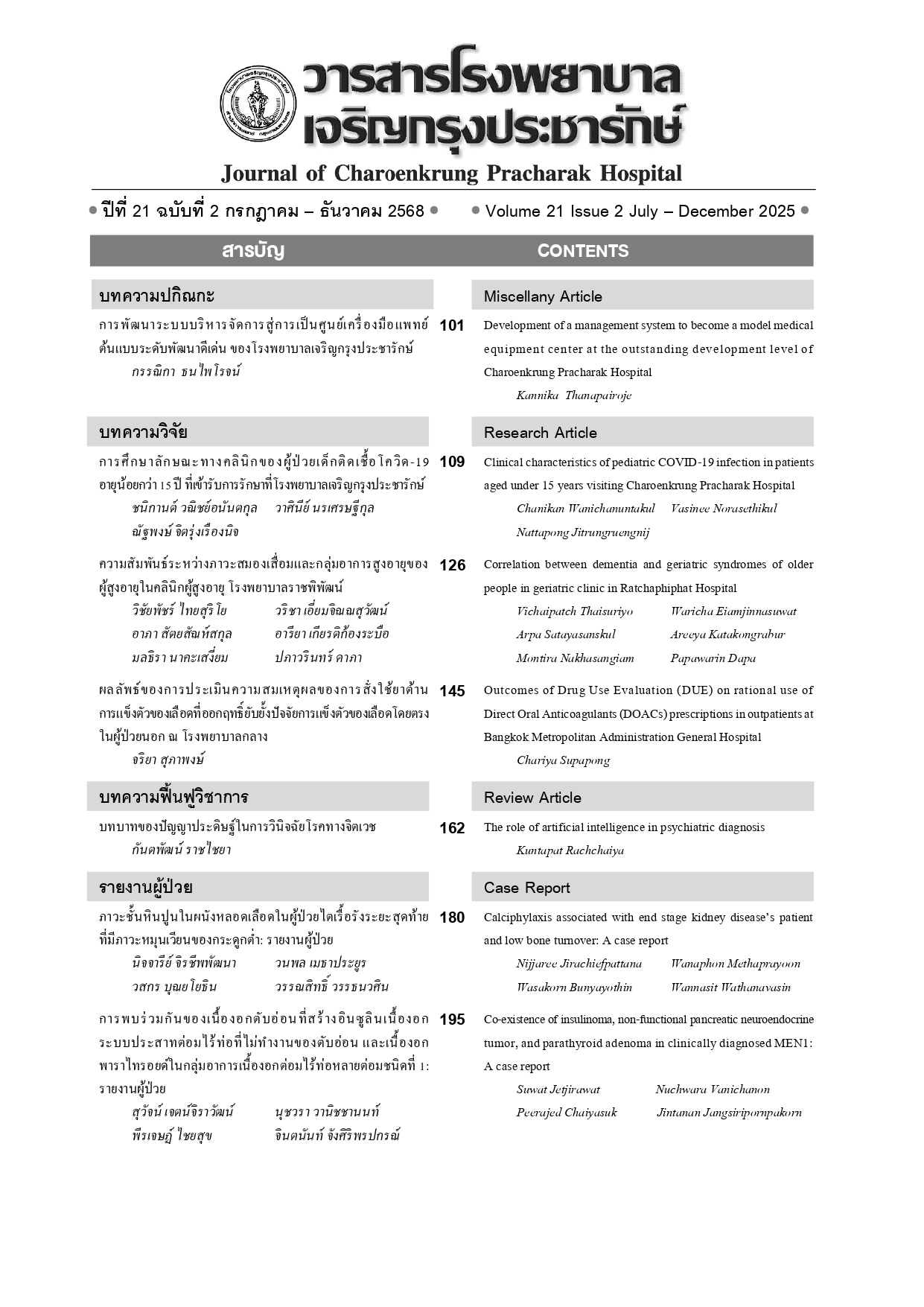
การพบร่วมกันของเนื้องอกตับอ่อนที่สร้างอินซูลินเนื้องอกระบบประสาทต่อมไร้ท่อที่ไม่ทำงานของตับอ่อน และเนื้องอกพาราไทรอยด์ในกลุ่มอาการเนื้องอกต่อมไร้ท่อหลายต่อมชนิดที่ 1: รายงานผู้ป่วย
Article Sidebar
Main Article Content
บทคัดย่อ
เนื้องอกของตับอ่อนอินซูลิโนมาเป็นเนื้องอกระบบประสาทต่อมไร้ท่อบริเวณตับอ่อนที่หลั่งฮอร์โมนอินซูลินมีอุบัติการณ์ประมาณ 1 ถึง 32 รายต่อประชากรหนึ่งล้านคนต่อปี ผู้ป่วยมักมีอาการแสดงจากภาวะน้ำตาลในเลือดต่ำ ซึ่งสามารถมีอาการทางระบบประสาทหรืออาการทางระบบประสาทอัตโนมัติ โดยอาการจะดีขึ้นหลังจากได้รับประทานอาหาร และจะมีอาการในช่วงอดอาหาร การตรวจทางห้องปฏิบัติการเบื้องต้นพบมีภาวะน้ำตาลต่ำร่วมกับค่าอินซูลินและ c-peptide ที่สูง
รายงานฉบับนี้นำเสนอผู้ป่วยชายอายุ 67 ปี มาด้วยพฤติกรรมเปลี่ยนแปลงและระดับความรู้สึกตัวลดลง การตรวจทางห้องปฏิบัติการพบภาวะน้ำตาลและฟอสเฟตในเลือดต่ำ แคลเซียมในเลือดสูง การสแกนพาราไทรอยด์พบก้อนเนื้องอกที่หลั่งฮอร์โมนผิดปกติ ผลตรวจ Magnetic Resonance Imaging (MRI) และ Computed Tomography (CT) ช่องท้องส่วนบนพบเนื้องอกระบบประสาทต่อมไร้ท่อที่ตับอ่อนจำนวนสองก้อน ได้แก่ เนื้องอกที่บริเวณส่วนปลายของตับอ่อนชนิดที่สร้างอินซูลินและบริเวณส่วนต้นของตับอ่อนชนิดไม่สร้างฮอร์โมน ซึ่งเข้าได้กับกลุ่มอาการเนื้องอกต่อมไร้ท่อหลายต่อมชนิดที่ 1 ผู้ป่วยได้รับการผ่าตัดด้วยวิธีการตัดตับอ่อนส่วนปลาย และการผ่าตัดตับอ่อนส่วนต้นกับลำไส้เล็กส่วนต้นออก ภายหลังการผ่าตัดผู้ป่วยมีภาวะรั่วของตับอ่อนซึ่งได้รับการรักษาแบบประคับประคอง และรายงานฉบับนี้ได้อภิปรายเกี่ยวกับขั้นตอนการวินิจฉัย การผ่าตัด การดูแลและติดตามหลังผ่าตัด และทบทวนวรรณกรรมเกี่ยวกับการเกิดร่วมกันของอินซูลิโนมาและเนื้องอกระบบประสาทต่อมไร้ท่อที่ไม่ทำงานของตับอ่อน
Article Details

อนุญาตภายใต้เงื่อนไข Creative Commons Attribution-NonCommercial-NoDerivatives 4.0 International License.
เอกสารอ้างอิง
Nashidengo PR, Quayson FW, Abebrese JT, Negumbo L, Enssle C, Kidaaga F. Varied presentations of pancreatic insulinoma: a case report. Pan Afr Med J 2022;42:69.
Ro C, Chai W, Yu VE, Yu R. Pancreatic neuroendocrine tumors: biology, diagnosis, and treatment. Chin J Cancer 2013;32(6):312-24.
Singh S, Granberg D, Wolin E, Warner R, Sissons M, Kolarova T, et al. Patient-reported burden of a neuroendocrine tumor (NET) diagnosis: results from the first global survey of patients with NETs. J Glob Oncol 2016;3(1):43-53.
Zhuo F, Menon G, Anastasopoulou C. Insulinoma [Internet]. Treasure Island (FL): StatPearls Publishing; 2025 [cited 2025 Feb 10]. Available from: https://www.ncbi.nlm.nih.gov/books/NBK544299/
Lodish MB, Powell AC, Abu-Asab M, Cochran C, Lenz P, Libutti SK, et al. Insulinoma and gastrinoma syndromes from a single intrapancreatic neuroendocrine tumor. J Clin Endocrinol Metab 2008;93(4):1123-8.
Ozbas B, Karaca Z, Okcesiz I, Karahan I, Topaloglu N, Abdulrezzak U, et al. Co-existence of two different types of pancreatic neuroendocrine tumors in a patient with multiple endocrine neoplasia type-1. J Clin Transl Endocrinol Case Rep 2021;21:100088.
Unlu MT, Aygun N, Akgun IE, Yetkin SG, Erol RS, Isgor A, et al. Parathyroidectomy results in primary hyperparathyroidism: analysis of the results from a single center. Sisli Etfal Hastan Tip Bul 2021;55(2):173-8.
Wolfe SA, Sharma S. Parathyroid adenoma [Internet]. Treasure Island (FL): StatPearls Publishing; 2023 [cited 2025 Jan 30]. Available from: https://www.ncbi.nlm.nih.gov/books/NBK507870/
Brandi ML, Pieterman CRC, English KA, Lines KE, Shariq OA, Marini F, et al. Multiple endocrine neoplasia type 1 (MEN1): recommendations and guidelines for best practice. Lancet Diabetes Endocrinol 2025;13(8):699-721.
Cavalcanti MS, Gonen M, Klimstra DS. The ENETS/WHO grading system for neuroendocrine neoplasms of the gastroenteropancreatic system: a review of the current state, limitations and proposals for modifications. Int J Endocr Oncol 2016;3(3):203-19.
Kim J, Hong SS, Kim SH, Hwang HK, Kang CM. Optimal surgical management of unifocal vs. multifocal NF-PNETs: a respective cohort study. World J Surg Oncol 2024;22(1):115.
Roberts KJ, Schrem H, Hodson J, Angelico R, Dasari BVM, Coldham CA, et al. Pancreas exocrine replacement therapy is associated with increased survival following pancreatoduodenectomy for periampullary malignancy. HPB (Oxford) 2017;19(10):859-67.
Newey PJ, Newell-Price J. MEN1 surveillance guidelines: time to (re) think?. J Endocr Soc 2022;6(2):bvac001.
PDQ Cancer Genetics Editorial Board. Genetics of Endocrine and Neuroendocrine Neoplasias. In: National Cancer Institute (US). PDQ Cancer Information Summaries [Internet]. 2017 [cited 2025 Aug 9]. Available from: https://www.ncbi.nlm.nih.gov/books/NBK65830/
