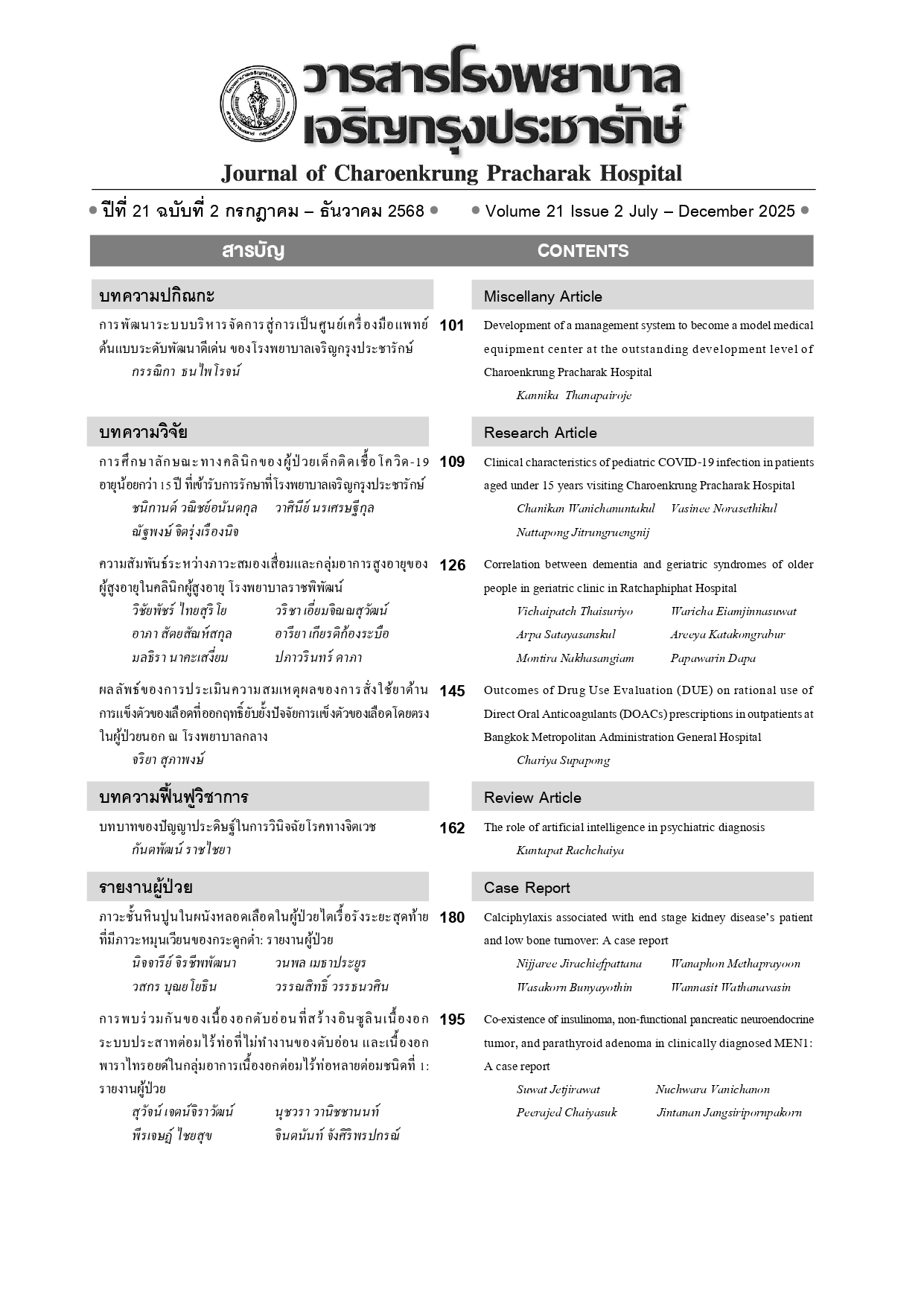
Co-existence of insulinoma, non-functional pancreatic neuroendocrine tumor, and parathyroid adenoma in clinically diagnosed MEN1: A case report
Article Sidebar
Main Article Content
Abstract
Insulinoma is a rare functioning neuroendocrine tumor that typically presents with neuroglycopenic or autonomic symptoms due to hypoglycemia. These tumors are uncommon, with an incidence ranging from approximately 1 to 32 million cases per year, and are the most common cause of hyperinsulinemic hypoglycemia in adults. Symptoms usually resolve after glucose administration or postprandial, with typical manifestations occurring during fasting due to excessive insulin secretion. Laboratory evaluations typically reveal elevated insulin and C-peptide levels.
We report a case of a 67-year-old male who presented with behavioral changes and altered consciousness. Initial laboratory investigations revealed hypoglycemia, hypophosphatemia, and hypercalcemia. A parathyroid scan identified a hyperfunctioning parathyroid adenoma. MRI and CT imaging of the upper abdomen revealed Pancreatic Neuroendocrine Tumors (PNETs) in both the distal pancreas (insulinoma) and the pancreatic head (non-functional NET). With two major endocrine tumors, the patient can be clinically diagnosed with MEN1. The patient underwent surgical resection, including distal pancreatectomy and pancreaticoduodenectomy. Postoperatively, the patient developed feeding intolerance and a pancreatic fistula, both of which were managed conservatively. We discuss the diagnostic workup, surgical management, postoperative management, surveillance and review the current literature on the co-existence of insulinomas and non-functional pancreatic neuroendocrine tumors.
Article Details

This work is licensed under a Creative Commons Attribution-NonCommercial-NoDerivatives 4.0 International License.
References
Nashidengo PR, Quayson FW, Abebrese JT, Negumbo L, Enssle C, Kidaaga F. Varied presentations of pancreatic insulinoma: a case report. Pan Afr Med J 2022;42:69.
Ro C, Chai W, Yu VE, Yu R. Pancreatic neuroendocrine tumors: biology, diagnosis, and treatment. Chin J Cancer 2013;32(6):312-24.
Singh S, Granberg D, Wolin E, Warner R, Sissons M, Kolarova T, et al. Patient-reported burden of a neuroendocrine tumor (NET) diagnosis: results from the first global survey of patients with NETs. J Glob Oncol 2016;3(1):43-53.
Zhuo F, Menon G, Anastasopoulou C. Insulinoma [Internet]. Treasure Island (FL): StatPearls Publishing; 2025 [cited 2025 Feb 10]. Available from: https://www.ncbi.nlm.nih.gov/books/NBK544299/
Lodish MB, Powell AC, Abu-Asab M, Cochran C, Lenz P, Libutti SK, et al. Insulinoma and gastrinoma syndromes from a single intrapancreatic neuroendocrine tumor. J Clin Endocrinol Metab 2008;93(4):1123-8.
Ozbas B, Karaca Z, Okcesiz I, Karahan I, Topaloglu N, Abdulrezzak U, et al. Co-existence of two different types of pancreatic neuroendocrine tumors in a patient with multiple endocrine neoplasia type-1. J Clin Transl Endocrinol Case Rep 2021;21:100088.
Unlu MT, Aygun N, Akgun IE, Yetkin SG, Erol RS, Isgor A, et al. Parathyroidectomy results in primary hyperparathyroidism: analysis of the results from a single center. Sisli Etfal Hastan Tip Bul 2021;55(2):173-8.
Wolfe SA, Sharma S. Parathyroid adenoma [Internet]. Treasure Island (FL): StatPearls Publishing; 2023 [cited 2025 Jan 30]. Available from: https://www.ncbi.nlm.nih.gov/books/NBK507870/
Brandi ML, Pieterman CRC, English KA, Lines KE, Shariq OA, Marini F, et al. Multiple endocrine neoplasia type 1 (MEN1): recommendations and guidelines for best practice. Lancet Diabetes Endocrinol 2025;13(8):699-721.
Cavalcanti MS, Gonen M, Klimstra DS. The ENETS/WHO grading system for neuroendocrine neoplasms of the gastroenteropancreatic system: a review of the current state, limitations and proposals for modifications. Int J Endocr Oncol 2016;3(3):203-19.
Kim J, Hong SS, Kim SH, Hwang HK, Kang CM. Optimal surgical management of unifocal vs. multifocal NF-PNETs: a respective cohort study. World J Surg Oncol 2024;22(1):115.
Roberts KJ, Schrem H, Hodson J, Angelico R, Dasari BVM, Coldham CA, et al. Pancreas exocrine replacement therapy is associated with increased survival following pancreatoduodenectomy for periampullary malignancy. HPB (Oxford) 2017;19(10):859-67.
Newey PJ, Newell-Price J. MEN1 surveillance guidelines: time to (re) think?. J Endocr Soc 2022;6(2):bvac001.
PDQ Cancer Genetics Editorial Board. Genetics of Endocrine and Neuroendocrine Neoplasias. In: National Cancer Institute (US). PDQ Cancer Information Summaries [Internet]. 2017 [cited 2025 Aug 9]. Available from: https://www.ncbi.nlm.nih.gov/books/NBK65830/
