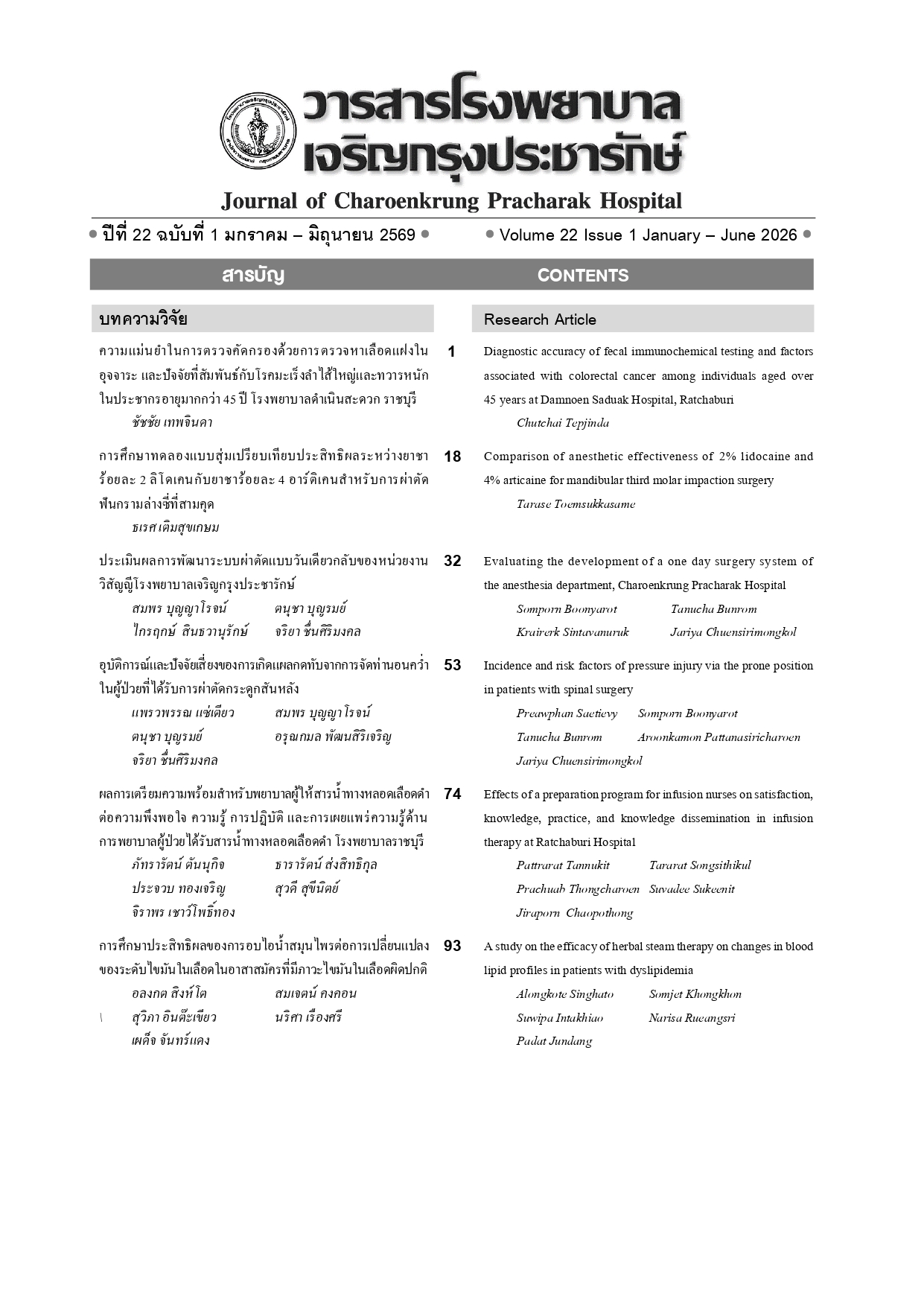
อุบัติการณ์และปัจจัยเสี่ยงของการเกิดแผลกดทับจากการจัดท่านอนคว่ำในผู้ป่วยที่ได้รับการผ่าตัดกระดูกสันหลัง
Article Sidebar
Main Article Content
บทคัดย่อ
วัตถุประสงค์: เพื่อศึกษาอุบัติการณ์และปัจจัยเสี่ยงของการเกิดแผลกดทับจากการจัดท่านอนคว่ำในผู้ป่วยที่เข้ารับการผ่าตัดกระดูกสันหลัง
วิธีดำเนินการวิจัย: การวิจัยนี้เป็นการศึกษาเชิงสังเกตแบบภาคตัดขวาง (observational cross-sectional study) ดำเนินการในผู้ป่วยที่เข้ารับการผ่าตัดกระดูกสันหลังในท่านอนคว่ำ ณ โรงพยาบาลเจริญกรุงประชารักษ์ ระหว่างเดือนมิถุนายน 2567 ถึงเดือนมีนาคม 2568 โดยคัดเลือกกลุ่มตัวอย่างแบบเฉพาะเจาะจง (purposive sampling) จำนวน 111 ราย เครื่องมือที่ใช้ในการวิจัยประกอบด้วย แบบบันทึกข้อมูลส่วนบุคคล ปัจจัยก่อนผ่าตัด ปัจจัยระหว่างผ่าตัด และแบบประเมินแผลกดทับตามเกณฑ์ของ National Pressure Injury Advisory Panel (NPIAP) ซึ่งผ่านการตรวจสอบความตรงตามเนื้อหาโดยผู้ทรงคุณวุฒิ 3 ท่าน มีค่าดัชนีความตรงตามเนื้อหา (Index of item Objective Congruence; IOC) เท่ากับ 1.00 และมีค่าความเชื่อมั่นของการสังเกตและความสอดคล้องระหว่างผู้ประเมินอยู่ในเกณฑ์ดี การประเมินผิวหนังดำเนินการก่อนจัดท่านอนคว่ำ หลังผ่าตัด 30 นาที และติดตามที่ 24 และ 48 ชั่วโมงหลังผ่าตัดในรายที่พบแผลกดทับ วิเคราะห์ข้อมูลโดยใช้สถิติเชิงพรรณนา และการวิเคราะห์ถดถอยโลจิสติกพหุตัวแปร
ผลการวิจัย: ผู้ป่วยหลังผ่าตัดมีอุบัติการณ์การเกิดแผลกดทับภายหลังผ่านไป 30 นาที ร้อยละ 5.4 โดยแผลกดทับทั้งหมดอยู่ในระดับที่ 1 พบมากที่สุดบริเวณใบหน้า รองลงมา บริเวณหน้าอก ผลการวิเคราะห์แบบตัวแปรเดี่ยวพบว่า การสูญเสียเลือดระหว่างการผ่าตัดมากกว่า 500 มิลลิลิตร มีความสัมพันธ์กับการเกิดแผลกดทับอย่างมีนัยสำคัญทางสถิติที่ระดับ 0.05 อย่างไรก็ตาม การถดถอยโลจิสติกพหุตัวแปรไม่พบปัจจัยเสี่ยงที่มีความสัมพันธ์กับการเกิดแผลกดทับอย่างมีนัยสำคัญทางสถิติ
สรุป: การเกิดแผลกดทับจากการจัดท่านอนคว่ำในผู้ป่วยผ่าตัดกระดูกสันหลังพบในอัตราต่ำ และส่วนใหญ่อยู่ในระยะเริ่มต้น ผลการศึกษาชี้ให้เห็นถึงความสำคัญของการประเมินความเสี่ยง การจัดท่าที่เหมาะสม และการเฝ้าระวังสภาพผิวหนังอย่างใกล้ชิด เพื่อป้องกันการเกิดแผลกดทับและส่งเสริมความปลอดภัยของผู้ป่วย
Article Details

อนุญาตภายใต้เงื่อนไข Creative Commons Attribution-NonCommercial-NoDerivatives 4.0 International License.
เอกสารอ้างอิง
Lin S, Hey HWD, Lau ETC, Tan KA, Thambiah JS, Lau LL, et al. Prevalence and predictors of pressure injuries from spine surgery in the prone position: do body morphological changes during deformity correction increase the risks?. Spine (Phila Pa 1976) 2017;42(22):1730-6. doi:10.1097/BRS.0000000000002177
Kumagai A, Ohno N, Miyati T, Sugama J. Prediction of tissue deformation based on mechanical and physiological factors in the prone position during surgery. J Tissue Viability 2024;33(2):312-7. doi:10.1016/j.jtv.2024.02.004
Kwee MM, Ho YH, Rozen WM. The prone position during surgery and its complications: a systematic review and evidence-based guidelines. Int Surg 2015;100(2):292-303.doi:10.9738/INTSURG-D-13-00256.1
Grisell M, Place HM. Face tissue pressure in prone positioning: a comparison of three face pillows while in the prone position for spinal surgery. Spine (Phila Pa 1976) 2008;33(26):2938-41. doi:10.1097/BRS.0b013e31818b9029
Padula WV, Delarmente BA. The national cost of hospital-acquired pressure injuries in the United States. Int Wound J 2019;16(3):634-40. doi:10.1111/iwj.13071
Nghiem S, Campbell J, Walker RM, Byrnes J, Chaboyer W. Pressure injuries in Australian public hospitals: a cost of illness study. Int J Nurs Stud 2022;130:104191. doi:10.1016/j.ijnurstu.2022.104191
Price MC, Whitney JD, King CA, Doughty D. Development of a risk assessment tool for intraoperative pressure ulcers. J Wound Ostomy Continence Nurs 2005;32(1):19-30;quiz 31-2. doi:10.1097/00152192-200501000-00006
Edsberg LE, Black JM, Goldberg M, McNichol L, Moore L, Sieggreen M. Revised national pressure ulcer advisory panel pressure injury staging system: revised pressure injury staging system. J Wound Ostomy Continence Nurs 2016;43(6):585-97. doi:10.1097/WON.0000000000000281
Suh D, Kim SY, Yoo B, Lee S. An exploratory study of risk factors for pressure injury in patients undergoing spine surgery. Anesth Pain Med (Seoul) 2021;16(1):108-15. doi:10.17085/apm.20081
Choi MA, Kim MS, Kim C. Incidence and risk factors of medical device-related pressure injuries among patients undergoing prone position spine surgery in the operating room. J Tissue Viability 2021;30(3):331-8. doi:10.1016/j.jtv.2021.06.006
Techanivate A, Athibai N, Siripongsaporn S, Singhatanadgige W. Risk factors for facial pressure ulcers in patients who underwent prolonged prone orthopedic spine surgery. Spine (Phila Pa 1976) 2021;46(11):744-50. doi:10.1097/BRS.0000000000003892
ฝ่ายวิชาการและแผนงาน โรงพยาบาลเจริญกรุงประชารักษ์. รายงานสถิติผู้ป่วยผ่าตัดกระดูกสันหลัง ปี 2564-2566. กรุงเทพฯ: โรงพยาบาลเจริญกรุงประชารักษ์; 2567.
WHO Expert Consultation. Appropriate body-mass index for Asian populations and its implications for policy and intervention strategies. Lancet 2004;363(9403):157-63. doi.10.1016/S0140-6736(03)15268-3
Ninlaphut T, Boonsri N, Koompong N. Incidence and risk factors of pressure injury in patients undergoing spinal surgery in the prone position: aretrospective cohort study. J Perianesth Nurs 2025;40(6):1567-71.e1. doi:10.1016/j.jopan.2025.03.006
