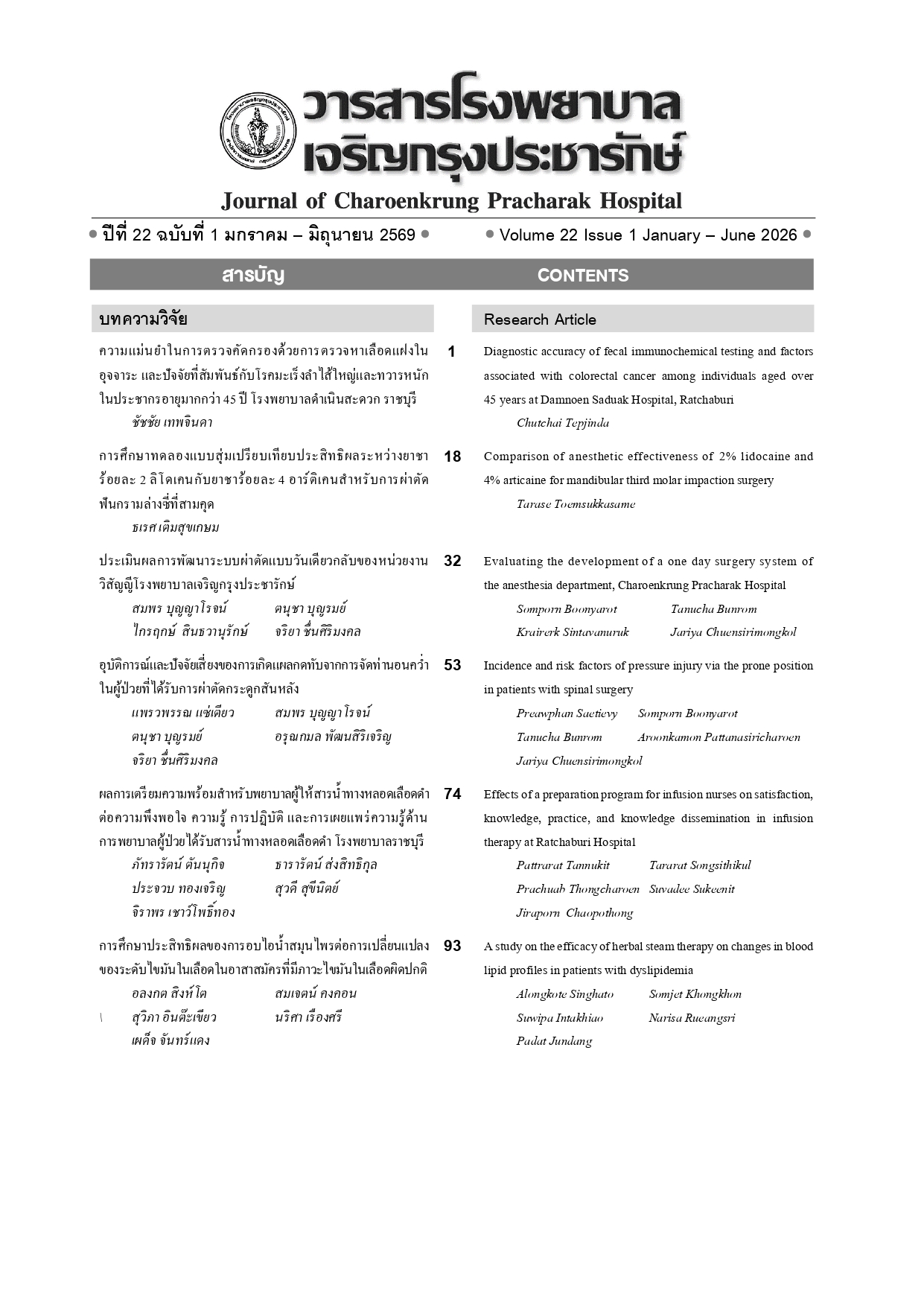
Incidence and risk factors of pressure injury via the prone position in patients with spinal surgery
Article Sidebar
Main Article Content
Abstract
Objective: To explore the incidence and risk factors of pressure injuries associated with the prone position in patients with spinal surgery.
Materials and Methods: This was an observational cross-sectional study conducted among 111 patients undergoing spinal surgery in the prone position at Charoenkrung Pracharak Hospital between June 2024 and March 2025. The participants were selected using purposive sampling. The research instruments included a personal data record form, preoperative factors, intraoperative factors, and a pressure injury assessment form based on the National Pressure Injury Advisory Panel (NPIAP) criteria. The instruments were validated by three experts; the Index of item Objective Congruence (IOC) is 1.00, with good inter-rater reliability. Skin assessments were performed before prone positioning, 30 minutes postoperatively, and followed up at 24 and 48 hours for patients who developed pressure injuries. Data were analyzed using descriptive statistics and multiple logistic regression analysis.
Results: The incidence of pressure injuries for 30 minutes after surgery was 5.4%. All identified pressure injuries were classified as Stage 1. The most common areas of pressure injuries were the face, followed by the chest. Univariable logistic regression analysis demonstrated that intraoperative blood loss greater than 500 mL was significantly associated with the development of pressure injuries (p<0.05). However, multivariable logistic regression analysis showed that none of the studied factors were independently associated with pressure injury occurrence.
Conclusion: Pressure injuries related to prone positioning in spine surgery occurred at a low incidence and were predominantly early-stage injuries. These findings highlight the importance of preoperative risk assessment, appropriate positioning techniques, use of protective devices, and close postoperative skin monitoring to prevent pressure injuries and enhance patient safety during spine surgery.
Article Details

This work is licensed under a Creative Commons Attribution-NonCommercial-NoDerivatives 4.0 International License.
References
Lin S, Hey HWD, Lau ETC, Tan KA, Thambiah JS, Lau LL, et al. Prevalence and predictors of pressure injuries from spine surgery in the prone position: do body morphological changes during deformity correction increase the risks?. Spine (Phila Pa 1976) 2017;42(22):1730-6. doi:10.1097/BRS.0000000000002177
Kumagai A, Ohno N, Miyati T, Sugama J. Prediction of tissue deformation based on mechanical and physiological factors in the prone position during surgery. J Tissue Viability 2024;33(2):312-7. doi:10.1016/j.jtv.2024.02.004
Kwee MM, Ho YH, Rozen WM. The prone position during surgery and its complications: a systematic review and evidence-based guidelines. Int Surg 2015;100(2):292-303.doi:10.9738/INTSURG-D-13-00256.1
Grisell M, Place HM. Face tissue pressure in prone positioning: a comparison of three face pillows while in the prone position for spinal surgery. Spine (Phila Pa 1976) 2008;33(26):2938-41. doi:10.1097/BRS.0b013e31818b9029
Padula WV, Delarmente BA. The national cost of hospital-acquired pressure injuries in the United States. Int Wound J 2019;16(3):634-40. doi:10.1111/iwj.13071
Nghiem S, Campbell J, Walker RM, Byrnes J, Chaboyer W. Pressure injuries in Australian public hospitals: a cost of illness study. Int J Nurs Stud 2022;130:104191. doi:10.1016/j.ijnurstu.2022.104191
Price MC, Whitney JD, King CA, Doughty D. Development of a risk assessment tool for intraoperative pressure ulcers. J Wound Ostomy Continence Nurs 2005;32(1):19-30;quiz 31-2. doi:10.1097/00152192-200501000-00006
Edsberg LE, Black JM, Goldberg M, McNichol L, Moore L, Sieggreen M. Revised national pressure ulcer advisory panel pressure injury staging system: revised pressure injury staging system. J Wound Ostomy Continence Nurs 2016;43(6):585-97. doi:10.1097/WON.0000000000000281
Suh D, Kim SY, Yoo B, Lee S. An exploratory study of risk factors for pressure injury in patients undergoing spine surgery. Anesth Pain Med (Seoul) 2021;16(1):108-15. doi:10.17085/apm.20081
Choi MA, Kim MS, Kim C. Incidence and risk factors of medical device-related pressure injuries among patients undergoing prone position spine surgery in the operating room. J Tissue Viability 2021;30(3):331-8. doi:10.1016/j.jtv.2021.06.006
Techanivate A, Athibai N, Siripongsaporn S, Singhatanadgige W. Risk factors for facial pressure ulcers in patients who underwent prolonged prone orthopedic spine surgery. Spine (Phila Pa 1976) 2021;46(11):744-50. doi:10.1097/BRS.0000000000003892
ฝ่ายวิชาการและแผนงาน โรงพยาบาลเจริญกรุงประชารักษ์. รายงานสถิติผู้ป่วยผ่าตัดกระดูกสันหลัง ปี 2564-2566. กรุงเทพฯ: โรงพยาบาลเจริญกรุงประชารักษ์; 2567.
WHO Expert Consultation. Appropriate body-mass index for Asian populations and its implications for policy and intervention strategies. Lancet 2004;363(9403):157-63. doi.10.1016/S0140-6736(03)15268-3
Ninlaphut T, Boonsri N, Koompong N. Incidence and risk factors of pressure injury in patients undergoing spinal surgery in the prone position: aretrospective cohort study. J Perianesth Nurs 2025;40(6):1567-71.e1. doi:10.1016/j.jopan.2025.03.006
