
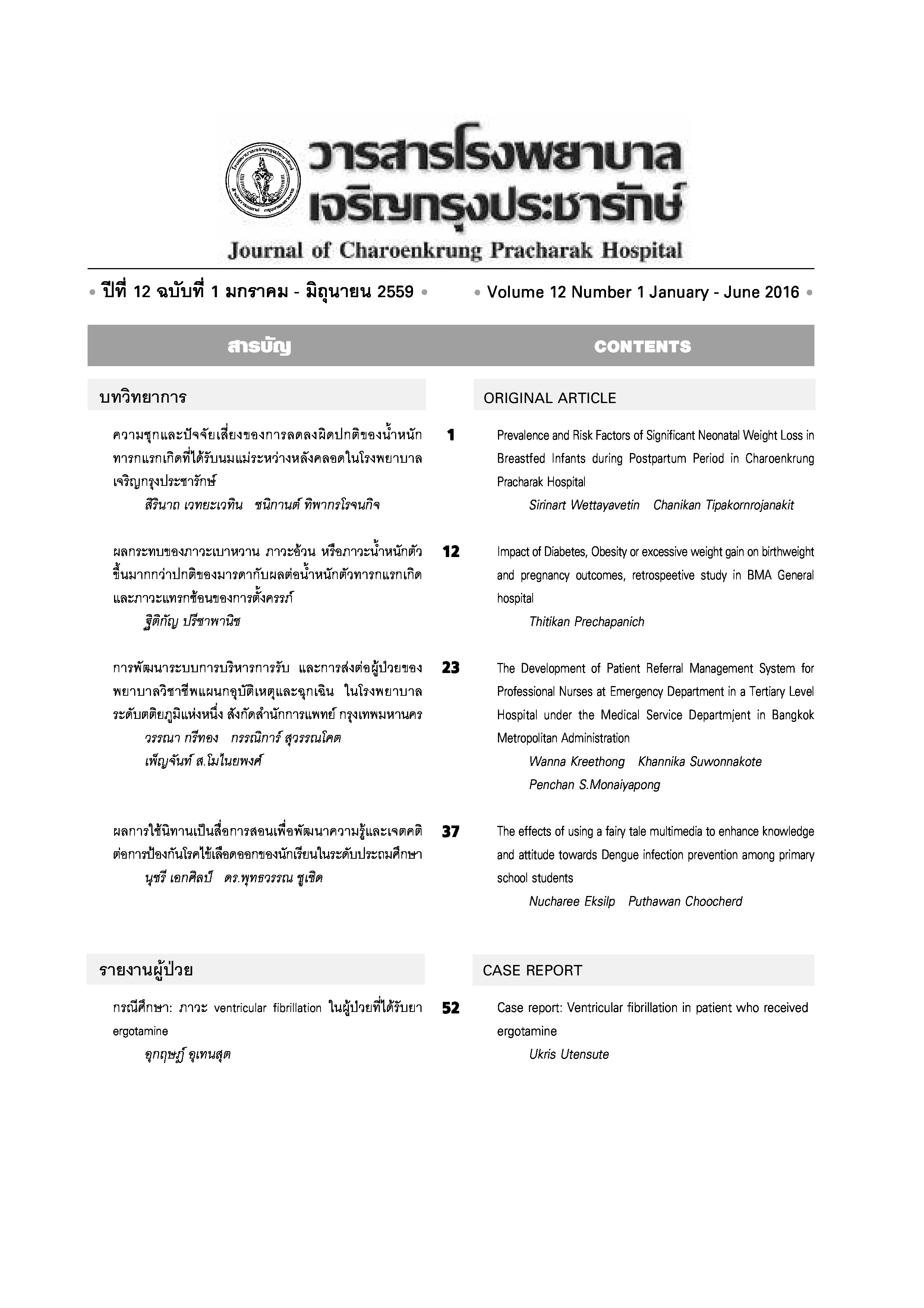
ผลกระทบของภาวะเบาหวาน ภาวะอ้วน หรือภาวะน้ำหนักตัวขึ้นมากกว่าปกติของมารดากับผลต่อน้ำหนักตัวทารกแรกเกิด และภาวะแทรกซ้อนของการตั้งครรภ์ การศึกษาย้อนหลังในโรงพยาบาลกลาง
Article Sidebar
Main Article Content
บทคัดย่อ
บทนำ: ภาวะเบาหวานหรือภาวะน้ำหนักตัวขึ้นมากเป็นภาวะแทรกซ้อนที่สำคัญในสตรีตั้งครรภ์ที่ทำให้เกิดผลเสียต่อทั้งมารดาและทารกในครรภ์ เช่น ภาวะครรภ์เป็นพิษ ทารกน้ำหนักตัวมาก
ทำให้คลอดยาก และมีโอกาสเกิดอันตรายระหว่างการคลอดได้สูงขึ้น
วัดถุประสงค์: ศึกษาความสัมพันธ์ของภาวะเบาหวาน ภาวะอ้วน ภาวะน้ำหนักตัวเพิ่มขึ้นมากในสตรีตั้งครรภ์ที่มีผลต่อน้ำหนักทารกแรกเกิด
วิธีดำเนินการวิจัย: วิจัยศึกษาย้อนหลังจากเวชระเบียนสตรีตั้งครรภ์จำนวน 577 ราย ที่มาคลอดบุตรที่โรงพยาบาลกลางอายุระหว่าง 18-35 ปี เปรียบเทียบกับน้ำหนักทารกแรกเกิดแยกออก
เป็น 4 กลุ่มคือ กลุ่มสตรีตั้งครรภ์ปกติ สตรีตั้งครรภ์มีภาวะอ้วน (obesity) หรือน้ำหนักตัวเพิ่มขึ้นมาก กลุ่มสตรีตั้งครรถ์มีภาวะเบาหวาน (gestational diabetic mellitus) และกลุ่มสตรีตั้ง
ครรภ์ที่มีทั้ง 2 ภาวะ
ผลการวิจัย: จากข้อมูลสตรีตั้งครรภ์ 577 ราย พบว่าในทั้ง 4 กลุ่มมี อายุมารดา BMI และน้ำหนักตัวที่ขึ้นแตกต่างกันอย่างมีนัยสำคัญทางสถิติ น้ำหนักทารกแรกเกิดเฉลี่ยทั้ง 4 กลุ่ม
3,027 3,2741 3,210 3,438 กรัมตามลำดับ แตกต่างกันอย่างมีนับสำคัญทางสถิติ (p 0.01) เมื่อวิเคราะห์ปัจจัยต่างๆ โดยวิธี logistic regression พบว่า ในสตรีคั้งครรภ์ที่น้ำหนักตัวเพิ่มขึ้น
มากพบภาวะน้ำหนักทารกแรกเกิดมากกว่าปกติได้เป็น 5 เท่าสตรีตั้งครรภ์ที่มีภาวะเบาหวานจะเกิดภาวะ birth asphyxia ภาวะความดันโลหิตสูง อัตราการผ่าคลอดเพิ่มขึ้น (p 0.01)
ส่วนภาวะตกเลือดหลังคลอดในตรีตั้งครรภ์ทั้ง 4 กลุ่มไม่แตกต่างกัน
สรุป: ปัจจัยเสี่ยงที่ทำให้ไน้ำหนังตัวทารกแรกเกิดมากกว่าปกติคือ ภาวะน้ำหนักตัวเพิ่มขึ้นมากในสตรีตั้งครรภ์ส่วนปัจจัยที่ทำให้เกิดความดันโลหิตสูง ภาวะ birth asphyxia และเพิ่มอัตตรา
การผ่าคลอดคือ ภาวะเบาหวานระหว่างตั้งครรภ์
คำสำคัญ: ภาวะเบาหวานระหว่างตั้งครรภ์ น้ำหนักตัวทารกแรกเกิดมากกว่าปกติ ภาวะน้ำหนักตัวขึ้นมาก
Article Details
เอกสารอ้างอิง
India J med Res 2013; 137: 728-733.
2. ธีระ ทองสง. โรคเบาหวานในสตรีตั้งครรภ์.ใน:ธีระ ทองสง,สุชยา ลือวรรณ, บรรณาธิการ. สูติศาสตร์ เรียบเรียง. พิมพ์ครั้งที่ 5.
ปทุมธานี: PB FORBOOK xm6,Tkou. sohk 425-38.
3. Triunfo S, Lanzone A. Impact of overweight and
obesity on obstetric outcomes. Journal of
Endocrinological investigation 2014; 37: 323-9.
4. Lao TT1, Wong KY. Perinatal outcome in large-
for-gestational-age infants. Is it influenced by
gestational impaired glucose tolerance?. J Reprod
Med 2002; 47: 497-502.
5. Casay BM, Lucas MJ. Pregnancy outcomes in
women with gestational diabetes compared with
the general obstetric population. Obstet Gynecol
1997; 90: 869-73.
6. Jensen MD. Obesity. In: Goldman L, Schafer
th
AI, editors. Goldmanûs Cecil Medicine. 24 ed.
Philadelphia, PA: Saunders Elsevier 2011; chap
227.
7. American College of Obstetricians and
Gynecologists. Committee Opinion No.549:
Obesity in pregnancy. Obstet Gynecol 2013; 121:
213-7.
8. Lashen H, Fear K, Sturdee DW. Obesity is
associated with increased risk of first trimester
and recurrent miscarriage: matched case-control
study. Hum Reprod 2004; 19: 1644-6.
9. Baeten JM, Bukusi EA, Lambe M. Pregnancy
complications and outcomes among overweight
and obese nulliparous women. Am J Public Health
2001; 91: 436-40.
10. Cedergren MI. Maternal morbid obesity and the
risk of adverse pregnancy outcome. Obstet
Gynecol. 2004; 103: 219-24.†
11. Cnattingius S, Bergstrom R, Lipworth L, Kramer
MS. Prepregnancy weight and the risk of adverse
pregnancy outcomes. N Engl J Med 1998; 338:
147-52.†
12. Oken E, Taveras EM, Kleinman KP, Rich-Edwards
JW, Gillman MW. Gestational weight gain and
child adiposity at age 3 years. Am J Obstet
Gynecol 2007; 196: 322.e1-8.
13. American College of Obstetricians and
Gynecologists. Fetal macrosomia. ACOG Practice
Bulletin 22. Washington, DC: ACOG; 2000.
14. American College of Obstetricians and
Gynecologists. Committee Opinion No.548:
Weight gain during pregnancy. Obstet Gynecol
2013; 121: 210-2.
15. Crane JM, White J, Murphy P. The effect of
gestational weight gain by body mass index on
maternal and neonatal outcomes. J Obstet
Gynaecol Can 2009; 31: 28-35.
16. Marin J.A., Russu M., Hudita D, Nastasia S.
Diabetes, Obesity and Excessive weight gain and
Pregnancy outcomes. Timisoara Medical Journal
2009; 59: 184-7.
17. Chow S, Shao J, Wang H. Sample Size
Calculations in Clinical Research. 2nd ed.
Chapman & Hall/CRC Biostatistics Series 2008;
p.100.
