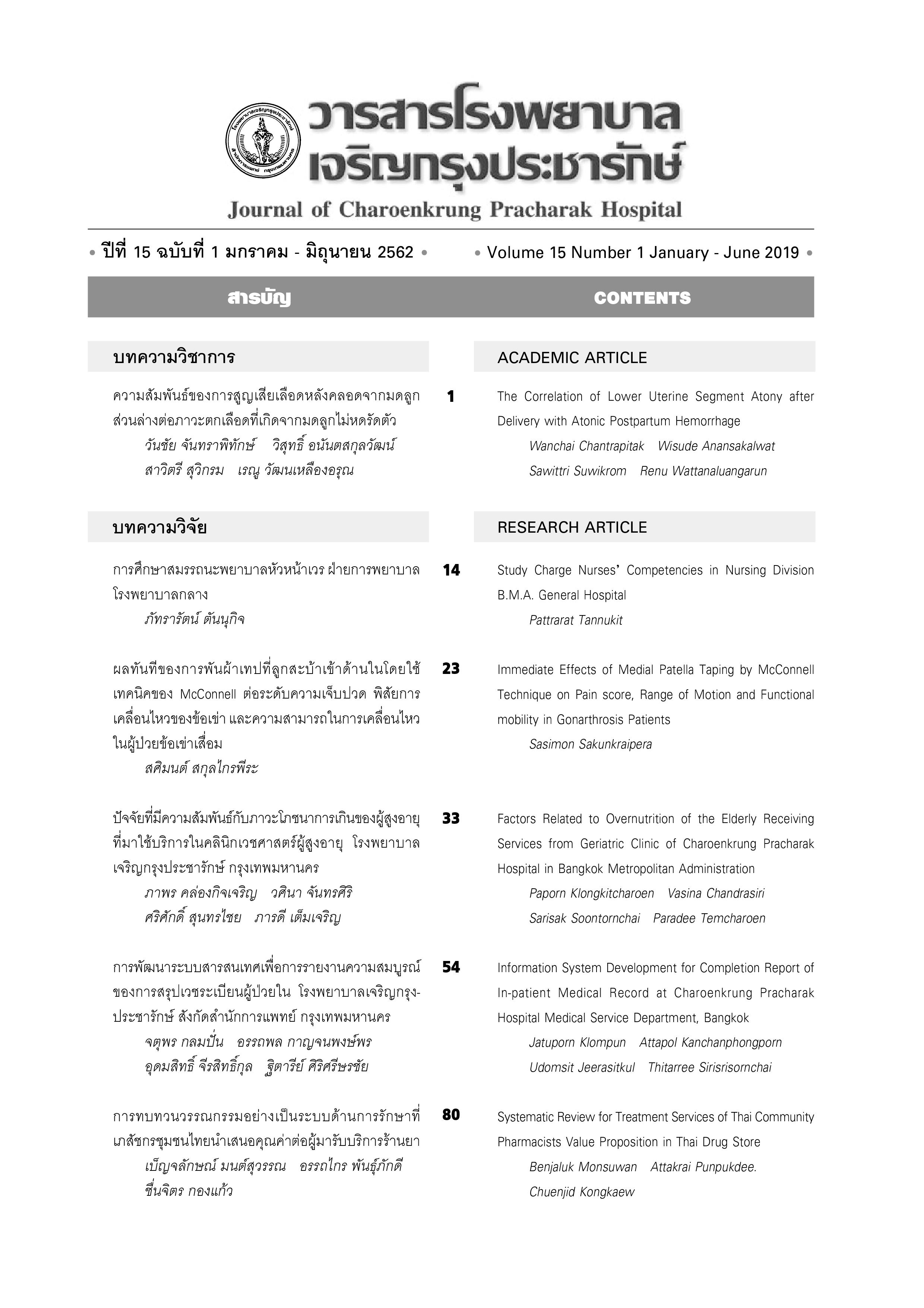
Study Charge Nurses’ Competencies in Nursing Division B.M.A. General Hospital
Article Sidebar
Main Article Content
Abstract
Objective: The purpose of this research was to study the charge nurses’ competencies.
Method: The descriptive research study. There were 2 steps in this research. First, literature review was done for a conceptual framework of the charge nurses’ competencies. Second, analysis was conducted using the Delphi technique. The sample group was 7 assistant directors of nursing, 7 front line administrators and 6 academic nurses. The research instruments were 3 questionnaires. The first was the open-ended questionnaire about charge nurses’ competencies. The second was the Likert scale questionnaire containing 20 items which the experts used for identifying the necessary level of the charge nurses’ competencies. The third was the questionnaire containing 20 items, which included the suggestion from the experts, and the median and the interquartile range which were analyzed from the second questionnaire. The experts confirmed the necessary level of the charge nurses’ competencies in 20 items. Researcher summarized the charge nurses’ competencies based on the median of more than 3.50 and the interquartile range of less than 1.50
Results: The charge nurses’ competencies was subdivided into 4 competencies as follows: 1) technical competency includes 7 items 2) management competency includes 5 items 3) human resource management and human resource development competency includes 3 items and 4) professional characteristics includes 6 items.
Conclusions: The charge nurses’ competencies are the important factor for achieve the nursing services’ performance.
Article Details
References
มหาวิทยาลัยธรรมศาสตร์; 2559.
2. เสาวลักษณ์ จิรธรรมคุณ. ถามและตอบ: การบริหารหอผู้ป่วย. ฮายาบุสะ กราฟฟิก: กรุงเทพมหานคร;
2552.
3. ชมพูนุช ทิพย์ฟั่น, บุญพิชชา จิตต์ภักดี, ผ่องศรี เกียรติเลิศนภา. การพัฒนาโปรแกรมการเตรียมความพร้อม
สำหรับการเป็นพยาบาลหัวหน้าเวร. พยาบาลสาร. 2014; 40(1): 145-57.
4. อุดมรัตน์ สงวนศิริธรรม. การพัฒนาวิชาชีพการพยาบาล พิมพ์ครั้งที่ 2. เชียงใหม่: คณะพยาบาลศาสตร์
มหาวิทยาลัยเชียงใหม่; 2553.
5. Spencer LM, Jr., Spencer SM. Competence at work: models for superior performance: John Wiley &
Sons; 1993.
6. Linstone HA, Turoff M. The Delphi method: techniques and applications: Addison-Wesley Pub. Co.,
Advanced Book Program; 1975.
7. Jamieson JM, Clark JE. Charge Nurse Competencies Legacy Good Samaritan Medical Center Portland
Oregon 2019. Available at http://www.synovaassociates.com/wp-content/uploads/2018/12/Charge-
8. Stoddart K, Bugge C, Shepherd A, Farquharson B. The new clinical leadership role of senior charge
nurses: a mixed methods study of their views and experience. J Nurs Manag. 2014; 22(1): 49-59.
9. Carlin A, Duffy K. Newly qualified staff's perceptions of senior charge nurse roles. Nursing
Management - UK. 2013; 20(7): 24-30.
