
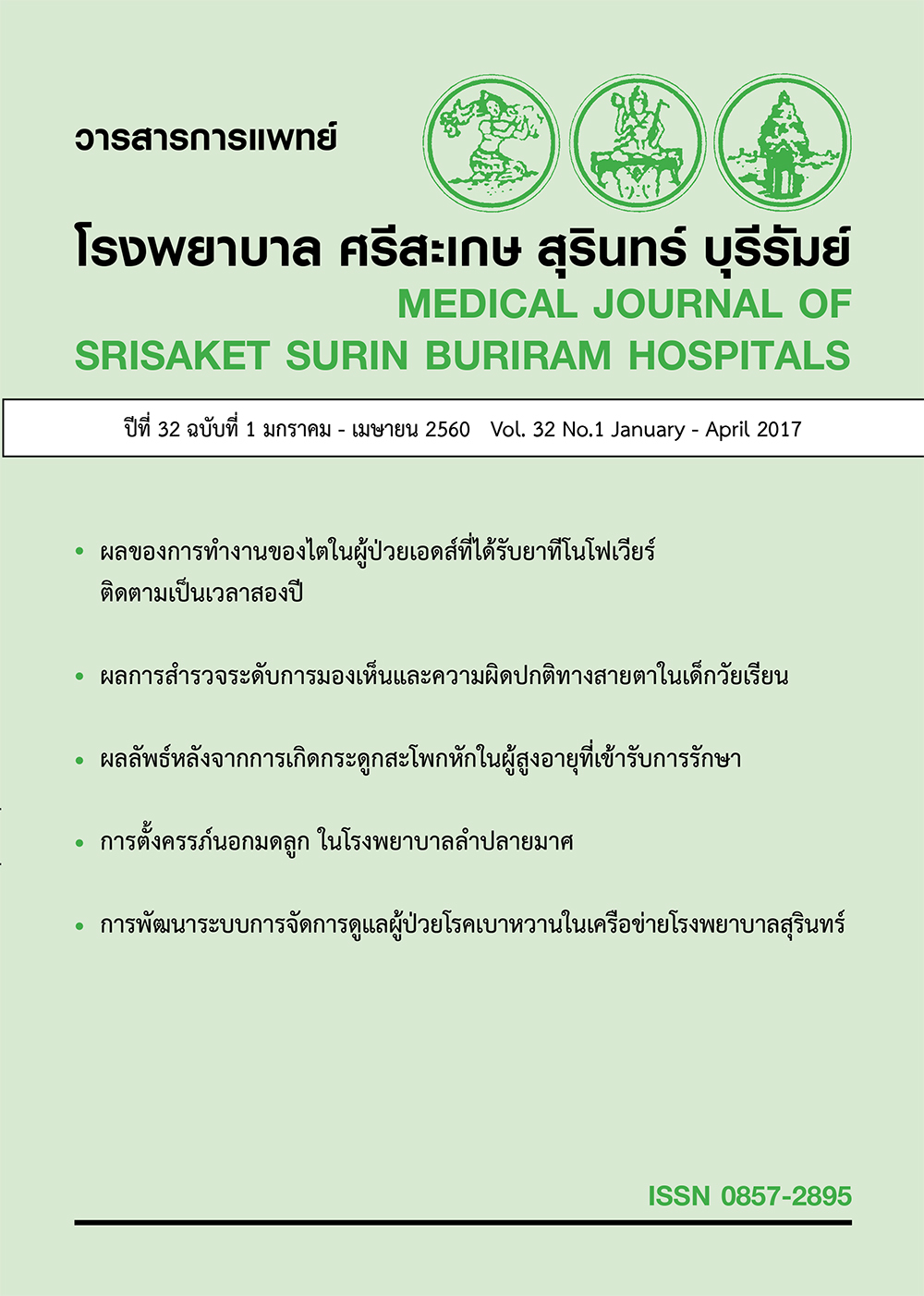
Decreased renal function in HIV-infected patients receiving tenofovir disoproxil fumarate-based antiretroviral regimen
Article Sidebar
Main Article Content
Abstract
Background: Tenofovir disoproxil fumarate (TDF) is currently considered as an essential component of major antiretroviral(ARV) regimens in combination with nonnucleoside reverse-transcriptase inhibitor- based regimen (NNRTI) or protease inhibitor(PI). This study aimed to determine the incidence and predictors of declined kidney function after the use of TDF during 2-year follow-up period.
Methods: A retrospective cohort study was conducted in our institute. We collected data from consecutive HIV-infected patients who received TDF-containing regimens, either with NNRTI or PI, in HIV clinic between January 2010 to December 2012. Kidney function was determined by creatinine clearance (CrCl) which was calculated using a modification of diet in renal disease (MDRD) equation at baseline and at 2-year follow-up.
Results: A total of 135 patients were included in the study, mean age 39.7 ± 8.5 years and a median of CD4 cell count 274 cell/mm3 (IQR 133-432). Seventy-four cases (54.8%) were female. At 2-year after initiation of TDF, 26 patients (19.3%) had decreased CrCl>25% from baseline. The presence of lipodystrophy (adjusted odds ratio, 2.16; 95% Cl, 0.66 to 7.01) was correlated with decline kidney function, but the presence of zidovudine-induced anemia (adjusted odds ratio, 0.45; 95% Cl, 0.10 to 2.20) and higher BMI (adjusted odds ratio, 0.84; 95% Cl, 0.70 to 1.02) were a factor that slows down the declined kidney function. However, they were not statistically significant risk factors. No discontinuation of TDF or significant clinical changes was observed among the study population during a follow-up period.
Conclusion: The incidence of declined kidney function in the patients using TDF treatment regimens was around 19.3% during 2-year follow-up period. Further study with more sample size, with a control group and long-term follow-up is needed.
Article Details
References
2. ประพันธ์ ภานุภาค, ทวีทรัพย์ ศิรประภาศิร, วสันต์ จันทราทิตย์, วิชัย เตชะสาธิต,อัจฉรา ธีรรัตน์กุล, กุลกัญญา โชคไพบูลย์กิจ, สมนึก สังฆานุภาพ. แนวทางการตรวจวินิจฉัยและการดูแลรักษาผู้ติดเชื้อเอชไอวีและผู้ป่วยเอดส์ ระดับชาติ ปี พ.ศ. 2553. กรุงเทพฯ : ชุมนุมสหกรณ์การเกษตรแห่งประเทศไทย จำกัด: ศูนย์พัฒนาระบบบริการยาต้านไวรัส สำหรับผู้ติดเชื้อเอชไอวี และผู้ป่วยเอดส์ในประเทศไทย; 2553.
3. Zimmermann AE, Pizzoferrato T, Bedford J, Morris A, Hoffman R, Braden G. Tenofovir-associated acute and chronic kidney disease: a case of multiple drug interactions. Clin Infect Dis 2006;42(2):283-90. Epub 2005/12/16.
4. Verhelst D, Monge M, Meynard JL, Fouqueray B, Mougenot B, Girard PM, et al. Fanconi syndrome and renal failure induced by tenofovir: a first case report. Am J Kidney Dis 2002;40(6):1331-3. Epub 2002/12/03.
5. Karras A, Lafaurie M, Furco A, Bourgarit A, Droz D, Sereni D, et al. Tenofovir-related nephrotoxicity in human immunodeficiency virus-infected patients: three cases of renal failure, Fanconi syndrome, and nephrogenic diabetes insipidus. Clin Infect Dis 2003;36(8):1070-3. Epub 2003/04/10.
6. Coca S, Perazella MA. Rapid communication: acute renal failure associated with tenofovir: evidence of drug-induced nephrotoxicity. Am J Med Sci 2002;324(6):342-4. Epub 2002/12/24.
7. Creput C, Gonzalez-Canali G, Hill G, Piketty c, Kazatchkine M, Nochy D. Renal lesions in HIV-l-positive patient treated with tenofovir. AIDS 2003;17(6):935-7. Epub 2003/03/28.
8. Perazella MA. Drug-induced renal failure: update on new medications and unique mechanisms of nephrotoxicity. Am J Med Sci 2003;325(6):349- 62. Epub 2003/06/18.
9. Izzedine H, Hulot JS, Vittecoq D, Gallant JE, Staszewski S, Launay-Vacher V, et al. Long-term renal safety of tenofovir disoproxil fumarate in antiretroviral-naive HIV-1-infected patients. Data from a double-blind randomized active-controlled multicentre study. Nephrol Dial Transplant 2005;20(4):743-6. Epub 2005/03/03.
10. Izzedine H, Launay-Vacher V, Deray G. Antiviral drug-induced nephrotoxicity. Am J Kidney Dis 2005;45(5):804-17. Epub 2005/04/30.
11. Pierrat A, Gravier E, Saunders C, Caira MV, Ait-Djafer Z, Legras B, et al. Predicting GFR in children and adults: a comparison of the Cockcroft-Gault, Schwartz, and modification of diet in renal disease formulas. Kidney Int 2003;64(4): 1425-36. Epub 2003/09/13.
12. Szczech LA. Renal dysfunction and tenofovir toxicity in HIV-infected patients. Topics in HIV medicine : a publication of the International AIDS Society, USA. 2008;16(4):122-6.
13. Gallant JE, Parish MA, KerulyJ C, Moore RD. Changes in renal function associated with tenofovir disoproxil fumarate treatment, compared with nucleoside reverse-transcriptase inhibitor treatment. Clin Infect Dis 2005;40(8):1194-8. Epub 2005/03/26.
14. Kiertiburanakul S, Chaisiri K, Kasettratat N, Visuttimak P, Bowonwatanuwong C. Monitoring of Renal Function among HIV-Infected Patients Receiving Tenofovir in a Resource-Limited Setting. J Int Assoc Physicians AIDS Care 2011;10(5):297-302.
15. Nelson MR, Katlama C, Montaner JS, Cooper DA, Gazzard B, Clotet B, et al. The safety of tenofovir disoproxil fumarate for the treatment of HIV infection in adults: the first 4 years. AIDS 2007 Jun 19;21(10):1273-81.
16. Manosuthi W, Mankatitham W, Lueangniyomkul A, Prasithsirikul W, Tantanathip P, Suntisuklappon B, et al. Renal impairment after switching from stavudine/lamivudine to tenofovir/lamivudine in NNRTI-based antiretroviral regimens. AIDS Res Ther 2010;7(1):37.
