
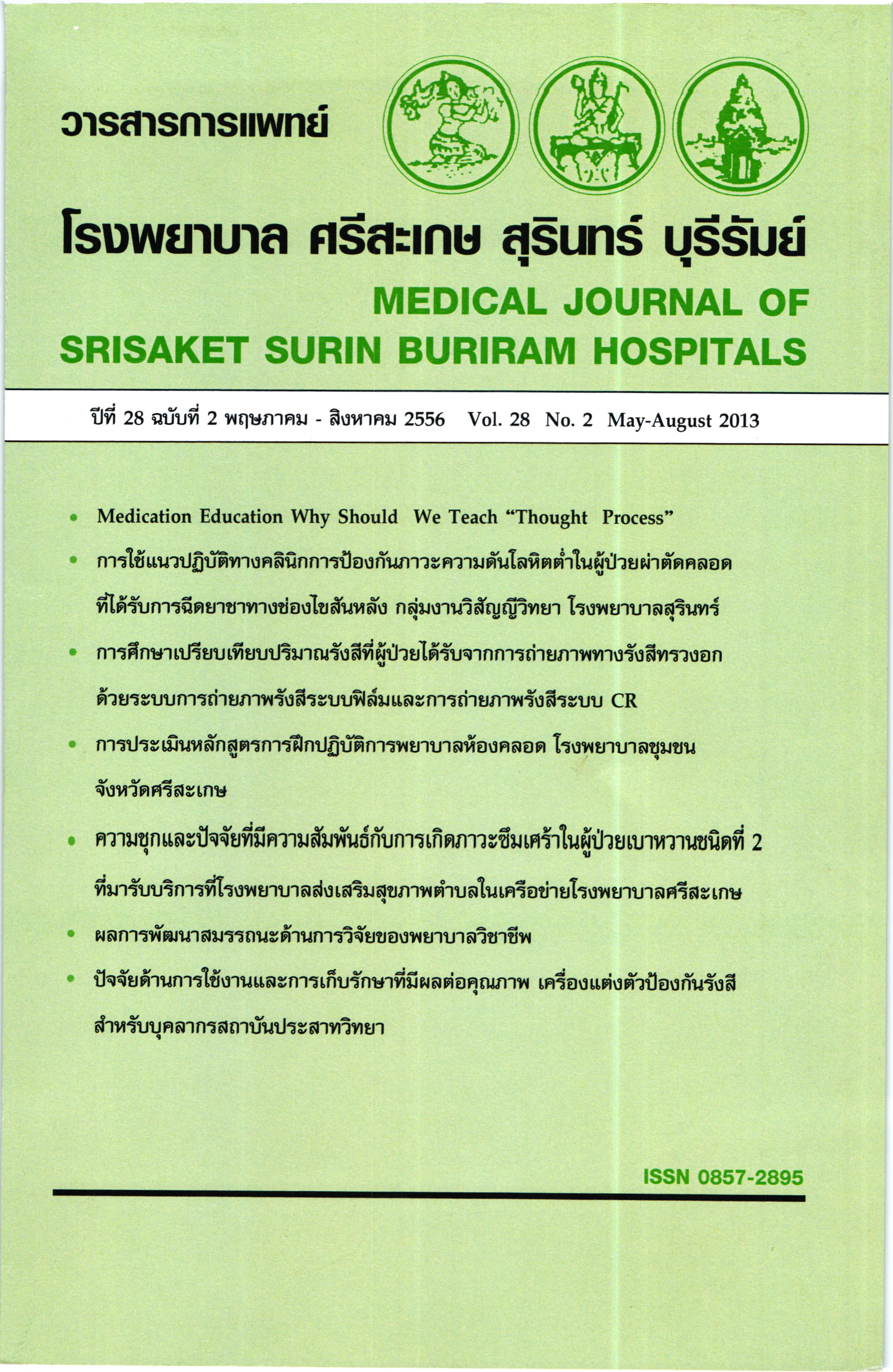
Prevalence and Factors Associated with Depression in Sisaket’s Primary Care Patients with Type 2 Diabetes
Article Sidebar
Main Article Content
Abstract
Background: Depression is a frequent co-morbidity found in type2 diabetes patients. Without any management of this co-morbidity results in higher rates of complication, morbidities and mortalities.
Objectives: To determine the prevalence of depression and associated factors in type2 diabetic patients attending the primary care unit of Sisaket hospital.
Setting: Primary care unit of Sisaket hospital
Research design: Cross-sectional study
Methods: Study in Sisaket’s primary care patients with type 2 diabetes in the period between November 2012 to January 2013.Data was collected by interviewing and the nine-question depression questionnaire, which was used for diagnosis of depression. Pearson’s chi-square test and multivariate logistic regression analysis was used to determine the independent associated factors of depression.
Results: Total 452 type2 diabetic patients were studied, prevalence of depression according to nine-question depression questionnaire was 22.6% (102) and multivariate logistic regression analysis revealed that female gender (odds ratio = 2, 95%CI = 1.124-3.558), age 60 years old or higher (odds ratio = 1.97, 95%CI = 1.193-3.272), and peripheral neuropathy (odds ratio = 2.28, 95%CI =1.311-3.998) were the independent associated factors of depression in type2 diabetic patients.
Conclusion: The prevalence of depression among type2 diabetes patients in primary care unit of Sisaket hospital was high as well as previous studies. Regular depression screening in type2 diabetes patients is important, especially in patient with peripheral neuropathy, female gender or more than 60 years old of age.
Article Details
References
2. Anderson RJ, Freedland KE, Clouse RE, Lustman PJ.The prevalence ofcomorbid depression in adults with diabetes: a meta-analysis. Diabetes Care 2001; 24:6:1069-78.
3. Lustman PJ, Anderson RJ, Freedland KE, de Groot M, Carney RM, Clouse RE. Depression and poor glycemic control: a กาeta-analytic review of the literature. Diabetes Care 2000:23:7:934-42.
4. Clouse RE, Lustman PJ, Freedland KE, Griffith LS, McGill JB, Carney RM. De pression and coronary heart disease in women with diabetes. Psychosom Med 2003;65:3:376-83.
5. Lustman PJ, Freedland KE, Griffith LS, Clouse RE. Predicting response to cognitive behavior therapy of depression in type 2 diabetes. Gen Hosp Psychiatry 1998;20:5:302.
6. Katon WJ, Rutter C, Simon G, Lin EH, Ludman E, Ciechanowski P, Kinder L, Young B, VonKorff M. The association of comorbid depression with mortality in patients with type2 diabetes. Diabetes Care 2005;28:11:2668-72.
7. Black SA, Markides KS, Ray LA. Depression predicts increased incidence of adverse health outcomes in older Mexican Americans with type 2 diabetes. Diabetes Care 2003;26:10:2822.
8. Lin HHB. Depression and increased mortality in diabetes : Unexpected causes of death. Annals of Family Medicine 2009;7:5:414-21.
9. ธิติพั'นธ์ ธานีรัตน์. ความชุกของภาวะซึมเศร้าระดับ,น้ำตาลสะสมในเลือด และปัจจัยที่เกี่ยวข้องในผู้ป่วยเบาหวานชนิดที่ 2 ที่เข้ารับการรักษาแบบผู้ป่วยนอกคลินิกต่อมไร้ท่อ โรงพยาบาลจุฬาลงกรณ์. วิทยานิพนธ์ วิทยาศาสตร์มหาบัณฑิต จุฬาลงกรณ์มหาวิทยาลัย; 2551.
10. ธรณินทร์ กองสุข, สุวรรณา อรุณพงศ์ไพศาล, ณรงค์ มณีทอน, เบญจลักษณ์ มณีทอน, กมลเนตร วรรณเสวก, เกษราภรณ์ เคนบุปผา และคณะ. การพัฒนาและความเที่ยงตรงของแบบประเมินโรคซึมเศร้า 9 คำถาม ภาษาอีสาน. การประชุมวิชาการสุขภาพจิตนานาชาติ ครั้งที 6 เรื่องสุขภาพจิต : ชีวิตชาวเมือง; 1-3 สิงหาคม 2550; ณ โรงแรมปรินซ์พาเลช. กรุงเทพมหานคร; 2550.
11. Nefs G, Pouwer F, Denollet J, Pop V. The course of depressive symptoms in primary care patients with type 2 diabetes: results from the Diabetes, Depression, Type D Personality Zuidoost-Brabant (DiaDDZoB) Study. Diabetologia 2012; 55:3:608-16.
12. Payrot, M., Rubin, R.R. Level and risks of depression and anxiety symptomatology among diabetes adults. Diabetes care 1997;20:58590.
13. นันท์ชัตสัณห์ สกุลพงศ์. ความชุกและปัจจัยเสี่ยงต่อการเกิดภาวะซึมเศร้าในผู้ป่วยเบาหวาน. วิทยานิพนธ์วิทยาศาสตร์ มหาบัณฑิต(จิตวิทยาให้คำปรึกษา) มหาวิทยาลัยรามคำแหง; 2554.
14. Fisher L, Chesla, CA, Mullan JT, Skaff MM, & Kanter RA. Contributions to depression in Latino and European-American patients with type 2 diabetes. Diabetes care 2001;24:1751-7.
15. Wild S, Roglic G, Green A, Sicree R, King H. Global Prevalence of Diabetes Estimated For the year 2000 and projections for 2030. Diabetes care 2004;27:47-53.
16. มาโนช หล่‘อตระกูล. จิตเวชศาสตร์รามาธิบดี. พิมพ์ครั้งที่ 2. กรุงเทพา: มหาวิทยาลัยมหิดล; 2548.
17. Veerabenjapol A. Prevalence and risk factors of depression in Thai diabetic patients. Rama Med Journal 2010:33: 10-8.
18. พิรุณี สัพโส. ความชุกของภาวะซึมเศร้าในผู้ป่วยเบาหวานชนิดที่ 2 ในคลินิกเบาหวานโรงพยาบาล พังโคน. ศรีนครินทร์เวซสาร 2553; 25:4::272-9.
19. สายฝน เอกวรางกุล. รู้จัก เข้าใจ ดูแลภาวะซึมเศร้า. กรุงเทพๆ : สำนักพิมพ์แห่งจุฬาลงกรณ์ มหาวิทยาลัย; 2553; หน้า 6-8.
20. Poongothai S, Anjana RM, Pradeepa R, Ganesan A, Unnikrishnan R, Rema M, et al. Association of depression with complications of type 2 diabetes-the Chennai Urban Rural Epidemiology Study (CURES- 102). The Journal of the Association of Physicians
of India. 2011;59:644-8. Epub 2012/04/07.
21. Rodin GM. Psychosocial Aspect of Diabetes Mellitus. Canadian Journal of Psychiatry 1983; 28:3:219-23.
