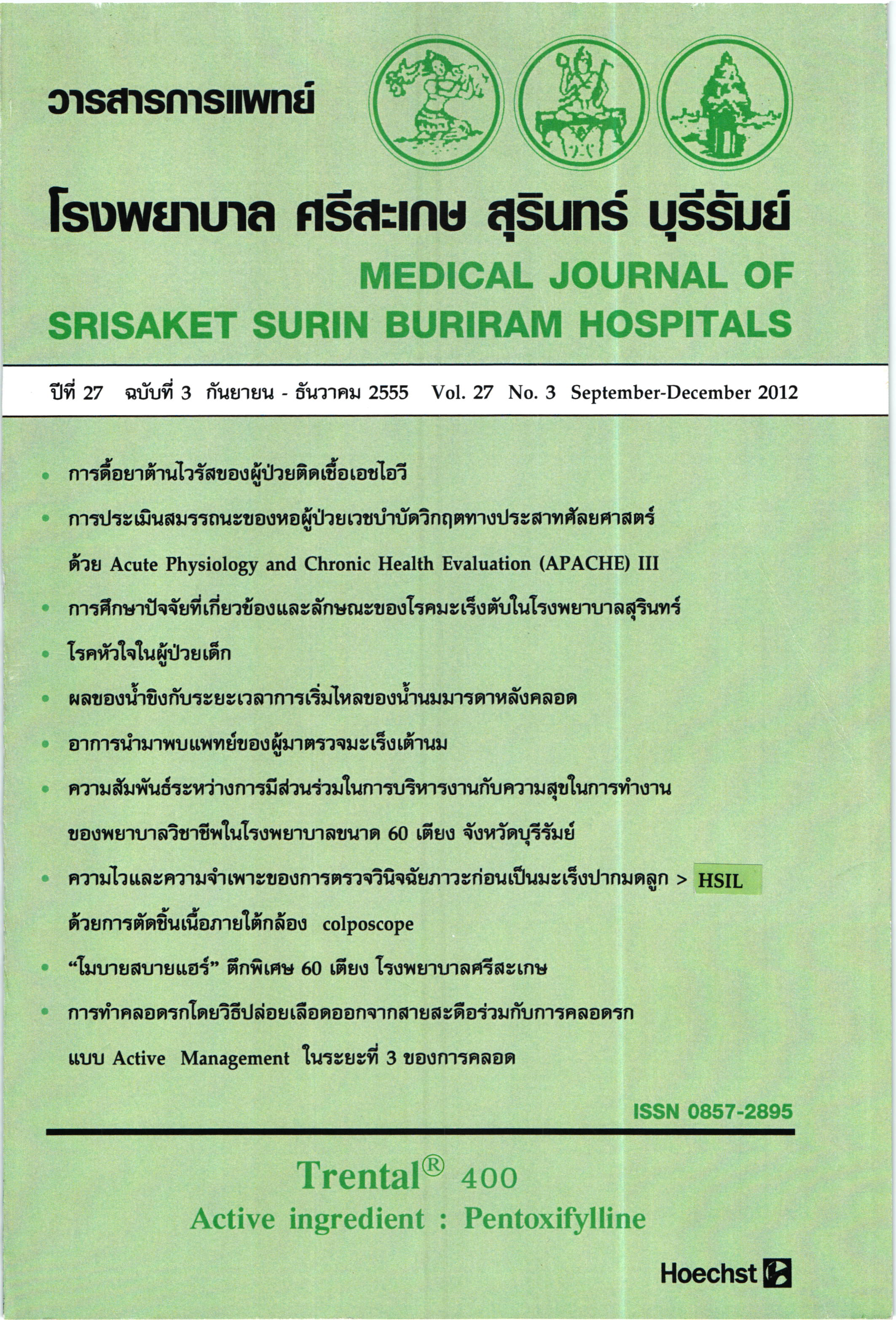
Correlation of Involvement in Management and Happiness in Workplace of Professional Nurses in 60-bed Community Hospitals, Buriram Province
Article Sidebar
Main Article Content
Abstract
Backgrounds: Shortage of nurses is still a problem in community hospital. The management system and happiness in workplace are the factors.
Objective: To study the influences of management system and happiness in workplace on professional nurse in the community hospitals in Buriram province.
Setting: All of 60-bed Community Hospitals, Buriram.
Study design: Survey study
Methods: Using questionnaires to collect data analyze to find percentage, One-way ANOVA and coefficient of correlation of Pearson correlation.
Results: The study revealed 80.7% of professional nurses had moderate to high level concerns in management system. 65.9% had moderate level happiness in workplace. The older and longer working year nurses significantly had more effect than the younger and those who concern more in management system significantly happier than those concern less (r = .64, value < 0.001).
Conclusion: Age, working year and employment status effect happiness in workplace and management system. The concern in management system has positive relationship to happiness in workplace.
Keywords: happiness in workplace, involvement in management/ professional nurses, sixty-bed community hospital
Article Details
References
2. ทัศนา บุญทอง. พลังพยาบาลกับการปฏิรูป การบริการใกล้บ้านใกล้ใจ.วารสารหมออนามัย 2551; 18:41-5.
3. กองแผนงาน สำนักงานปลัดกระทรวงมหาวิทยาลัย. ความต้องการกำลังคนสาขาพยาบาลศาสตร์ ในช่วง 10 ปีข้างหน้า (พ.ศ.2535-2544); กรกฎาคม 2535.
4. สำนักงานสาธารณสุขจังหวัดบุรีรัมย์. รายงาน ประจำปี 2553. บุรีรัมย์:สำนักงานปลัดกระทรวง สาธารณสุข; 2553(5/7):11-8.
5. สุวิริยา สุวรรณโคตร. ปัญหาจริยธรรมทางการ พยาบาล. วารสารวิทยาลัยศรีมหาสารคาม 2546;5:1:1-9.
6. Laschinger HK, Finegan J, Shamian J, Wilk P. Impact of structural and psycho¬logical empowerment on job strain in nursing work setting expanding Kanter’s model. J NursAdm 2001;31:5:260-72.
7. LetrakeS. Retraining the older nurse. J NursAdm 2002; 32(7/8):387-92.
8. Diener E. Subjective Well-Being. The science of happiness and proposal for a national index. Am Psychol 2000; 1:34-43.
9. ธงชัย สันติวงษ์. การบริหารงานบุคคล: Personal Management. พิมพ์ครั้งที่ 9. กรุงเทพฯ :ไทยวัฒนาพานิช; 2546.
10. อภิรดี สุขแสงดาว. ความสัมพันธ์ระหว่าง บรรยากาศองค์การกับการมีส่วนร่วมในการ บริหารงานตามการรับรู้ของอาจารย์พยาบาล วิทยาลัยพยาบาลในภาคตะวันออกเฉียงเหนือ. [วิทยานิพนธ์ปริญญาคุรุศาสตร์มหาบัณฑิต]. นครราชสีมา : มหาวิทยาลัยราชภัฎนครราชสีมา; 2530
10. วิศรุต ขันริกุล. สัมฤทธิ์ผลการทำงานแบบกลุ่ม และการมีส่วนร่วมในการบริหารงานอาชีวอนามัยและความปลอดภัยในพื้นที่ท่า อากาศยานไทย.[วิทยานิพนธ์ปริญญา ดุษฎีบัณฑิต]. กรุงเทพมหานคร : มหาวิทยาลัยรามคำแหง; 2552.
11. นภัชชล รอดเที่ยง. ปัจจัยที่มีอิทธิพลต่อความสุขในการทำงานของบุคลากรที่สังกัดศูนย์อนามัยในเขตภาคตะวันออกเฉียงเหนือ กรมอนามัย กระทรวงสาธารณสุข. [วิทยานิพนธ์ ปริญญาวิทยาคาสตรมหาบัณฑิต] สาขาวิชาเอกอนามัยครอบครัว. กรุงเทพฯ : มหาวิทยาลัยมหิดล; 2550
12. รัชนี หาญสมสกุล. ความสัมพันธ์ระหว่างปัจจัยส่วนบุคคล สภาพแวดล้อมที่เหมาะสมในการทำงาน ลักษณะงานกับความสุขในการทำงานของบุคคลากรพยาบาลประจำสถานพยาบาล สังกัดกรมราชทัณฑ์. [วิทยานิพนธ์ปริญญา พยาบาลศาสตร์มหาบัณฑิต]. กรุงเทพๆ : จุฬาลงกรณ์มหาวิทยาลัย; 2550.
13. Swansburg RC. Management and leadership for nurse managers. Sudbury Massachusetts : Jones and Bartlett Publishers; 1996.
