
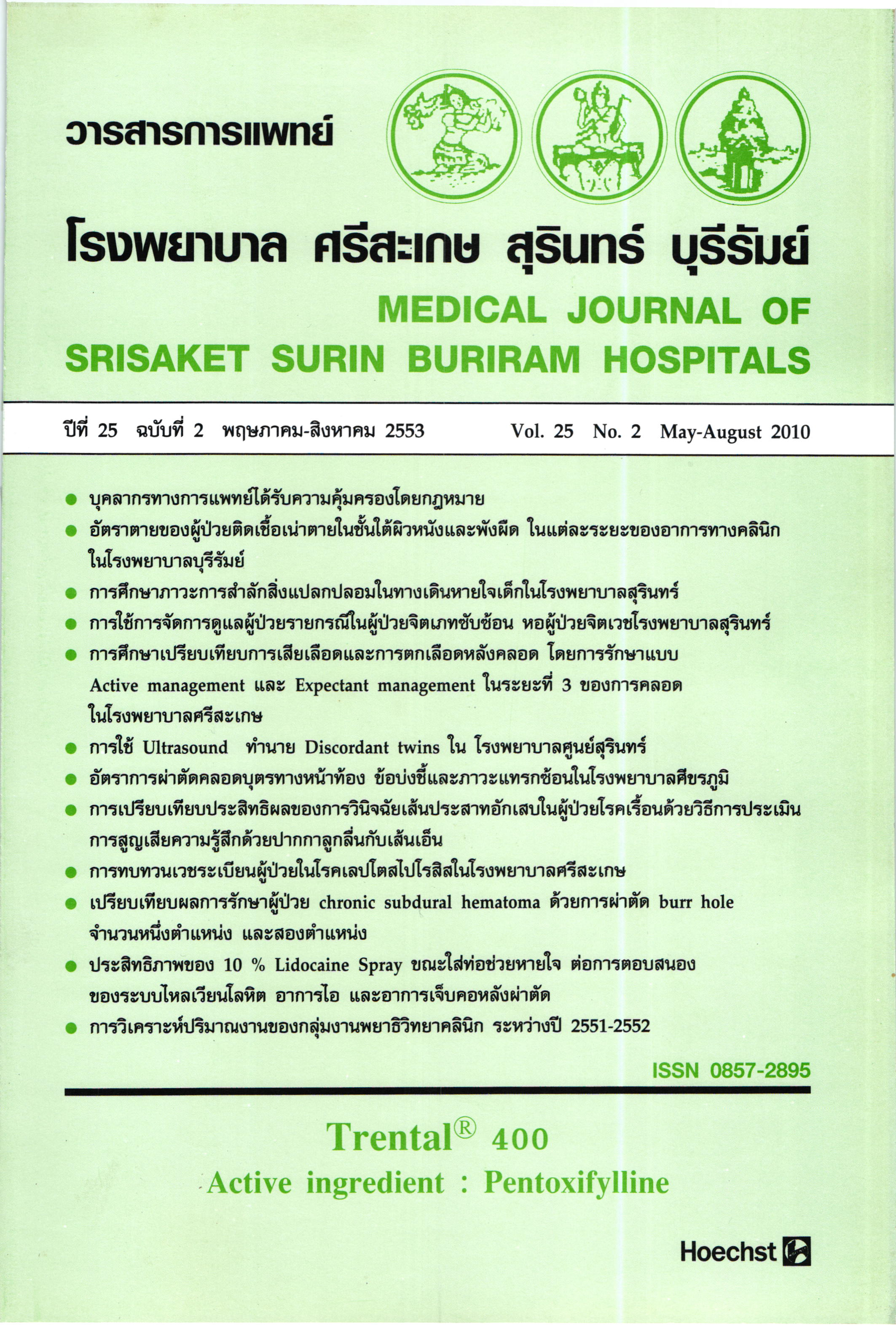
Comparative Study of Single and Double Burr Hole for the Treatment of Chronic Subdural Hematoma
Article Sidebar
Main Article Content
Abstract
Introduction: Chronic subdural hematoma is one of the most frequent problems in neurosurgical practice. There are several procedures for the treatment of this entity. While burr hole with continuous drainage is the most often used technique, there are no sufficient evidences of the number of burr hole in respect to the results and complications.
Objective: To compare the results of single and double burr holes for the treatment of unilateral chronic subdural hematoma
Methods: 115 patients with chronic subdural hematoma were surgically treated with burr hole craniostomy in Buriram hospital from February 2006 to January 2010 were analyzed retrospectively. All patients underwent irrigation and placement of closed-drainage system. Good outcome (GOS 5), recurrence, hospitalization days, mortality and complications were compared.
Results: Fifty five (47.8%) patients treated with single burr hole were compared to 60 (52.2%) patients treated with double burr holes. There are no statistical significant difference in good outcome, recurrence, hospitalization days, and mortality (p > 0.05).
Conclusions: The number of burr holes does not affect the post-operative outcomes, recurrence rate, hospitalization days, and mortality of chronic subdural hematoma.
Key words: Chronic subdural hematoma, Burr hole drainage, Recurrence
Article Details
References
Davarian Y, Hansen-Schwartz J, Sorensen P. [Chronic subdural hematoma. Physiopathology and treatment]. Ugeskr Laeger 2004;14:166(25):2427-30.
Vignes JR. [Surgical treatment of chronic subdural hematoma in the adult. Review of the literature]. Neurochirurgie 2001;47(5):479-87.
Weigel R, Krauss JK, Schmiedek P. Concepts of neurosurgical management of chronic subdural haematoma: historical perspectives. Br J Neurosurg 2004;18(1):8-18.
Cenic A, Bhandari M, Reddy K. Management of chronic subdural hematoma: a national survey and literature review. Can J Neurol Sci 2005;32(4):501-6.
Oishi M, Toyama M, Tamatani S, KitazawaT, Saito M. Clinical factors of recurrent chronic subdural hematoma. Neurol Med Chir (Tokyo) 2001;41(8):382-6.
Stanisic M, Lund-Johansen M, Mahesparan R. Treatment of chronic subdural hematoma by burr-hole craniostomy in adults: influence of some factors on postoperative recurrence. Acta Neurochir (Wien) 2005;147(12): 1249-56; discussion 56-7.
Taussky P, Fandino J, Landolt H. Number of burr holes as independent predictor of postoperative recurrence in chronic subdural haematoma. Br J Neurosurg 2008; 22(2):279-82.
Zakaraia AM, Adnan JS, Haspani MS, Naing NN, Abdullah JM. Outcome of 2 different types of operative techniques practiced for chronic subdural hematoma in Malaysia: an analysis. Surg Neurol 2008;69(6):608-15; discussion 16.
Weigel R, Schmiedek P, Krauss JK. Outcome of contemporary surgery for chronic subdural haematoma: evidence based review. J Neurol Neurosurg Psychiatry 2003;74(7):937-43.
Williams GR, Baskaya MK, Menendez J, Polin R, Willis B, Nanda A. Burr-hole versus twist-drill drainage for the evacuation of chronic subdural haematoma: a comparison of clinical results. J Clin Neurosci 2001;8(6):551-4.
Kansal R, Nadkami T, Goel A. Single versus double burr hole drainage of chronic subdural hematomas. A study of 267 cases. J Clin Neurosci Apr 2010;17(4):428-9.
Lee JK, Choi JH, Kim CH, Lee HK, Moon JG. Chronic subdural hematomas : a comparative study of three types of operative procedures. J Korean Neurosurg Soc 2009;46(3):210-4.
Fujisawa H, Ito H, Kashiwagi S, Nomura S, Toyosawa M. Kallikrein-kinin system in chronic subdural haematomas: its roles in vascular permeability and regulation of fibrinolysis and coagulation. J Neurol Neurosurg Psychiatry 1995;59(4):388-94.
Fujisawa H, Ito H, Saito K, Ikeda K, Nitta H, Yamashita J. Immunohistochemical localization of tissue-type plasminogen activator in the lining wall of chronic subdural hematoma. Surg Neurol 1991;35(6):441-5.
Kawakami Y, Chikama M, Tamiya T, Shimamura Y. Coagulation and fibrinolysis in chronic subdural hematoma. Neurosurgery 1989;25(l):25-9.
Nomura ร, Kashiwagi S, Fujisawa H, Ito H, Nakamura K. Characterization of local hyperfibrinolysis in chronic subdural hematomas by SDS-PAGE and immunoblot. J Neurosurg 1994 ; 81(6):910-3.
Saito K, Ito H, Hasegawa T, Yamamoto S. Plasmin-alpha 2-plasmin inhibitor complex and alpha 2-plasmin inhibitor in chronic subdural hematoma. J Neurosurg 1989;70(l):68-72.
Takahashi Y, Ohkura A, Yoshimura F, Ochiai S, Hirohata M, Shigemori M. Ultrastructure of collagen fibers in the outer membrane of recurrent chronic subdural hematoma. Neurol Med Chir (Tokyo) 1996;36(9):627-30; discussion 30-1.
