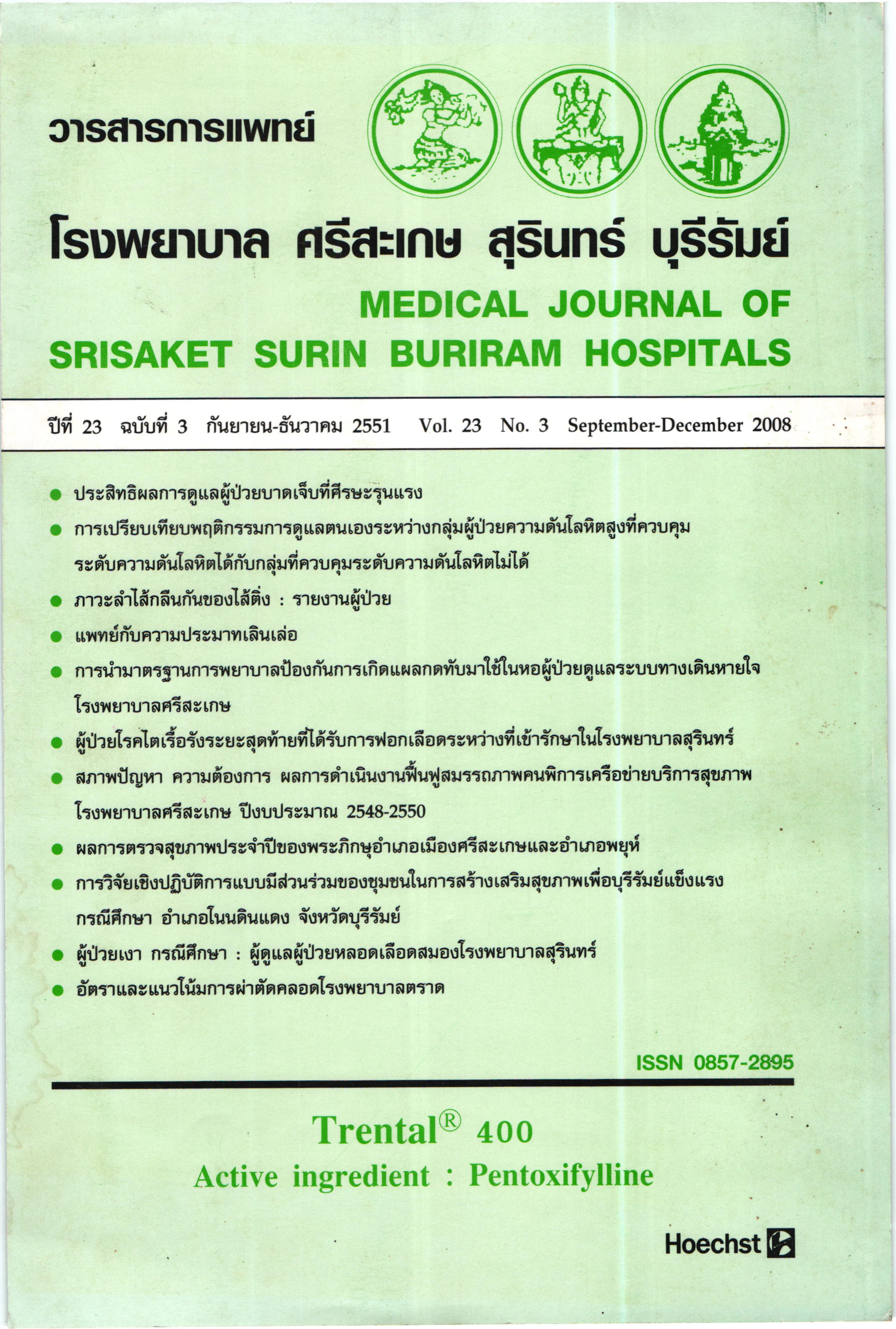
Efficacy of Nursing Care in Severe Head Injury
Article Sidebar
Main Article Content
Abstract
Background: Increasing of severe head injury rate resulting in disabilities that affect self care management for patients and their families. Development of nursing care in severe head injury patient will benefit for patient care.
Objective: To verify the efficacy and compare the outcome of clinical care plan of severe head injury patient.
Setting: Surgery department, Surin hospital
Study Design: Experimental research
Sample group: Severe head injury patients whose Glasgow Coma Score (GCS) was under or equal 8, admitted in male and female surgery wards including surgery intensive care unit. Ten patients from each arm were randomized specifically.
Method: Data was collected from September 1st 2007 to March 31st 2008. Research tools were 3 assessment forms (severe head injury clinical care plan assessment, caregiver's skill and educational plan assessment and ability in nursing care and patient's health status). Data was then analyzed by descriptive statistics (number, percentile, mean and standard deviation) and inferential statistics (Independent t-test).
Result: Result of the study found that 75.6% of experimental group was assigned clinical discharge plan 'clinical care plan. Thus all of caregivers in this group had ability to provide nursing care to patients and their clinical status in good level. Respiratory tract infection found in 70% of cases or 18.9 : 1,000 of intubation days. In the control group; 65.6% of cases received nursing care as the assigned clinical care plan. Discharge planning was assigned in 80.0% of cases. Consequently only 30.0% of caregivers had ability to provide nursing care to the patients and their clinical status. 50.0% of cases found respiratory tract infection or 14.3 ะ 1,000 of intubation days. Urinary tract infection found 10.0% of cases or 8.9 : 1,000 of catheterized days. Bed sore also found 10.0% or 1.7 : 1,000 hospitalized days. Comparison between experimental and control groups found that average score of length of stay and hospitalization cost of two groups were not different.
Conclusion: The result of this study leads to an improvement of clinical care plan to provide multi-disciplinary team to cover term of patient care. Prevention and decreasing of respiratory tract infection will enhance the quality of nursing care and decrease hospitalization cost and length of stay. Furthermore qualitative study in life-style modification of severe head injury patients and their families should also be verified.
Key words: efficacy, severe head injury
Article Details
References
2. นภาภรณ์ กวางทองและวิจิตรา กุสุมภ์. ภาวะวิกฤตเกี่ยวกับระบบประสาท .ใน วิจิตรา กุสุมภ์ (บรรณาธิการ), การพยาบาลผู้ป่วยภาวะวิกฤต. พิมพ์ครั้งที่ 2. กรุงเทพฯ : ห้างหุ้นส่วนสามัญ นิติบุคคล สหประชาพาณิชย์ ; 2546.
3. Jennett, B., & et al„ Disability after severe head injury : Observations on the use of the Glasgow Outcome Scale. Journal of Neurology. Neurosurgery. And Psychiatry ; 1981:44;286.
4. อรุณ กิจมหาตระกูล. บาดเจ็บที่ศีรษะโรงพยาบาลหาดใหญ่. สงขลานครินทร์เวชสาร 2542;17(2):103-8.
5. ศักดิ์ชัย ตั้งจิตวิทยา. บาดเจ็บรุนแรงที่ศีรษะในโรงพยาบาลสุราษฎร์ธานี. วารสารวิชาการแพทย์ เขต 15, 17, 2549;20:73.
6. ผลของโปรแกรมการสนับสนุนความต้องการของครอบครัวต่อการปรับตัวของสมาชิกในครอบครัวผู้ป่วยบาดเจ็บที่ศีรษะ [homepage on the Internet], กรุงเทพฯ : เบญจมาภรณ์ วงษ์ไกร ; [cited 2008 Oct 2], [1 screens]. Available from : https://cuir.car.chula.ac.th/handle/123456789/6232
7. ประภัสสร บัณฑุรัตน์ การติดเชื้อในโรงพยาบาล ในผู้ป่วยบาดเจ็บที่ศีรษะโรงพยาบาลมหาราช นครเชียงโหม,. เชียงใหม่ : บัณฑิตวิทยาลัย มหาวิทยาลัยเชียงใหม่ ; 2542.
