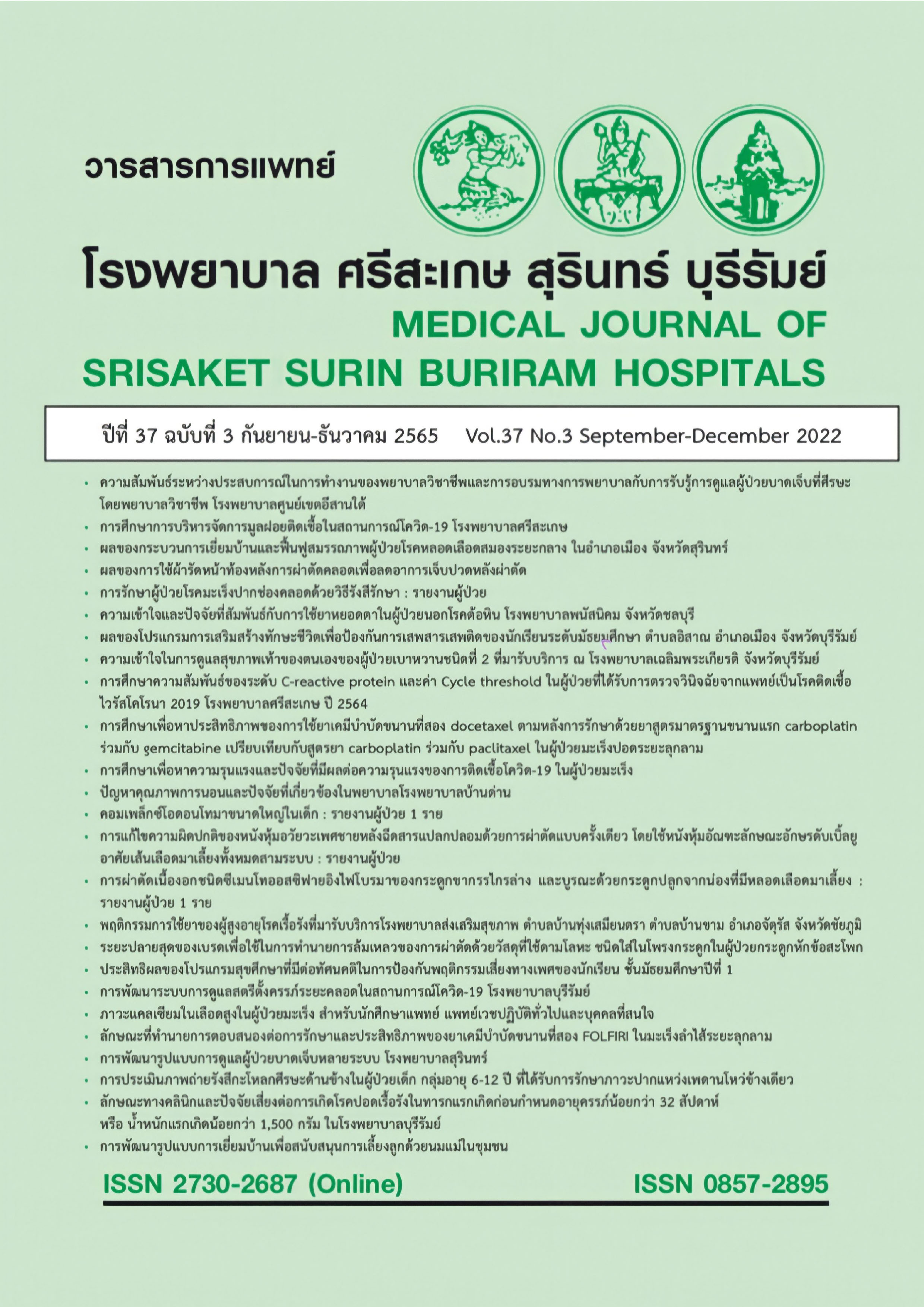
The Efficacy of the second Line Docetaxel in Previously Treated with Standard First Line Combination Carboplatin and Gemcitabine versus Carboplatin and Paclitaxel in Patients Diagnosed with Advanced Stage Non-Small Cell Lung Cancer (NSCLC), A Retrospective Study
Article Sidebar
Main Article Content
Abstract
Background: Cytotoxic chemotherapy is still the primary treatment for patients diagnosed with advanced-stage non-small cell lung cancer (NSCLC) in Thailand. International guidelines recommended the regimen in first- and second-line treatment, based on clinical data proving their efficacy in response rate, progression-free survival, and overall survival. In Thailand, the famous regimen of the 1st line treatment is a combination of carboplatin and either gemcitabine or paclitaxel. The 2nd line will always be docetaxel. We will compare the efficacy of the 2nd line docetaxel in previously treated between the 1st line regimens.
Methods: A retrospective cohort study was conducted in Surin hospital between June 2019 and February 2020. All medical records of 49 patients were reviewed for demographic data, the efficacy of the 1st line treatment, and the outcome of the 2nd line docetaxel. Kaplan-Meier method was used for survival time analysis.
Results: Forty-nine eligible patients received 1st line of combination carboplatin and gemcitabine (CG) 61.2% or carboplatin and paclitaxel (CP) 38.8%. Demographic characteristics were well-balance in both groups; male 40% vs 42.1% (p-value 0.88), adenocarcinoma 76.7% vs 84.2% (p-value 0.52), median progressive free survival on the 1st line treatment 7.7 vs 8.0. Months (p-value 0.71) in CG and CP, respectively. The response rate of the 2nd line docetaxel was 36.6% vs. 21.1% (p-value 0.24), and median progression-free survival on the 2nd line was 5.3 vs. 4.7 months (p-value 0.77) in CG and CP, respectively. They were going on to receive the 3rd line treatment of 36.6% vs. 47.3% (p-value 0.45) in CG and CP, respectively.
Conclusion: The response rate of 2nd line docetaxel in previously treated advanced stage NSCLC was higher after the 1st line treated with a combination of carboplatin and gemcitabine with a 15.5% increase in overall response rate. Although it’s not met statistically significant, it has clinically significant
Article Details

This work is licensed under a Creative Commons Attribution-NonCommercial-NoDerivatives 4.0 International License.
References
Berger MJ, Ettinger DS, Aston J, Barbour S, Bergsbaken J, Bierman PJ, et al. NCCN Guidelines Insights: Antiemesis, Version 2.2017. J Natl Compr Canc Netw 2017;15(7):883-93. doi: 10.6004/jnccn.2017.0117.
Roila F, Molassiotis A, Herrstedt J, Aapro M, Gralla RJ, Bruera E, et al. 2016 MASCC and ESMO guideline update for the prevention of chemotherapy- and radiotherapy-induced nausea and vomiting and of nausea and vomiting in advanced cancer patients. Ann Oncol 2016;27(suppl 5):v119-v133. doi: 10.1093/annonc/mdw270.
Rowinsky EK. The development and clinical utility of the taxane class of antimicrotubule chemotherapy agents. Annu Rev Med 1997;48:353-74. doi: 10.1146/annurev.med.48.1.353.
Weaver BA. How Taxol/paclitaxel kills cancer cells. Mol Biol Cell 2014;25(18):2677-81. doi: 10.1091/mbc.E14-04-0916.
Maloney SM, Hoover CA, Morejon-Lasso LV, Prosperi JR.Mechanisms of Taxane Resistance. Cancers (Basel) 2020;12(11):3323. doi: 10.3390/cancers12113323.
Galletti E, Magnani M, Renzulli ML, Botta M. Paclitaxel and docetaxel resistance: molecular mechanisms and development of new generation taxanes. ChemMedChem 2007;2(7):920-42. doi: 10.1002/cmdc.200600308.
Woodhouse JR, Ferry DR. The genetic basis of resistance to cancer chemotherapy. Ann Med 1995;27(2):157-67. doi: 10.3109/07853899509031953.
