
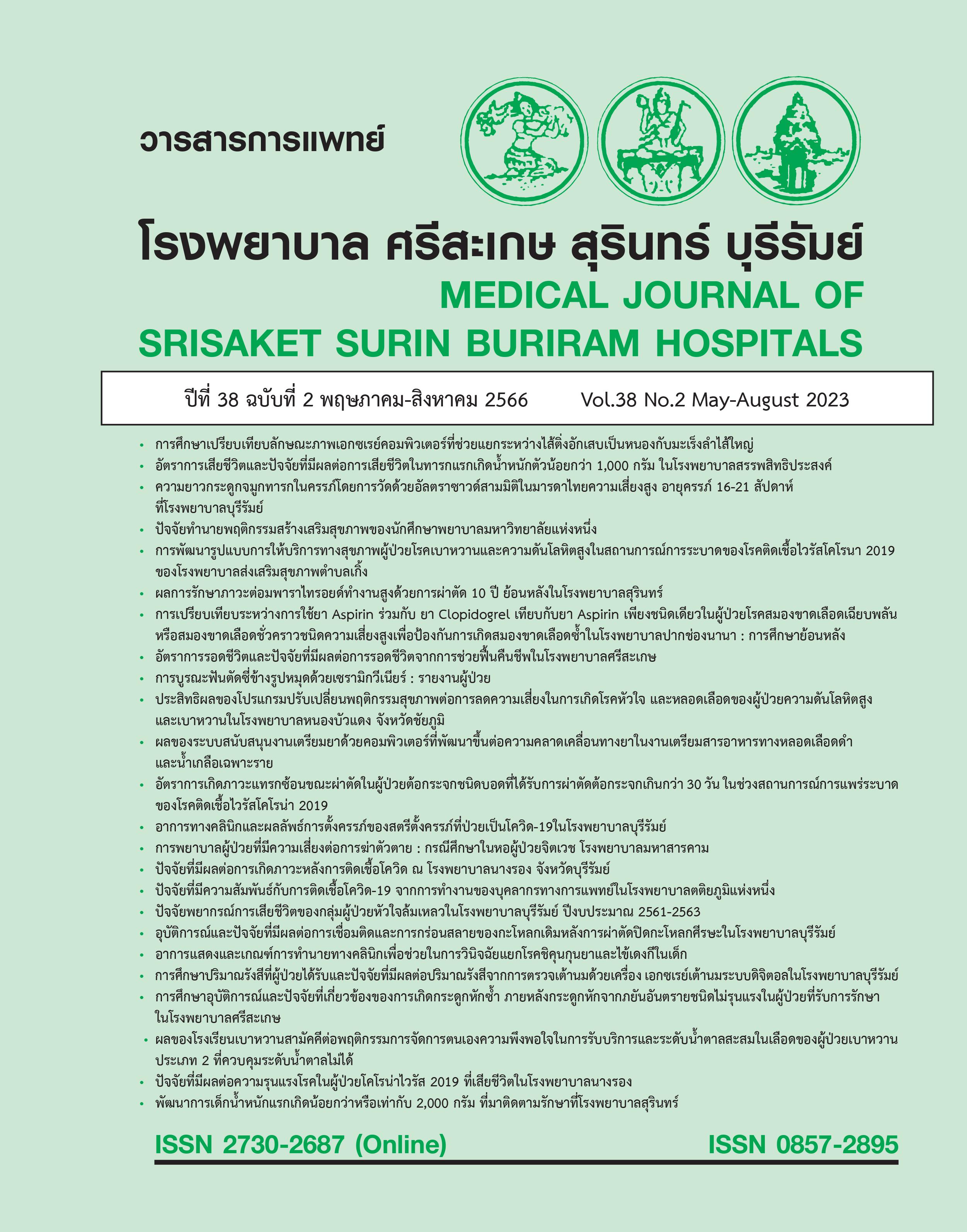
Development in Children born ≤ 2,000 grams in Surin Hospital
Article Sidebar
Main Article Content
Abstract
Background: At the present time, low birth weight infants have a higher survival percentage. They were at considerable risk for developmental delays, especially infants delivered weighing less than 2,000 grams.
Objective: To investigate the developmental outcome, outcomes after early intervention, and factors affecting developmental delays in infants born with birth weight less than 2,000 grams at Chaotuanoi clinic, Surin hospital.
Methods: A retrospective descriptive analysis was carried out using data from medical records of infants delivered with birth weight less than 2,000 grams between January 1, 2018 and December 31, 2020. The child's follow-up period was continued up to the age of two years old. Clinical information and complications were collected. The Denver development screening test (DDST-II) was performed at corrected ages 2, 4, 6, 9, 12, 18, and 24 months. Infants with developmental delays got immediate assistance, within one month of being identified.
Results: A total of 157 cases were collected. They were male in 83 cases (52.9%), with a gestational age of 32.6 (± 2.9) weeks and a birth weight of 1,584.2 (± 282.3) grams. Global delayed development was 7.8%, 7.2%, 8.7%, 16.9%, 9.7%, 10.2%, and 15.1% at corrected ages 2, 4, 6, 9, 12, 18, and 24 months, respectively. The language was the most frequent part of delays among the study population. By the age of 24 months, 126 patients had been properly followed up on. There were 14 cases of GDD (11.1%) and 2 cases of developmental language disorder (1.6%). There were 3 cases (2.4%) in which the development returned to normal after the intervention. Throughout this study, GA less than 28 weeks was one of a significant risk factor for developmental delays.
Conclusions: Most of these infants had normal development at age 24 month. Early detection and early intervention are important. Should be concern during antenatal care to prevent premature delivery.
Article Details

This work is licensed under a Creative Commons Attribution-NonCommercial-NoDerivatives 4.0 International License.
References
Vilanova CS, Hirakata VN, de Souza Buriol VC, Nunes M, Goldani MZ, da Silva CH.The relationship between the different low birth weight strata of newborns with infant mortality and the influence of the main health determinants in the extreme south of Brazil. Popul Health Metr 2019;17(1):15. doi: 10.1186/s12963-019-0195-7.
Sangtawesin V, Singarj Y, Kanjanapattanakul W. Growth and development of very low birth weight infants aged 18-24 months at Queen Sirikit National Institute of Child Health. J Med Assoc Thai 2011;94 Suppl 3:S101-6. PMID: 22043761
Chaudhari S, Otiv M, Khairnar B, Pandit A, Hoge M, Sayyad M. Pune low birth weight study - birth to adulthood - cognitive development. Indian Pediatr 2013;50(9):853-7. doi: 10.1007/s13312-013-0236-4.
Fernández Carrocera LA, Turcio Cortázar E, Garza Morales S, Rodríguez Pérez L, Udaeta Mora E. [Alterations in neuro-development in the 1st year of life in newborn infants weighing 2000 grams or less at birth]. Spanish. Neurologia 1992;7(5):98-101.PMID: 1382486
Upadhyay RP, Naik G, Choudhary TS, Chowdhury R, Taneja S, Bhandari N, et al. Cognitive and motor outcomes in children born low birth weight: a systematic review and meta-analysis of studies from South Asia. BMC Pediatr 2019;19(1):35. doi: 10.1186/s12887-019-1408-8.
Longo S, Caporali C, Pisoni C, Borghesi A, Perotti G, Tritto G, et al.Neurodevelopmental outcome of preterm very low birth weight infants admitted to an Italian tertiary center over an 11-year period. Sci Rep 2021;11(1):16316. doi: 10.1038/s41598-021-95864-0.
Smith L, Somner FF, von Tetzchner S. A longitudinal study of low birthweight children: reproductive, perinatal, and environmental precursors of developmental status at three years of age. Semin Perinatol 1982;6(4):294-304.PMID: 7156987
Ghaseminejad A, Niknafs P. Distribution of retinopathy of prematurity and its risk factors. Iran J Pediatr 2011;21(2):209-14.PMID: 23056789
Khatami, S. F. and Yousefi, A. and Bayat, G. F. and Mamuri, G. (2008) Retinopathy of prematurity among 1000-2000 gram birth weight Newborn infants. Iran J Pediatr 2008;18(2):137-42.
Poonual W, Navacharoen N, Kangsanarak J, Namwongprom S. Risk factors for hearing loss in infants under universal hearing screening program in Northern Thailand. J Multidiscip Healthc 2015;9:1-5. doi: 10.2147/JMDH.S92818.
Xiong X, Wightkin J, Magnus JH, Pridjian G, Acuna JM, Buekens P. Birth weight and infant growth: “catch-up” vs. “slow-down” growth. Ann Epidemiol 2005;15(8):658.
https://doi.org/10.1016/j.annepidem.2005.07.034
Pedersen SJ, Sommerfelt K, Markestad T. Early motor development of premature infants with birthweight less than 2000 grams. Acta Paediatr 2000;89(12):1456-61. doi: 10.1080/080352500456642.
Lammertink F, Vinkers CH, Tataranno ML, Benders MJNL. Premature Birth and Developmental Programming: Mechanisms of Resilience and Vulnerability. Front Psychiatry 2021;11:531571. doi: 10.3389/fpsyt.2020.531571.
Chaudhari S, Otiv M, Chitale A, Pandit A, Hoge M. Pune low birth weight study--cognitive abilities and educational performance at twelve years. Indian Pediatr 2004;41(2):121-8. PMID: 15004297
Rahman MS, Takahashi N, Iwabuchi T, Nishimura T, Harada T, Okumura A, et al. Elevated risk of attention deficit hyperactivity disorder (ADHD) in Japanese children with higher genetic susceptibility to ADHD with a birth weight under 2000 g. BMC Med 2021;19(1):229. doi: 10.1186/s12916-021-02093-3.
Lampi KM, Lehtonen L, Tran PL, Suominen A, Lehti V, Banerjee PN, et al. Risk of autism spectrum disorders in low birth weight and small for gestational age infants. J Pediatr 2012;161(5):830-6. doi: 10.1016/j.jpeds.2012.04.058.
