
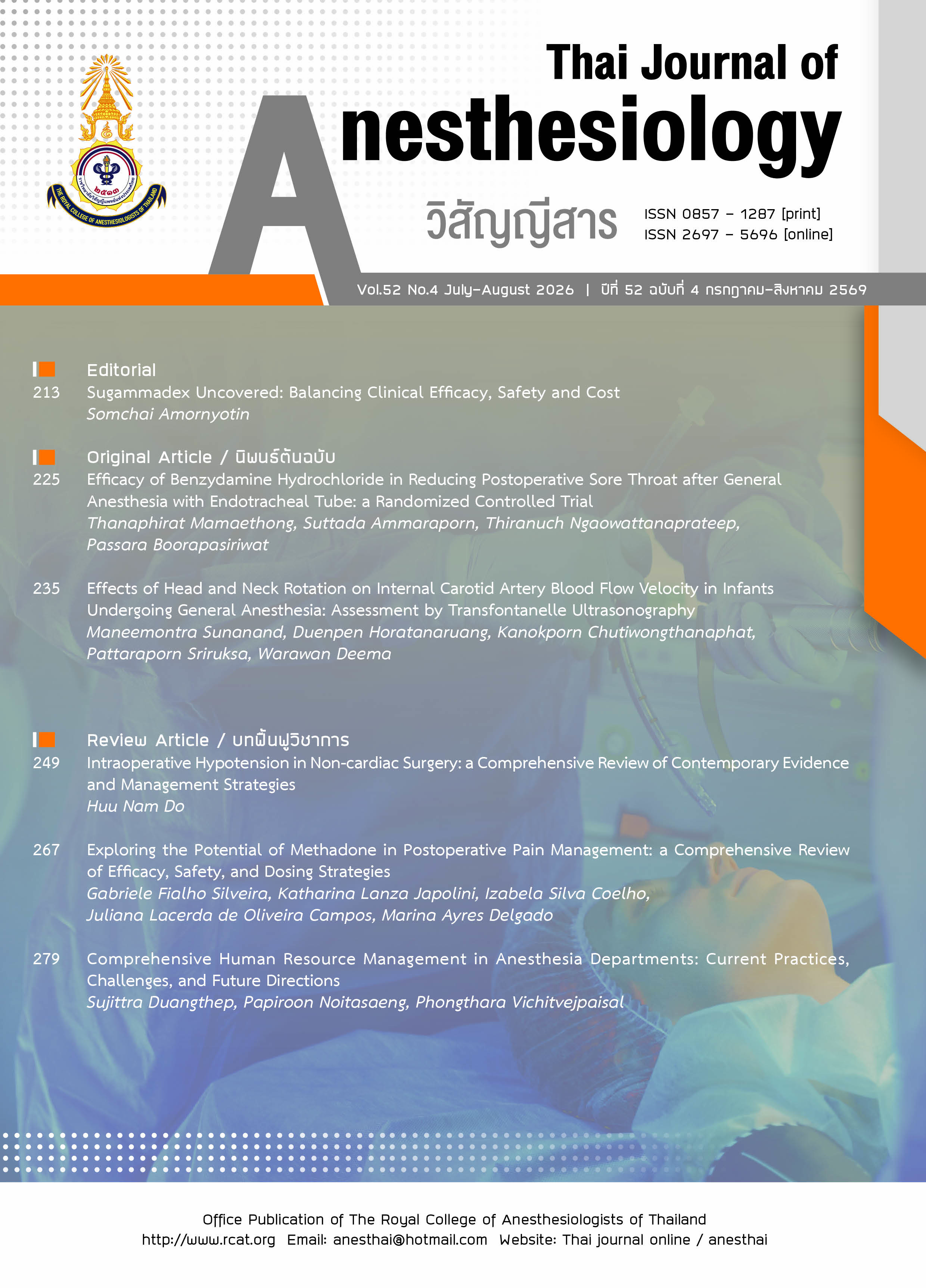
Sugammadex Uncovered: Balancing Clinical Efficacy, Safety and Cost
Keywords:
neuromuscular blockade, neuromuscular monitoring, residual paralysis, reversal, sugammadexAbstract
Sugammadex is a selective relaxant binding agent that has fundamentally changed the reversal of neuromuscular blockade produced by the aminosteroidal neuro- muscular blocking agents rocuronium and vecuronium. Unlike acetylcholinesterase inhibitors, sugammadex acts by encapsulating free molecules of these neuromuscular blocking agents in plasma, thereby reducing their availability at the neuromuscular junction and promoting diffusion of the drug away from the effect site. This unique mechanism allows rapid, predictable, and effective reversal of shallow, moderate, and deep neuromuscular blockade. Sugammadex has important practical applications in routine anesthesia, rapid-sequence induction, ambulatory surgery, patients at increased risk of postoperative pulmonary complications, and situations in which rapid restoration of neuromuscular function is desirable. Its major advantages include faster recovery compared with neostigmine, reliable reversal of deep blockade, absence of muscarinic adverse effects requiring anticholinergic coadministration, and potentially improved operating room efficiency and postoperative recovery. However, sugammadex is not without limitations. Important concerns include its relatively high acquisition cost, risk of residual neuromuscular blockade when underdosed, hypersensitivity and anaphylaxis, marked bradycardia or cardiac arrest in rare cases, recurrence of blockade after administration of an insufficient dose, and interactions with hormonal contraceptives. Dosing should therefore be guided whenever possible by quantitative neuromuscular monitoring rather than by elapsed time or clinical signs alone. Cost-effectiveness remains context dependent. Although the drug is substantially more expensive than neostigmine on a per-dose basis, its economic value may improve when reductions in recovery time, operating room occupancy, postoperative respiratory complications, and unplanned escalation of care are considered.
References
Ezril T, Boaz M, Sherman A, Armaly M, Berlovitz Y. Sugammadex: an update. J Crit Care Med. 2016;2:16-21.
Ravindranath S, Backfish-White K, Wolfe J, Ranganath YS. Sugammadex for Neuromuscular Blockade Reversal: A Narrative Review. J Clin Med. 2025;14:4128.
Jahr JS, Miller JE, Hiruma J, Emaus K, You M, Meistelman C. Sugammadex: a scientific review including safety and efficacy, update on regulatory issues, and clinical use in Europe. Am J Ther. 2015;22:288-97.
Woo T, Kim KS, Shim YH, et al. Sugammadex versus neostigmine reversal of moderate rocuronium-induced neuromuscular blockade in Korean patients. Korean J Anesthesiol. 2013;65:501-7.
Loupec T, Frasca D, Rousseau N, Faure JP, Mimoz O, Debaene B. Appropriate dosing of sugammadex to reverse deeprocuronium-induced neuromuscular blockade in morbidly obesepatients. Anaesthesia. 2016;71:265-72.
Sorensen MK, Bretlau C, Gatke MR, Sorensen AM, Rasmussen LS. Rapid sequence induction and intubation with rocuronium-sugamadex compared with succinyl choline: a randomized trial. Br J Anesth. 2012;108:682-9.
Horrow JC, LI W, Blobner M, et al. Actual versus ideal body weight dosing of sugammadex in morbidly obese patients offers faster reversal of rocuronium- or vecuronium-induced deep or moderate neuromuscular block: a randomized clinical trial. BMC Anesthesiol. 2021;21:62.
Kheterpal S, Vaughn MT, Dubovoy TZ, et al. Sugammadex versus neostigmine for reversal of neuromuscular blockade and postopoerative pumonary complications (STRONGER): a multicenter matched cohort analysis. Anesthesiology. 2020;132:1371-81.
Lee S, Chung W. Sugammadex for our little ones: a breif narrative review. Anesth Pain Med. 2024;19:269-79.
Lazorwitz A, Dindinger E, Aguirre N, Sheeder J. Pre and post-operative counseling for women on hormonal contraceptives receiving sugammadex at an academic hospital. J Anesth. 2020;34:294-7.
Crimmins D, Crilly H, van Nieuwenhuysen C, et al. Sugammadex hypersensitivity: a multicentre retrospective analysis of a large Australian cohort. Br J Anaesth. 2025;134:72-9.
Lan W, Tam KW,, Chen JT, et al. Cost-effectiveness of sugammadex versus neostigmine to reverse neuromuscular blockade in a university hospital in Taiwan: a propensity score-matched analysis. Healthcare. 2023;11:240.
Fuchs-Buder T, Meistelman C, Schreiber JU. Is sugammadex economiccally viable for routine use. Curr Open Anaesthesiol. 2012;25:217-20.
Downloads
Published
How to Cite
Issue
Section
License
Copyright
Copyright of all articles published in the Thai Journal of Anesthesiology is held by the Thai Journal of Anesthesiology, the Royal College of Anesthesiologists of Thailand. Submission of a manuscript constitutes the authors' agreement that, upon acceptance for publication, copyright of the work is transferred to the Journal. The content and any opinions expressed in published articles are the sole responsibility of the authors and do not necessarily reflect the views of the editorial board or the Royal College of Anesthesiologists of Thailand.
Licensing
All articles are published open access under the Creative Commons Attribution-NonCommercial-NoDerivatives 4.0 International License (CC BY-NC-ND 4.0). Under this license, anyone may copy and redistribute published articles in any medium or format for non-commercial purposes, provided that appropriate credit is given to the authors and to the Thai Journal of Anesthesiology as the original source of publication, a link to the license is included, and the material is not modified in any way. Requests for commercial use or for adaptation of published material should be directed to the editorial office.
Authors' Rights
Although copyright is held by the Journal, authors retain the right to reuse their own published material in their future scholarly works, theses and dissertations, teaching, and academic presentations, and to deposit the final published version (PDF) in institutional or subject repositories or on personal and institutional websites, without embargo, provided that the Thai Journal of Anesthesiology is clearly acknowledged as the original place of publication.