
Prevalence of DVSS Screen-positive Bladder and Bowel Dysfunction among Students Aged 3 - 18 Years with Hearing Impairment: A Cross-Sectional Study
DOI:
https://doi.org/10.33192/smj.v78i8.281197Keywords:
Bladder and bowel dysfunction, DVSS, hearing impairment, pediatric LUTS, cross-sectional studyAbstract
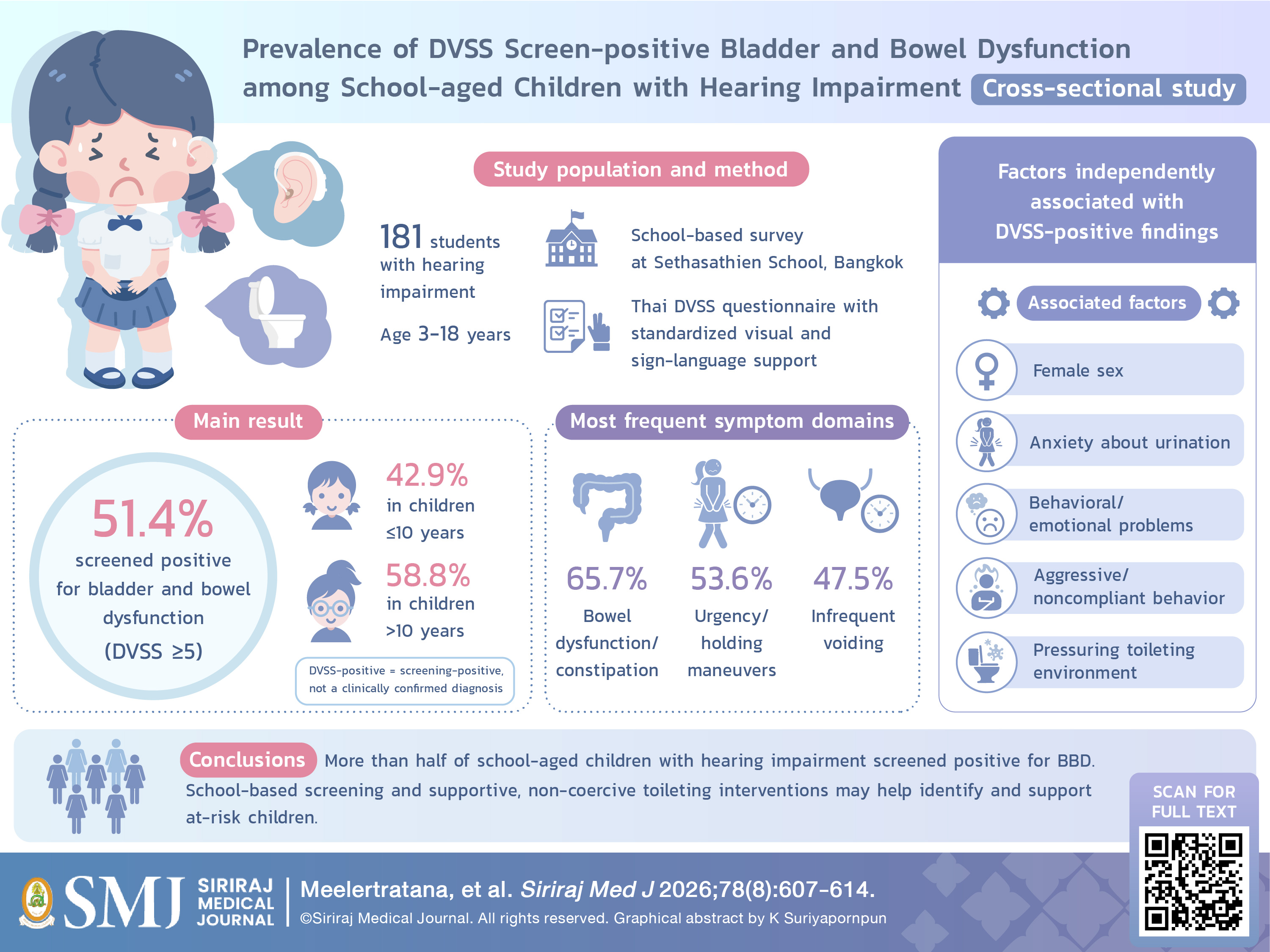
Objective: To determine the screening prevalence of bladder and bowel dysfunction (BBD) using the Thai version of the Dysfunctional Voiding Symptom Score (DVSS) and explore associated psychosocial and environmental factors.
Materials and Methods: A school-based cross-sectional survey was conducted among children aged 3-18 years with hearing impairment. Baseline data and DVSS were collected using questionnaires supported by standardized visual and sign-language materials. DVSS-positive BBD was defined as a total DVSS score ≥ 5. Prevalence, symptom domains, and factors associated with DVSS-positive BBD were analyzed using group comparisons and multivariable logistic regression.
Results: Among 181 participants (mean age 10.4±2.7 years; 65.7% female), 93 (51.4%; 95% CI: 44.1-58.6) screened positive for BBD. DVSS-positive prevalence was 42.9% in children aged <=10 years and 58.8% in those aged >10 years. The most frequent domains were bowel dysfunction/constipation (65.7%), urgency/holding maneuvers (53.6%), and infrequent voiding (47.5%). Independent associated factors were female sex (adjusted OR 2.37, 95% CI 1.08-5.17), anxiety about urination (adjusted OR 6.97, 95% CI 2.48-19.64), behavioral/emotional problems (adjusted OR 2.36, 95% CI 1.04-5.34), aggressive/noncompliant behavior (adjusted OR 2.76, 95% CI 1.13-6.77), and a pressuring toileting environment (adjusted OR 18.56, 95% CI 2.20-156.96).
Conclusions: More than half of students with hearing impairment were DVSS-positive for BBD. Psychosocial and environmental factors were independently associated with screening-positive findings. These results support targeted school-based screening and supportive, non-coercive toileting interventions, while emphasizing that DVSS-positive cases are not clinically confirmed diagnoses.
References
Vaz GT, Vasconcelos MM, Oliveira EA, Ferreira AL, Magalhães PG, Silva FM, et al. Prevalence of lower urinary tract symptoms in school-age children. Pediatr Nephrol [Internet]. 2012 Apr [cited 2026 Mar 24];27(4):597-603. Available from: https://doi.org/10.1007/s00467-011-2028-1
Tavukçu HH, Tanıdır Y, Tavukçu E, Akbal C, Şimşek F, Tarcan T. Assessment of voiding dysfunction and nocturnal enuresis rates in primary school children in an Anatolian city with a validated dysfunctional voiding scoring system questionnaire. J Urol Surg [Internet]. 2018 Dec [cited 2026 Mar 24];5(4):182-8. Available from: https://doi.org/10.4274/jus.1875
Park S, Kim BN, Kim JW, Hong SB, Shin MS, Yoo HJ, et al. Nocturnal enuresis is associated with attention deficit hyperactivity disorder and conduct problems. Psychiatry Investig [Internet]. 2013 Sep [cited 2026 Mar 24];10(3):253-8. Available from: https://doi.org/10.4306/pi.2013.10.3.253
Kodman-Jones C, Hawkins L, Schulman SL. Behavioral characteristics of children with daytime wetting. J Urol [Internet]. 2001 Dec [cited 2026 Mar 24];166(6):2392-5. Available from: https://doi.org/10.1016/S0022-5347(05)65599-1
Rakowska-Silska M, Jobs K, Paturej A, Kalicki B. Voiding disorders in pediatrician’s practice. Clin Med Insights Pediatr [Internet]. 2020 Nov [cited 2026 Mar 24];14:1179556520975035. Available from: https://doi.org/10.1177/1179556520975035
Piyaphanee N, Sirikuntaramas S, Sumboonnanonda A, Farhat WA. Validity and reliability of the Thai version of Dysfunctional Voiding Symptom Score (DVSS) questionnaire. J Med Assoc Thai [Internet]. 2017 Jan [cited 2026 Mar 24];100(1):9-16. Available from: https://he02.tci-thaijo.org/index.php/jmat/article/view/78154
Chase J, Bower W, Gibb S, Schaeffer A, von Gontard A. Diagnostic scores, questionnaires, quality of life, and outcome measures in pediatric continence: a review of available tools from the International Children’s Continence Society. J Pediatr Urol [Internet]. 2018 Feb [cited 2026 Mar 24];14(1):1-10. Available from: https://doi.org/10.1016/j.jpurol.2017.12.003
Published
How to Cite
License
Copyright (c) 2026 Siriraj Medical Journal

This work is licensed under a Creative Commons Attribution-NonCommercial-NoDerivatives 4.0 International License.
Authors who publish with this journal agree to the following conditions:
Copyright Transfer
In submitting a manuscript, the authors acknowledge that the work will become the copyrighted property of Siriraj Medical Journal upon publication.
License
Articles are licensed under a Creative Commons Attribution-NonCommercial-NoDerivatives 4.0 International License (CC BY-NC-ND 4.0). This license allows for the sharing of the work for non-commercial purposes with proper attribution to the authors and the journal. However, it does not permit modifications or the creation of derivative works.
Sharing and Access
Authors are encouraged to share their article on their personal or institutional websites and through other non-commercial platforms. Doing so can increase readership and citations.