
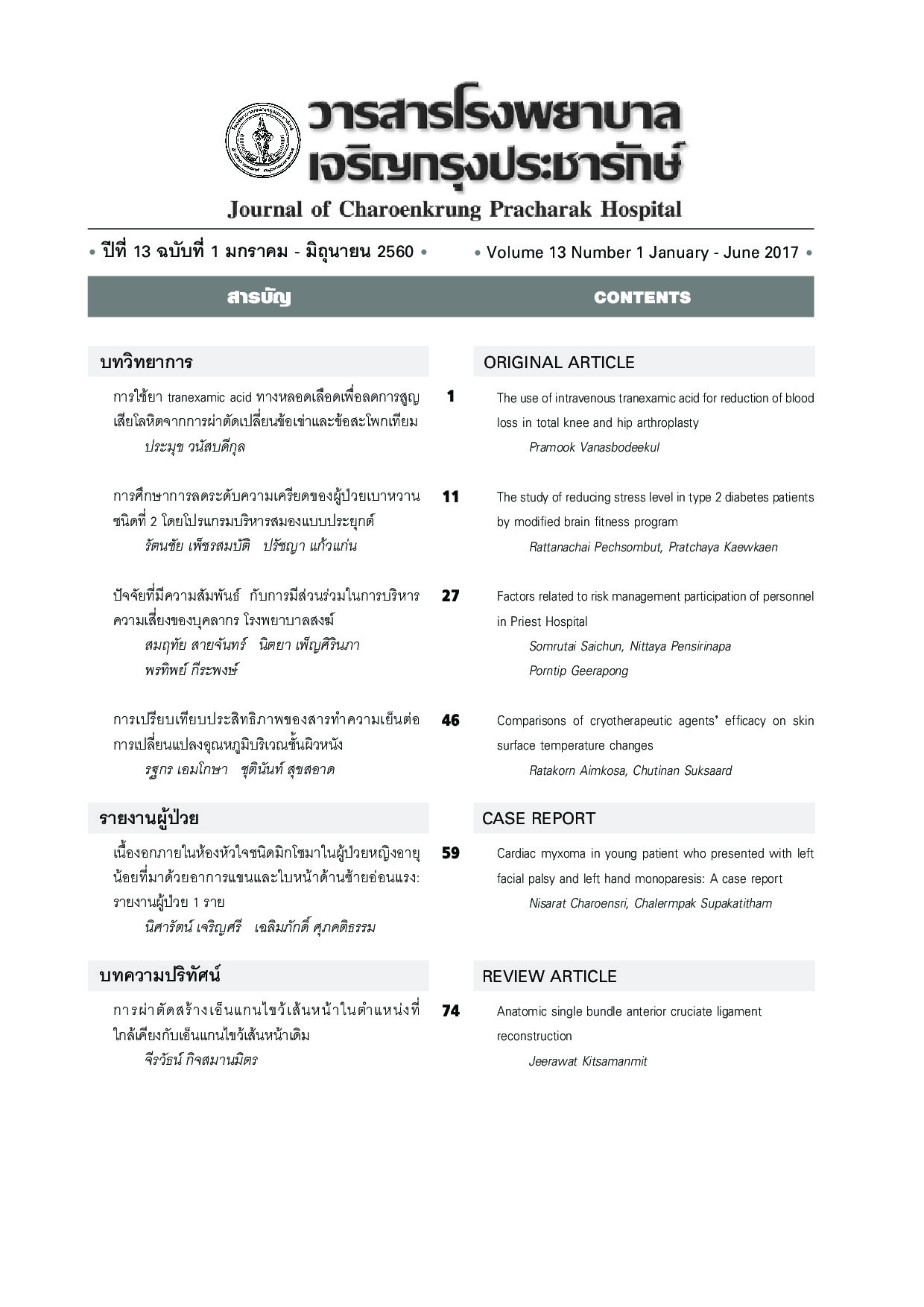
การเปรียบเทียบประสิทธิภาพของสารทำความเย็นต่อการเปลี่ยนแปลงอุณหภูมิบริเวณชั้นผิวหนัง
Article Sidebar
Main Article Content
บทคัดย่อ
บทนำ: การรักษาโดยใช้ความเย็น (Cryotherapy) เป็นที่นิยมใช้ในการปฐมพยาบาลและรักษาการบาดเจ็บของระบบโครงร่างกล้ามเนื้อและข้อต่อต่างๆในผู้ที่ได้รับบาดเจ็บจากการเล่นกีฬาหรือออกกำลังกาย อย่างไรก็ตามสารทำความเย็นที่ก่อให้เกิดประสิทธิภาพในการรักษาสูงสุดยังไม่เป็นที่แน่ชัดนัก
วัตถุประสงค์: เพื่อเป็นการเปรียบเทียบประสิทธิภาพของสารทำความเย็น ซึ่งประกอบไปด้วย ถุงเจล (3M Nexcare) ถุงน้ำแข็งก้อน (Cubed-ice pack) ถุงน้ำแข็งก้อนผสมน้ำ (Wetted cubed-ice pack) และถุงน้ำแข็งบดผสมกับน้ำ (Wetted crushed-ice pack)
วิธีดำเนินงานวิจัย: นำสารทำความเย็นวางไว้บริเวณกึ่งกลางต้นขาด้านหน้าของผู้เข้าร่วมการทดลองและรัดให้กระชับด้วยผ้ายืด (Elastic bandage) บันทึกการเปลี่ยนแปลงของอุณหภูมิเป็นเวลา 20 นาที เมื่อครบกำหนดจึงนำสารทำความเย็นออกและบันทึกอุณหภูมิต่ออีก 20 นาที ผู้เข้าร่วมการทดลองแต่ละคนจะได้รับการทดลองกับสารทำความเย็นทั้ง 4 ชนิด โดยมีระยะห่างกันทุก 1 สัปดาห์
ผลการวิจัย: ไม่พบความแตกต่างของค่าเฉลี่ยอุณหภูมิของผิวหนัง/สารทำความเย็น และค่าเฉลี่ยอัตราการลด/เพิ่มของอุณหภูมิระหว่างถุงน้ำแข็งก้อน (Cubed-ice pack) ถุงน้ำแข็งก้อนผสมน้ำ (Wetted cubed-ice pack) และถุงน้ำแข็งบดผสมกับน้ำ (Wetted crushed-ice pack) อย่างไรก็ตามถุงน้ำแข็งก้อนผสมน้ำ (Wetted cubed-ice pack) เป็นสารที่มีค่าเฉลี่ยอุณหภูมิของผิวหนัง/สารทำความเย็นต่ำที่สุดและมีค่าเฉลี่ยอัตราการลดอุณหภูมิดีที่สุดในช่วงการรักษา ส่วนถุงน้ำแข็งก้อน (Cubed-ice pack) เป็นสารที่มีค่าเฉลี่ยอุณหภูมิของผิวหนัง/สารทำความเย็นต่ำที่สุดและมีค่าเฉลี่ยอัตราการเพิ่มอุณหภูมิดีที่สุดในช่วงพักฟื้น
สรุปผลการวิจัย: ถุงน้ำแข็งก้อนผสมน้ำ (Wetted cubed-ice pack) และถุงน้ำแข็งก้อน (Cubed-ice pack) เป็นสารที่มีความสามารถในการลดอุณหภูมิและคงความเย็นของชั้นผิวหนังบริเวณต้นขาด้านหน้าได้ดีกว่าแบบอื่นที่เปรียบเทียบในการทดลอง
คำสำคัญ: การรักษาโดยใช้ความเย็น, น้ำแข็ง, อุณหภูมิของชั้นผิวหนัง
Article Details
เอกสารอ้างอิง
2. Schlesinger, N., Detry, M. A., Holland, B. K., Baker, D. G., Beutler, A. M., Rull, M., et al. Local ice therapy during bouts of acute gouty arthritis. J Rheumatol. 2002; 29: 331-4.
3. Deal, D. N., Tipton, J., Rosencrance, E., Curl, W. W., & Smith, T. L. Ice reduces edema: a study of microvascular permeability in rats. J Bone Joint Surg Am. 2002; 84A: 1573–8.
4. Karunakara, R. G., Lephart, S. M., & Pincivero, D. M. (1999). Changes in forearm blood flow during single and intermittent cold application. J Orthop Sports Phys Ther. 1999; 29: 177–80.
5. Weston, M., Taber, C., Casagranda, L., & Cornwall, M. W. Changes in local blood volume during cold gel pack application to traumatized ankles. J Orthop Sports Phys Ther. 1994; 19: 197–9.
6. McMeeken, J., Murray, L., & Cocks, S. Effects of cooling with simulated ice on skin temperature and nerve conduction velocity. Aust J Phys Ther. 1984; 30: 111–4.
7. Lee, S. U., Bang, M. S., & Han, T. R. Effect of cold air therapy in relieving spasticity: applied to spinalized rabbits. Spinal Cord. 2002; 40: 167–73.
8. Miglietta, O. E. Electromyographic characteristics of clonus and influence of cold. Arch Phys Med Rehabil. 1964; 45: 508–12.
9. Knight, K. L. The effects of hypothermia on inflammation and swelling. J Athl Train. 1976; 11: 7–10.
10. Lehmann, J. F., Masock, A. J., Wareen, C. G., & Koblanski, J. N. Effect of therapeutic temperatures on tendon extensibility. Arch Phys Med Rehabil. 1970; 51: 481–7.
11. Michenfelder, J. D., & Theye, R. A. Hypothermia: effect on canine brain and whole-body metabolism. Anesthesiology. 1968; 29: 1107–12.
12. Merrick, M. A. Secondary injury after musculoskeletal trauma: a review and update. J Athl Train. 2002; 37: 209–17.
13. Merrick, M. A., Rankin, J. M., Andres, F. A., & Hinman, C. L. A preliminary examination of cryotherapy and secondary injury in skeletal muscle. Med Sci Sports Exerc. 1999; 31: 1516–21.
14. Belitsky, R.B., Odam, S.J., & Hubley-Kozey C. Evaluation of the effectiveness of wet ice, dry ice, and cryogen packs in reducing skin temperature. Phys Ther. 1987; 67: 1080-4.
15.Chesterton, L.S., Foster, N.E., & Ross, L. Skin temperature response to cryotherapy. Arch Phys Med Rehabil. 2002; 83: 543-9.
16. Merrick, M.A., Jutte, L.S., & Smith, M.E. Cold modalities with different thermodynamic properties produce different surface and intramuscular temperatures. J Athl Train. 2003; 38: 28-33.
17. Myrer, W., Meason, G., & Fellingham, G.W. Temperature changes in the human leg during and after two methods of cryotherapy. J Athl Train. 1998; 33: 25-9.
18. Zemke, J.E., Anderson, J.C., Guion, W.K., McMillan, J., & Joyner, A.B. Intramuscular temperature responses in the human leg to two forms of cryotherapy: ice massage and ice bag. J Orthop Sports Phys Ther. 1998; 27: 301-7.
19. Sapega, A.A., Heppenstall, R.B., Sokolow, D.P., et al. The bioenergetics of preservation of limbs before replantation. J Bone Joint Surg Am. 1988; 70: 1500-13.
20. Owen, E.F. Jr., Hart, J.F., Donofrio, J.J., Haralambous, J. Mierzejewski, E. Paraspinal skin temperature pattern: an interexaminer and intraexaminer reliability study. J Manipulative Physiol Ther. 2004; 27: 155-9.
21.Dolan M.G., Thornton R.M., Fish D.R., & Mendel F.C. Effects of cold water immersion on edema formation after blunt injury to the hind limbs of rats. J Athl Train. 1997; 32(3): 233-7.
22. Drez D., Faust D.C., & Evan J.P. Cryotherapy and nerve palsy. Am J Sports Med. 1981; 9(4): 256-7.
23. Hocutt J.E., Jaffe R., Rylander C.R., & Beeve J.K. Cryotherapy in ankle sprains. Am J Sports Med. 1982; 10(5): 316-9.
24. Halar E.M., DeLisa J.A., & Brozovich F.V. Nerve conduction velocity: relationship of skin, subcutaneous and intramuscular temperatures. Arch Phys Med Rehabil. 1980; 61(5): 199-203.
25. Curl W.W., Smith B.P., Marr A., Rosenctance E., Holden M., & Smith T.L. The effects of contusion and cryotherapy on skeletal muscle microcirculation. J Sports Med Phys Fitness. 1997; 37(4): 279-86.
26. Jutte, L.S., Merrick, M.A., Ingersoll, C.D., Edwards, J.E. The relationship between intramuscular temperature, skin temperature, and adipose thickness during cryotherapy and rewarming. Arch Phys Med Rehabil. 2001; 82: 845-50.
27. Kanlayanaphotporn, R., Janwantanakul, P. Comparison of skin surface temperature during the application of various cryotherapy modalities. Arch Phys Med Rehabil. 2005; 86: 1411-5.
28. Enwemeka, C.S., Allen, C., Avila, P. Bina, J., Konrade, J., Munns, S. Soft tissue thermodynamics before, during, and after cryotherapy, Arch Phys Med Rehabil. 2002; 83: 1501-5.
29. Merrick, M.A., Knight, K.L., Ingersoll, C.D., Potteiger, J.A. The effects of ice and compression wraps on intramuscular temperature at various depths, . J Athl Train. 1993; 28: 236-45.
30. Palmer, J.E., Knight, K.L. Ankle and thigh skin surface temperature changes with repeated ice pack application, . J Athl Train. 1996; 31: 319-23.
31. Gage, A.A. What temperature is lethal for cells?. J Dermatol Surg Oncol. 1979; 5: 459-60.
32. Santos, Vanessa Batista da Costa et al. Effect of cryotherapy on the ankle temperature in athletes: ice pack and cold water immersion. Fisioterapia em Movimento. 2015; 28(1): 23-30.
33. Janwantanakul, P. The effect of quantity of ice and size of contact area on ice pack/skin interface temperature. Phys Ther. 2009; 95(2): 120-5.
34. Lide D.R. CRC Handbook of chemistry and physics. 84thed. Cleveland, OH: CRC press, 2003; 6_1–6_7.
35. Hardaker, N., Hobbs, S., Kennet, J. & Selfe, J. Cooling efficiency of 4 common cryotherapeutic agents. J Athl Train. 2007; 42(3): 343-8.
