
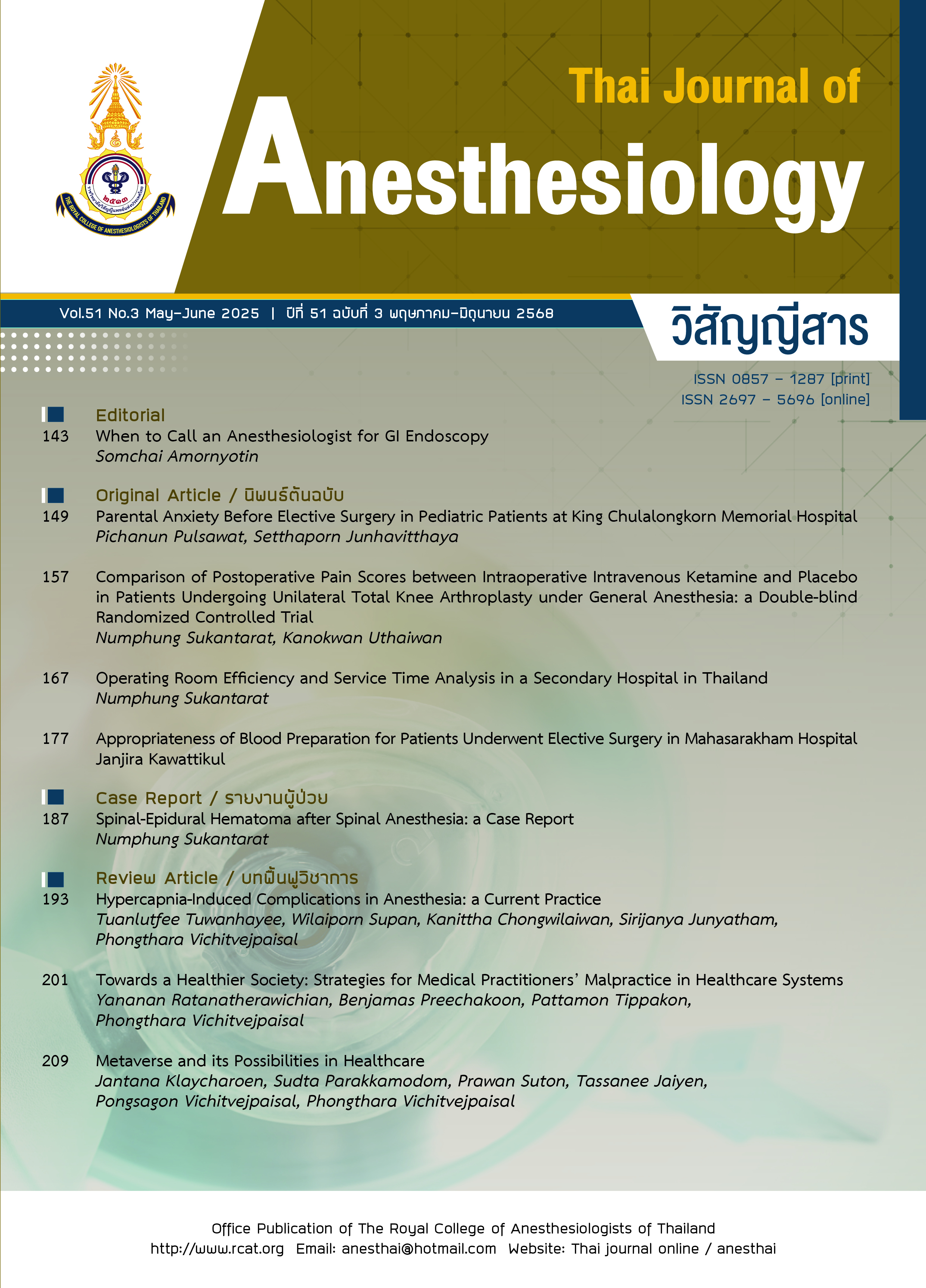
When to Call an Anesthesiologist for GI Endoscopy
Keywords:
anesthesia, anesthesiologist, gastrointestinal endoscopy, sedationAbstract
Gastrointestinal endoscopy (GIE) has evolved significantly with advancements in endoscopic technology and techniques. As procedures become more complex and patient populations more diverse, the role of anesthesia services has expanded. This review explores the clinical indications, patient factors, procedural complexities, and institutional considerations that determine when it is appropriate to involve an anesthesiologist in GIE procedures. It also discusses sedation techniques, risk stratification, and the benefits of interdisciplinary collaboration to enhance patient safety and procedural success.
References
Amornyotin S, Pranootnarabhal T, Chalayonnavin W, Kongphlay S. Anesthesia for gastrointestinal endoscopy from 2005-2006 in Siriraj Hospital: a prospective study. Thai J Anesthesiol. 2007;33:93-101.
Amornyotin S. Registered nurse-administered sedation for gastrointestinal endoscopic procedure. World J Gastrointest Endosc. 2015;7:769-76.
Amornyotin S. Sedation-related complications in gastrointestinal endoscopy. World J Gastrointest Endosc. 2013;5:527-33.
Amornyotin S. Intravenous sedation techniques for gastrointestinal endoscopy. J Gastroenterol Hepatol Res. 2016;5:2050-7.
Amornyotin S. Common patient positioning in gastrointestinal endoscopy. J Clin Anesth Intens Care. 2020;1:11-2.
Amornyotin S. Sedative and analgesic drugs for gastrointestinal endoscopic procedure. J Gastroenterol Hepatol Res. 2014;3:1133-44.
Amornyotin S. Sedation and monitoring for gastrointestinal endoscopy. World J Gastrointest Endosc. 2013;5:47-55.
Amornyotin S, Srikureja W, Pausawasdi N, Prakanrattana U, Kachintorn U. Intravenous sedation for gastrointestinal endoscopy in very elderly patients of Thailand. Asian Biomed. 2011;5:485-91.
Amornyotin S, Aanpreung P, Prakanrattana U, Chalayonnavin W, Chatchawankitkul S, Srikureja W. Experience of intravenous sedation for pediatric gastrointestinal endoscopy in a large tertiary referral center in a developing country. Pediatr Anesth. 2009;19:784-91.
Downloads
Published
How to Cite
Issue
Section
License

This work is licensed under a Creative Commons Attribution-NonCommercial-NoDerivatives 4.0 International License.
Copyright
Copyright of all articles published in the Thai Journal of Anesthesiology is held by the Thai Journal of Anesthesiology, the Royal College of Anesthesiologists of Thailand. Submission of a manuscript constitutes the authors' agreement that, upon acceptance for publication, copyright of the work is transferred to the Journal. The content and any opinions expressed in published articles are the sole responsibility of the authors and do not necessarily reflect the views of the editorial board or the Royal College of Anesthesiologists of Thailand.
Licensing
All articles are published open access under the Creative Commons Attribution-NonCommercial-NoDerivatives 4.0 International License (CC BY-NC-ND 4.0). Under this license, anyone may copy and redistribute published articles in any medium or format for non-commercial purposes, provided that appropriate credit is given to the authors and to the Thai Journal of Anesthesiology as the original source of publication, a link to the license is included, and the material is not modified in any way. Requests for commercial use or for adaptation of published material should be directed to the editorial office.
Authors' Rights
Although copyright is held by the Journal, authors retain the right to reuse their own published material in their future scholarly works, theses and dissertations, teaching, and academic presentations, and to deposit the final published version (PDF) in institutional or subject repositories or on personal and institutional websites, without embargo, provided that the Thai Journal of Anesthesiology is clearly acknowledged as the original place of publication.