
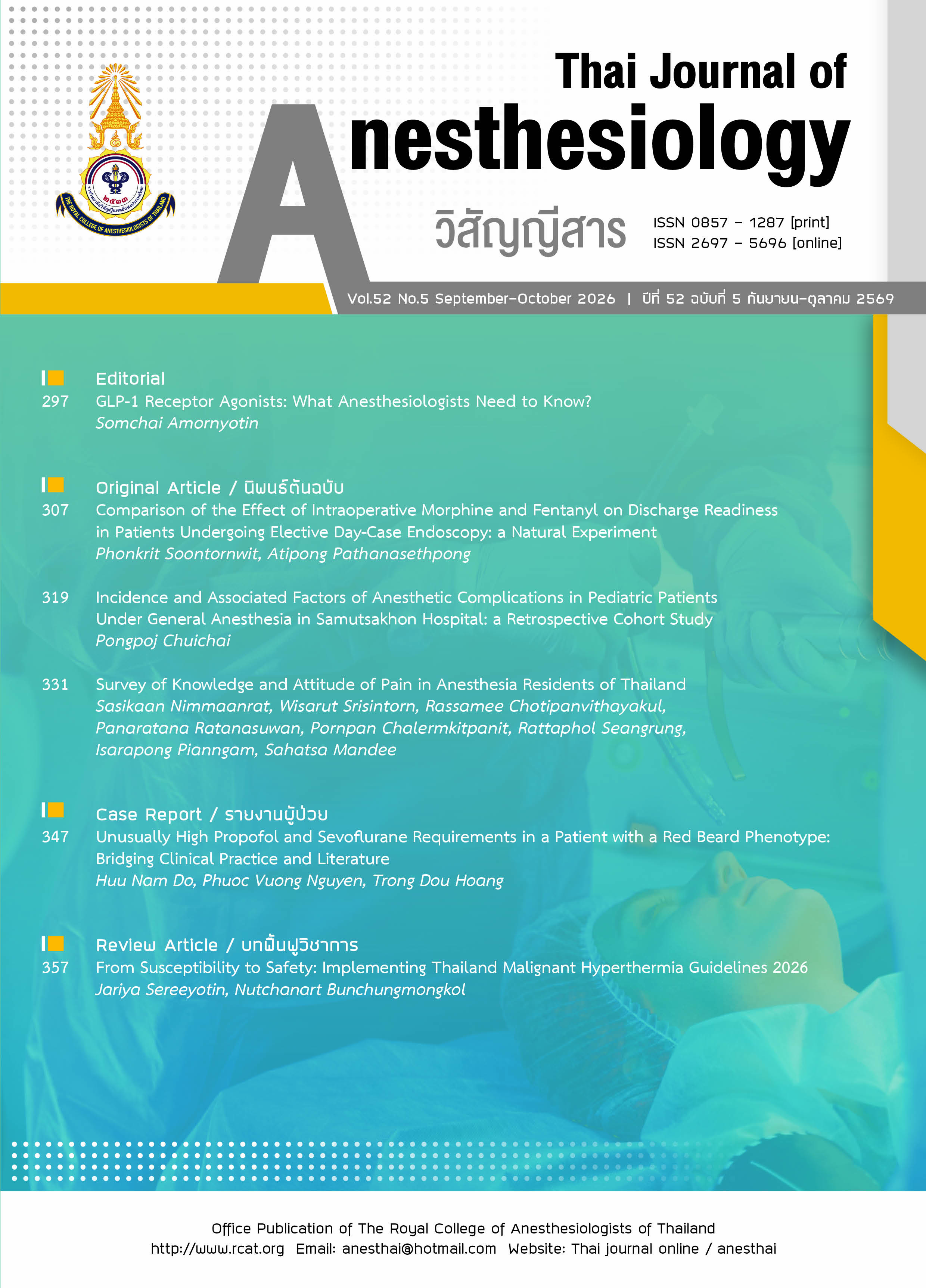
Comparison of the Effect of Intraoperative Morphine and Fentanyl on Discharge Readiness in Patients Undergoing Elective Day-Case Endoscopy: A Natural Experiment
Keywords:
ambulatory surgical procedure, endoscopy, fentanyl, morphine, procedural sedationAbstract
Objective: This study assessed whether morphine, compared to fentanyl, delayed fitness for discharge in patients undergoing day-case gastrointestinal (GI) endoscopy. Materials and methods: Using a retrospective observational design with a natural experiment framework, we compared two groups created by unpredictable fentanyl shortages that prompted morphine use without changes to caregivers or care: the fentanyl and the morphine groups. Data came from pre-anesthetic, intraoperative, and post-anesthesia care unit (PACU) records at Srinagarind Hospital, Khon Kaen University, from January 2021 to December 2022. The primary outcome was time from PACU arrival to a post-anesthetic discharge scoring system (PADSS) score of 9 or more. Secondary outcomes were the PADSS sub- categories: vital signs, post-anesthetic activity, postoperative nausea and vomiting (PONV), pain, and surgical bleeding. Analyses used Kaplan-Meier survival analysis. Results: Of the 442 patients (286 in the fentanyl group and 156 in the morphine group), the proportion achieving a PADSS score of 9 or more by 75 min was significantly higher in the fentanyl group (P < 0.001), but no significant differences remained at 90 min or later. The 75-min difference persisted after adjustment for opioid dose. Among sub-categories, patients in the fentanyl group reached full marks sooner in vital signs (P < 0.001) and activity (P < 0.001), with no significant differences in PONV (P = 0.81), pain (P = 0.62), or surgical bleeding (P = 0.16). Conclusion: In day-case GI endoscopy, discharge readiness at 75 min was more frequent with intraoperative fentanyl than morphine; no significant difference was detected thereafter.
References
1. Misal US, Joshi SA, Shaikh MM. Delayed recovery from anesthesia: a postgraduate educational review. Anesth Essays Res. 2016;10:164-72.
2. Ellis TA, Edberg JL, Kumar N, Applefield DJ. Delayed emergence from anesthesia: a simulation case for anesthesia learners. MedEdPORTAL. 2017;13:10628.
3. Gupta K, Nagappa M, Prasad A, et al. Risk factors for opioid-induced respiratory depression in surgical patients: a systematic review and meta-analyses. BMJ Open. 2018;8:e024086.
4. Sinclair RC, Faleiro RJ. Delayed recovery of consciousness after anaesthesia. Contin Educ Anaesth Crit Care Pain. 2006;6:114-8.
5. Grewal G, Joshi GP. Obesity and obstructive sleep apnea in the ambulatory patient. Anesthesiol Clin. 2019;37:215-24.
6. Peng PW, Sandler AN. A review of the use of fentanyl analgesia in the management of acute pain in adults. Anesthesiology. 1999;90:576-99.
7. Vahedi HSM, Hajebi H, Vahidi E, Nejati A, Saeedi M. Comparison between intravenous morphine versus fentanyl in acute pain relief in drug abusers with acute limb traumatic injury. World J Emerg Med. 2019;10:27-32.
8. Bhagat H, Sahni N, Bhukal I, et al. Comparative evaluation of morphine and fentanyl for emergence following supratentorial craniotomy. J Neuroanaesth Crit Care. 2017;4:155-8.
9. Sanford TJ Jr, Smith NT, Dec-Silver H, Harrison WK. A comparison of morphine, fentanyl, and sufentanil anesthesia for cardiac surgery: induction, emergence, and extubation. Anesth Analg. 1986;65:259-66.
10. Fox ER, McLaughlin MM. ASHP guidelines on managing drug product shortages. Am J Health Syst Pharm. 2018;75:1742-50.
11. Hughes MA, Glass PS, Jacobs JR. Context-sensitive half-time in multicompartment pharmacokinetic models for intravenous anesthetic drugs. Anesthesiology. 1992;76:334-41.
12. Craig P, Katikireddi SV, Leyland A, Popham F. Natural experiments: an overview of methods, approaches, and contributions to public health intervention research. Annu Rev Public Health 2017;38:39-56.
13. Treillet E, Laurent S, Hadjiat Y. Practical management of opioid rotation and equianalgesia. J Pain Res. 2018;11:2587-601.
14. Chung F, Chan VW, Ong D. A post-anesthetic discharge scoring system for home readiness after ambulatory surgery. J Clin Anesth. 1995;7:500-6.
15. Apfelbaum JL, Walawander CA, Grasela TH, et al. Eliminating intensive postoperative care in same-day surgery patients using short-acting anesthetics. Anesthesiology. 2002;97:66-74.
16. Rüsch D, Eberhart LH, Wallenborn J, Kranke P. Nausea and vomiting after surgery under general anesthesia: an evidence-based review concerning risk assessment, prevention, and treatment. Dtsch Arztebl Int. 2010;107:733-41.
Downloads
Published
How to Cite
Issue
Section
License
Copyright
Copyright of all articles published in the Thai Journal of Anesthesiology is held by the Thai Journal of Anesthesiology, the Royal College of Anesthesiologists of Thailand. Submission of a manuscript constitutes the authors' agreement that, upon acceptance for publication, copyright of the work is transferred to the Journal. The content and any opinions expressed in published articles are the sole responsibility of the authors and do not necessarily reflect the views of the editorial board or the Royal College of Anesthesiologists of Thailand.
Licensing
All articles are published open access under the Creative Commons Attribution-NonCommercial-NoDerivatives 4.0 International License (CC BY-NC-ND 4.0). Under this license, anyone may copy and redistribute published articles in any medium or format for non-commercial purposes, provided that appropriate credit is given to the authors and to the Thai Journal of Anesthesiology as the original source of publication, a link to the license is included, and the material is not modified in any way. Requests for commercial use or for adaptation of published material should be directed to the editorial office.
Authors' Rights
Although copyright is held by the Journal, authors retain the right to reuse their own published material in their future scholarly works, theses and dissertations, teaching, and academic presentations, and to deposit the final published version (PDF) in institutional or subject repositories or on personal and institutional websites, without embargo, provided that the Thai Journal of Anesthesiology is clearly acknowledged as the original place of publication.