
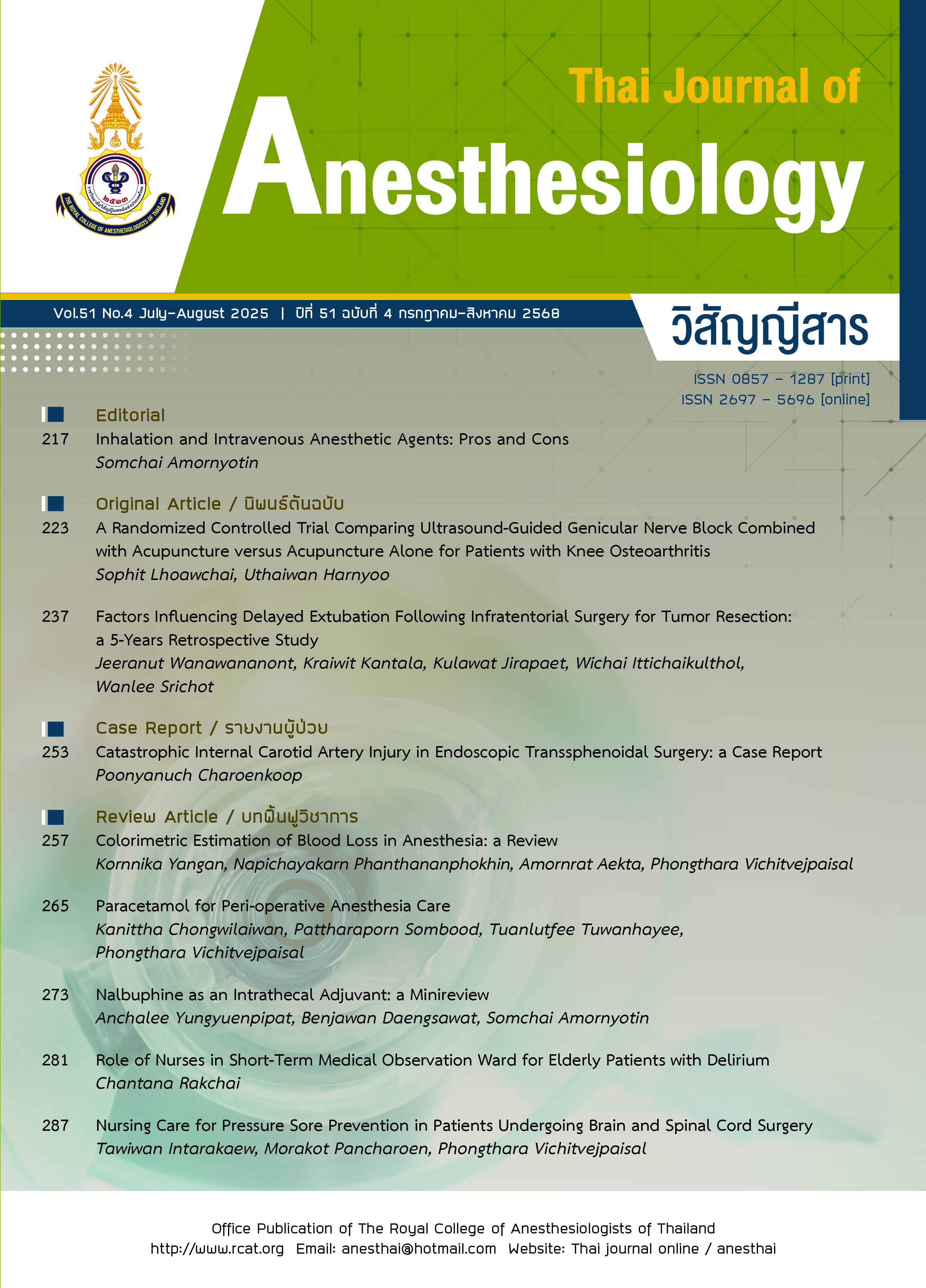
Paracetamol for Peri-operative Anesthesia Care
Keywords:
acetaminophen, multimodal analgesia, pain management, paracetamol, peri-operative anesthesia careAbstract
This review encapsulates paracetamol’s pharmacokinetics, pharmacodynamics, and pharmacogenomics. Preclinical and experimental evidence underscores paracetamol’s unique analgesic effects, examining animal models, dose-response relationships, and its influence on inflammatory and nociceptive pathways. In the clinical realm, paracetamol emerges as a cornerstone of multimodal analgesia, targeting peri-operative pain challenges. This article explores paracetamol’s role in diverse surgical contexts, and in special patient populations. Notably, paracetamol’s ability to reduce opioid consumption while preserving effective pain control is examined, alongside its impact on post-operative outcomes and patient satisfaction.
References
Freo U, Ruocco C, Valerio A, Scagnol I, Nisoli E. Paracetamol: a review of guideline recommendations. J Clin Med. 2021;10:3420.
Frauenknecht J, Kirkham KR, Jacot-Guillarmod A, Albrecht E. Analgesic impact of intra-operative opioids vs. opioid-free anaesthesia: a systematic review and meta-analysis. Anaesthesia. 2019;74:651-62.
Sharma CV, Mehta V. Paracetamol: mechanisms and updates. Cont Educ Anaesth Crit Care Pain. 2014;14:153-8.
Allegaert K, Olkkola KT, Owens KH, et al. Covariates of intravenous paracetamol pharmacokinetics in adults. BMC Anesthesiol. 2014;14:77.
Ohashi N, Kohno T. Analgesic effect of acetaminophen: a review of known and novel mechanisms of action. Front Pharmacol. 2020;11:580289.
Pickering G, Loriot MA, Libert F, Eschalier A, Beaune P, Dubray C. Analgesic effect of acetaminophen in humans: first evidence of a central serotonergic mechanism. Clin Pharmacol Ther. 2006;79:371-8.
Ayoub SS. Paracetamol (acetaminophen): a familiar drug with an unexplained mechanism of action. Temperature. 2021;8:351-71.
Caparrotta TM, Antoine DJ, Dear JW. Are some people at increased risk of paracetamol-induced liver injury? A critical review of the literature. Eur J Clin Pharmacol. 2018;74:147-60.
García-Suástegui WA, Ramos-Chávez LA, Rubio-Osornio M, et al. The role of CYP2E1 in the drug metabolism or bioactivation in the brain. Oxid Med Cell Longev. 2017;2017:4680732.
Jarrar Y, Lee SJ. The functionality of UDP-glucuronosyltransferase genetic variants and their association with drug responses and human diseases. J Pers Med. 2021;11:554.
Zhao L, Pickering G. Paracetamol metabolism and related genetic differences. Drug Metab Rev. 2011;43:41-52.
Pickering G, Creveaux I, Macian N, Pereira B. Paracetamol and pain modulation by TRPV1, UGT2B15, SULT1A1 genotypes: a randomized clinical trial in healthy volunteers. Pain Med. 2020;21:661-9.
Hoshijima H, Hunt M, Nagasaka H, Yaksh T. Systematic review of systemic and neuraxial effects of acetaminophen in preclinical models of nociceptive processing. J Pain Res. 2021;14:3521-52.
Esh CJ, Chrismas BCR, Mauger AR, Taylor L. Pharmacological hypotheses: Is acetaminophen selective in its cyclooxygenase inhibition? Pharmacol Res Perspect. 2021;9:e00835.
Lee Y-S, Kim H, Brahim JS, Rowan J, Lee G, Dionne RA. Acetaminophen selectively suppresses peripheral prostaglandin E2 release and increases COX-2 gene expression in a clinical model of acute inflammation. Pain. 2007;129:279-86.
Freo U. Paracetamol for multimodal analgesia. Pain Manag. 2022;12:737-50.
Furyk J, Levas D, Close B, et al. Intravenous versus oral paracetamol for acute pain in adults in the emergency department setting: a prospective, double-blind, double-dummy, randomised controlled trial. Emerg Med J. 2018;35:179-84.
Mallama M, Valencia A, Rijs K, Rietdijk W, Klimek M, Calvache JA. A systematic review and trial sequential analysis of intravenous vs. oral peri-operative paracetamol. Anaesthesia. 2021;76:270-6.
Zhou Y, Yuan P, Xing Q, Jin W, Shi C. Efficacy of postoperative analgesia with intravenous paracetamol and mannitol injection, combined with thoracic paravertebral nerve block in post video-assisted thoracoscopic surgery pain: a prospective, randomized, double-blind controlled trial. BMC Anesthesiol. 2024;24:14.
Chen Q, Chen E, Qian X. A narrative review on perioperative pain management strategies in enhanced recovery pathways-the past, present and future. J Clin Med. 2021;10:2568.
Simpson JC, Bao X, Agarwala A. Pain management in enhanced recovery after surgery (ERAS) protocols. Clin Colon Rectal Surg. 2019;32:121-8.
Derry S, Moore RA. Paracetamol (acetaminophen) with or without an antiemetic for acute migraine headaches in adults. Cochrane Database Syst Rev. 2013;2013:CD008040.
Ogawa K, Uchida M, Yamaki T, et al. Delivery of acetaminophen to the central nervous system and the pharmacological effect after intranasal administration with a mucoadhesive agent and absorption enhancer. Int J Pharm. 2021;594:120046.
Sintov AC, Krymberk I, Gavrilov V, Gorodischer R. Transdermal delivery of paracetamol for paediatric use: effects of vehicle formulations on the percutaneous penetration. J Pharm Pharmacol. 2003;55:911-9.
Downloads
Published
How to Cite
Issue
Section
License

This work is licensed under a Creative Commons Attribution-NonCommercial-NoDerivatives 4.0 International License.
Copyright
Copyright of all articles published in the Thai Journal of Anesthesiology is held by the Thai Journal of Anesthesiology, the Royal College of Anesthesiologists of Thailand. Submission of a manuscript constitutes the authors' agreement that, upon acceptance for publication, copyright of the work is transferred to the Journal. The content and any opinions expressed in published articles are the sole responsibility of the authors and do not necessarily reflect the views of the editorial board or the Royal College of Anesthesiologists of Thailand.
Licensing
All articles are published open access under the Creative Commons Attribution-NonCommercial-NoDerivatives 4.0 International License (CC BY-NC-ND 4.0). Under this license, anyone may copy and redistribute published articles in any medium or format for non-commercial purposes, provided that appropriate credit is given to the authors and to the Thai Journal of Anesthesiology as the original source of publication, a link to the license is included, and the material is not modified in any way. Requests for commercial use or for adaptation of published material should be directed to the editorial office.
Authors' Rights
Although copyright is held by the Journal, authors retain the right to reuse their own published material in their future scholarly works, theses and dissertations, teaching, and academic presentations, and to deposit the final published version (PDF) in institutional or subject repositories or on personal and institutional websites, without embargo, provided that the Thai Journal of Anesthesiology is clearly acknowledged as the original place of publication.