
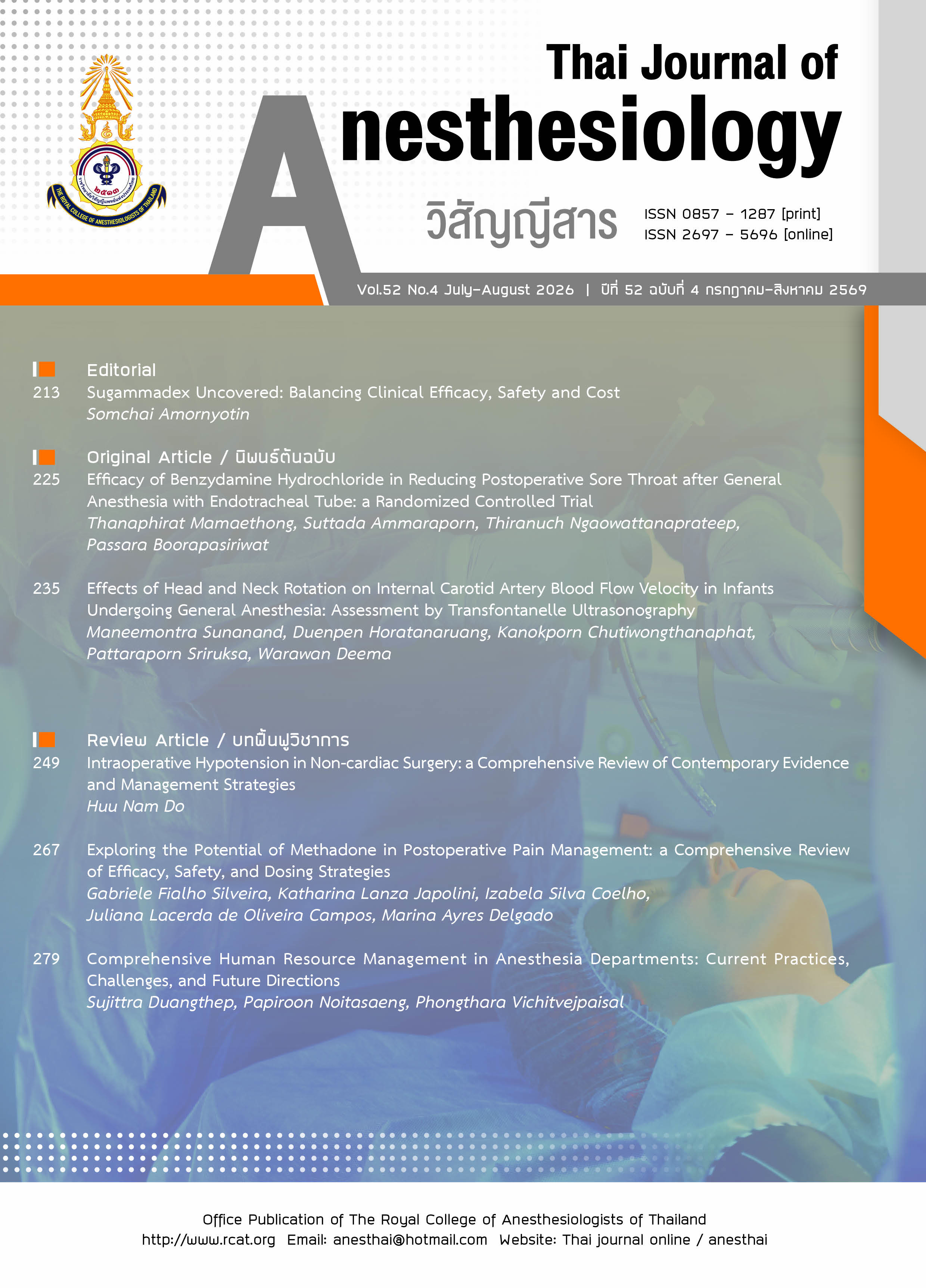
Exploring the Potential of Methadone in Postoperative Pain Management: a Comprehensive Review of Efficacy, Safety, and Dosing Strategies
Keywords:
intraoperative analgesia, methadone, multimodal analgesia, opioid-sparing, post- operative pain managementAbstract
Postoperative pain management is crucial for ensuring patient comfort, promoting recovery, and preventing complications such as delayed mobilization and hospital readmission. While opioids are the standard of care for severe postoperative pain, issues such as opioid tolerance, hyperalgesia, and adverse effects like sedation and respiratory depression complicate their use. Methadone, a synthetic opioid with NMDA receptor antagonism properties, has emerged as a promising alternative due to its long elimination half-life and multi-target effects. This review evaluates the current evidence supporting methadone use in intraoperative analgesia and its subsequent impact on postoperative pain relief. We highlight the pharmacodynamics, clinical efficacy, dosing strategies, safety profile, and comparison with traditional opioids. Methadone offers sustained analgesia, reduces opioid consumption, and shows potential for opioid-sparing strategies. However, its use requires careful monitoring due to risks such as respiratory depression and arrhythmias, especially in certain populations, such as the elderly or obese. The variability in individual response due to genetic factors, such as polymorphisms in the CYP2B6 gene, must also be considered. Continued research is needed to optimize dosing protocols and fully establish methadone’s role in postoperative pain management.
References
D’Souza RS, Gurrieri C, Johnson RL, Warner N, Wittwer E. Intraoperative methadone administration and postoperative pain control: a systematic review and meta-analysis. Pain. 2020;161:237-43.
Chui PT, Gin T. A double-blind randomised trial comparing postoperative analgesia after perioperative loading doses of methadone or morphine. Anaesth Intensive Care. 1992;20:46-51.
Machado FC, Vieira JE, de Orange FA, Ashmawi HA. Intraoperative methadone reduces pain and opioid consumption in acute postoperative pain: a systematic review and meta-analysis. Anesth Analg. 2019;129:1723-32.
Tognoli E, Proto PL, Motta G, Galeone C, Mariani L, Valenza F. Methadone for postoperative analgesia: contribution of N-methyl-D-aspartate receptor antagonism: a randomised controlled trial. Eur J Anaesthesiol. 2020;37:934-43.
Kreutzwiser D, Tawfic QA. Methadone for pain management: a pharmacotherapeutic review. CNS Drugs. 2020;34:827-39.
Packiasabapathy S, Aruldhas BW, Horn N, et al. Pharmacogenomics of methadone: a narrative review of the literature. Pharmacogenomics. 2020;21:871-87.
Chalabianloo F, Fadnes LT, Johansson KA, et al. Methadone pharmacokinetics in opioid agonist treatment: Influencing factors and clinical implications. Basic Clin Pharmacol Toxicol. 2024;134:333-44.
Carlé N, Nikolajsen L, Uhrbrand CG. Respiratory depression following intraoperative methadone: a retrospective cohort study. Anesth Analg. 2025;140:516-23.
Cheriyan T, Gaber M, Glenn T, et al. Effect of intraoperative methadone vs other opioids on postoperative outcomes: a meta-analysis of randomized controlled studies. Pain. 2022;163:e153-64.
Azamfirei R, Procaccini D, Lobner K, Kudchadkar SR. The effects of intraoperative methadone on postoperative pain control in pediatric patients: a scoping review. Anesth Analg. 2024;139:263-71.
Goldblatt J, Crawford L, Ross J, Edelman J, Pavey W. The influence of preoperative or intraoperative methadone on postcardiac surgery pain and opioid administration: a systematic review and meta-analysis. Cardiothorac Surg. 2024;32:8.
Carvalho AC, Sebold FJG, Calegari PMG, Oliveira BH de, Schuelter-Trevisol F. Comparison of postoperative analgesia with methadone versus morphine in cardiac surgery. Braz J Anesthesiol. 2018;68:122-7.
Pontes JPJ, Braz FR, Módolo NSP, Mattar LA, Sousa JAG, Lima LHNE. Intra-operative methadone effect on quality of recovery compared with morphine following laparoscopic gastroplasty: a randomised controlled trial. Anaesthesia. 2021;76:199-208.
Mercadante S, Bruera E. Methadone as a first-line opioid in cancer pain management: a Systematic Review. J Pain Symptom Manage. 2018;55:998-1003.
Mercadante S, David F, Villari P, Spedale VM, Casuccio A. Methadone versus morphine for postoperative pain in patients undergoing surgery for gynecological cancer: a randomized controlled clinical trial. J Clin Anesth. 2020;61:109627.
Friesgaard KD, Brix LD, Kristensen CB, Rian O, Nikolajsen L. Intraoperative methadone for postoperative pain after laparoscopic hysterectomy: protocol for a randomised, double-blind trial. Acta Anaesthesiol Scand. 2019;63:1257-61.
Murphy GS, Szokol JW, Avram MJ, et al. Clinical effectiveness and safety of methadone for intraoperative fusion surgery. Anesthesiology. 2017;126:822-33.
Gottschalk A, Durieux ME, Nemergut EC. Intraoperative methadone improves postoperative pain control in patients undergoing complex spine surgery. Anesth Analg. 2011;112:218-23.
Petrosan A, Zassman S, Cohn S, et al. Impact of intravenous methadone administered intraoperatively on postoperative opioid utilization. Ann Pharmacother. 2021;55:1341-6.
Robinson JD, Caruso TJ, Wu M, Kleiman ZI, Kwiatkowski DM. Intraoperative methadone is associated with decreased perioperative opioid use without adverse events: a case-matched cohort study. J Cardiothorac Vasc Anesth. 2020;34:335-41.
Pontes JPJ, Braz FR, Módolo NSP, Mattar LA, Sousa JAG, Navarro e Lima LH. Intra-operative methadone effect on quality of recovery compared with morphine following laparoscopic gastroplasty: a randomised controlled trial. Anaesthesia. 2021;76(2):199–208.
Carlé N, Nikolajsen L, Uhrbrand CG. Respiratory depression following intraoperative methadone: a retrospective cohort study. Anesth Analg. 2025;140:516-23.
Oneda B, Crettol S, Bochud M, et al. Β-Arrestin2 influences the response to methadone in
opioid-dependent patients. Pharmacogenomics J. 2011;11:258-66.
Mafi A, Kim SK, Goddard WA. Mechanism of β-arrestin recruitment by the μ-opioid G protein-coupled receptor. Proc Natl Acad Sci U S A. 2020;117:16346-55.
Green KW, Popovic G, Baitch L. Intraoperative methadone for day-case gynaecological laparoscopy: a double-blind, randomised controlled trial. Anaesth Intensive Care. 2024;52:168-79.
Richlin DM, Reuben SS. Postoperative pain control with methadone following lower abdominal surgery. J Clin Anesth. 1991;3:112-6.
Nygaard KH, Strøm T, Specht K, Petersen SR, Schønnemann JO. Perioperative methadone compared to placebo in elderly hip fracture patients: a study protocol for a randomized controlled trial (MetaHip trial). Trials. 2024;25:842.
Pedersen AK, Nygaard KH, Petersen SR, et al. Adjusting perioperative methadone dose for elderly and fragile hip fracture patients (MetaHip-trial)-a statistical analysis plan for an adaptive dose-finding trial. Contemp Clin Trials Commun. 2023;36:101228.
Methadone Hydrochloride Injection: Highlights of Prescribing Information [package insert]. Silver Spring, MD: US Food and Drug Administration; 2026. Available from: https://www.accessdata.fda.gov
Chalabianloo F, Fadnes LT, Johansson KA, et al. Methadone pharmacokinetics in opioid agonist treatment: Influencing factors and clinical implications. Basic Clin Pharmacol Toxicol. 2024;134:333-44.
Bøndergaard M, Uhrbrand PG, Karaca T, et al. Intraoperative methadone for postoperative pain in adult patients undergoing tonsillectomy-a randomised controlled trial. BJA Open. 2025;14:100418.
Downloads
Published
How to Cite
Issue
Section
License
Copyright
Copyright of all articles published in the Thai Journal of Anesthesiology is held by the Thai Journal of Anesthesiology, the Royal College of Anesthesiologists of Thailand. Submission of a manuscript constitutes the authors' agreement that, upon acceptance for publication, copyright of the work is transferred to the Journal. The content and any opinions expressed in published articles are the sole responsibility of the authors and do not necessarily reflect the views of the editorial board or the Royal College of Anesthesiologists of Thailand.
Licensing
All articles are published open access under the Creative Commons Attribution-NonCommercial-NoDerivatives 4.0 International License (CC BY-NC-ND 4.0). Under this license, anyone may copy and redistribute published articles in any medium or format for non-commercial purposes, provided that appropriate credit is given to the authors and to the Thai Journal of Anesthesiology as the original source of publication, a link to the license is included, and the material is not modified in any way. Requests for commercial use or for adaptation of published material should be directed to the editorial office.
Authors' Rights
Although copyright is held by the Journal, authors retain the right to reuse their own published material in their future scholarly works, theses and dissertations, teaching, and academic presentations, and to deposit the final published version (PDF) in institutional or subject repositories or on personal and institutional websites, without embargo, provided that the Thai Journal of Anesthesiology is clearly acknowledged as the original place of publication.