
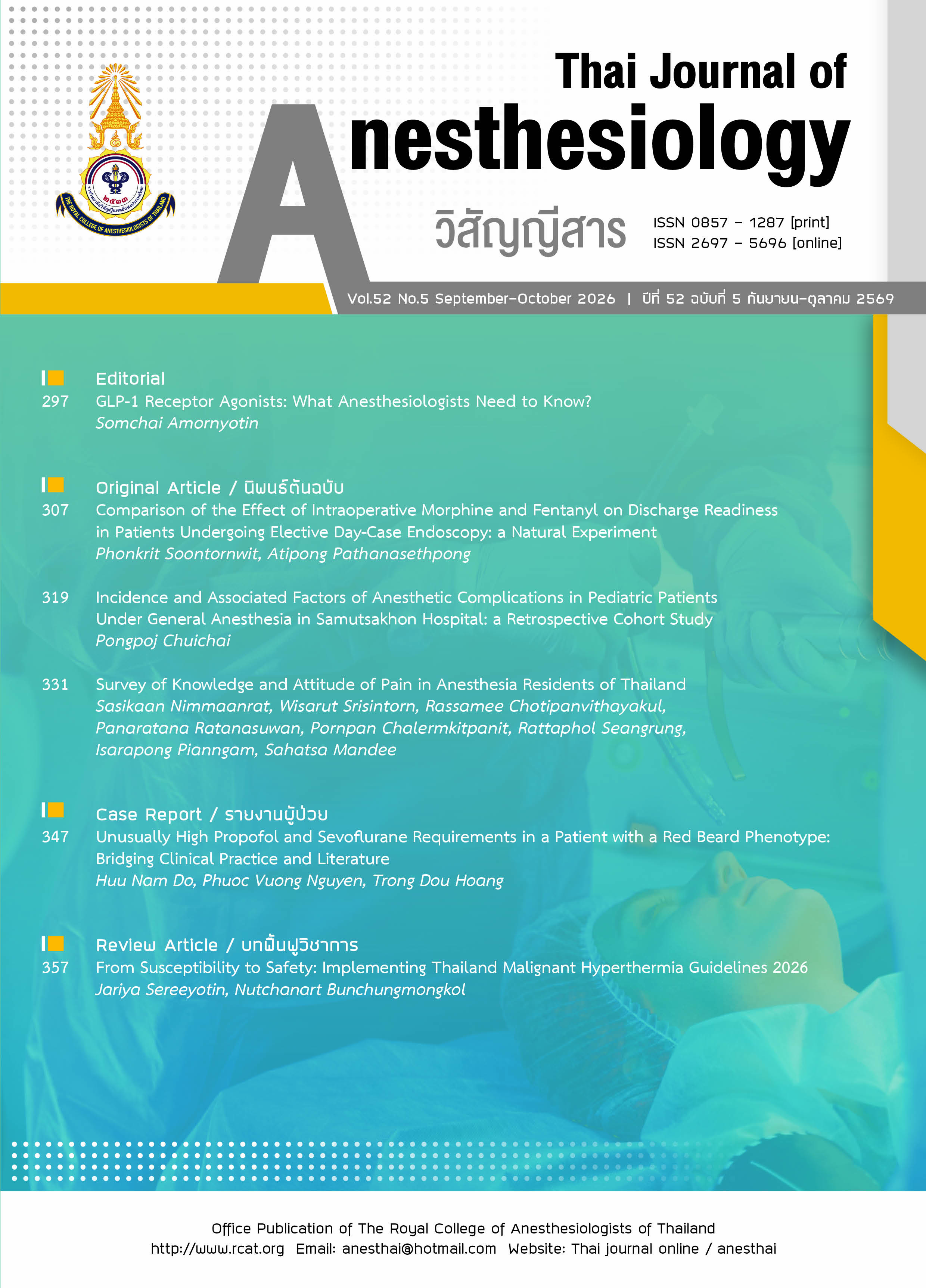
Unusually High Propofol and Sevoflurane Requirements in a Patient with a Red Beard Phenotype: Bridging Clinical Practice and Literature
Keywords:
MC1R gene, propofol resistance, red beard, sevoflurane requirementsAbstract
Background: The association between the red hair phenotype (homozygous MC1R mutations) and increased volatile anesthetic requirements is well-documented. However, current literature suggests that propofol requirements remain unaltered. Furthermore, the “red beard” phenotype in males with different scalp hair colors, representing a heterozygous MC1R state, is rarely explored in anesthesia research. We report a unique case of a Caucasian patient with a red beard who exhibited significant resistance to conventional induction doses of propofol. Case presentation: A 32-year-old healthy Caucasian male (ASA II, BMI 25.35 kg/m²) presenting with a bright red beard and blonde hair was scheduled for a bilateral varicocelectomy. Pre-anesthetic evaluation indicated a high risk for a difficult airway (Mallampati class 3, upper lip bite test class 3, and a DIFFMASK score of 6 points). Anesthetic induction was initiated with a high conventional dose of propofol (3 mg/kg) combined with 15 mcg of sufentanil. Following initial drug administration, the patient demonstrated poor mouth opening, persistent airway reflexes, and inadequate pharyngeal relaxation, making laryngeal mask airway insertion unfeasible. Propofol was further titrated to a total dose of approximately 4 mg/kg, combined with 50 mg of rocuronium, which successfully achieved complete muscle relaxation and smooth airway control. Anesthetic maintenance required a 20% increase in sevoflurane minimum alveolar concentration. Hemodynamics remained exceptionally stable throughout the surgery without meaningful hypotension or bradycardia. The patient emerged promptly and uneventfully. Conclusion: This case demonstrates that a red beard phenotype, reflecting a heterozygous MC1R mutation, can serve as a visible clinical surrogate marker predicting cross-resistance to standard doses of both volatile and intravenous anesthetics. Clinical anesthesiologists should prioritize individualized, physiological response-driven dose titration over strict weight-based formulas in this specific patient population.
References
1. Liem EB, Lin CM, Suleman MI, et al. Anesthetic requirement is increased in redheads. Anesthesiology. 2004;101:279-83.
2. Sessler DI. Red hair and anesthetic requirement. Can J Anesth. 2015;62:333-7.
3. Williams HR, Pandit JJ. Red hair and pain sensitivity: insights into genomics of pain? Anesthesiol Periop Sci. 2023;1:15.
4. Meretsky CR, Plitt VE, Friday BL, Schiuma AT, Ajebli M. A comparative analysis of the efficacy of local anesthetics and systemic anesthetics in the red-headed versus non-red-headed patient population: a comprehensive review. Cureus. 2024;16:e61797.
5. Chua MV, Tsueda K, Doufas AG. Midazolam causes less sedation in volunteers with red hair. Can J Anaesth. 2004;51:25-30.
6. Gerstman MD, Zhang RK, Ho KM, Kirkpatrick CMJ, Riedel B, Somogyi AA. Impact of genetic variations on the pharmacokinetics, dose requirements, and clinical effects of propofol: a systematic review. Br J Anaesth. 2025;135:594-607.
7. Doufas AG, Orhan-Sungur M, Komatsu R, et al. Bispectral index dynamics during propofol hypnosis is similar in red-haired and dark-haired subjects. Anesth Analg. 2013;116:319-26.
8. Gradwohl SC, Aranake A, Abdallah AB, et al. Intraoperative awareness risk, anesthetic sensitivity, and anesthetic management for patients with natural red hair: a matched cohort study. Can J Anesth. 2015;62:345-55.
9. Myles PS, Buchanan FF, Bain CR. The effect of hair color on anesthetic requirements and recovery time after surgery. Anaesth Intensive Care. 2012;40:683-9.
10. Liem EB, Joiner TV, Tsueda K, Sessler DI. Increased sensitivity to thermal pain and reduced subcutaneous lidocaine efficacy in redheads. Anesthesiology. 2005;102:509-14.
11. National Library of Medicine, Medline Plus. Is hair color determined by genetics? Retrieved 8 August 2022 from https://medlineplus.gov/genetics/understanding/traits/haircolor/.
12. Sessler DI. Red hair and anesthetic requirement. Can J Anesth. 2015;62:333-7.
13. Zorina-Lichtenwalter K, Lichtenwalter RN, Zaykin DV, et al. A study in scarlet: MC1R as the main predictor of red hair and exemplar of the flip-flop effect. Hum Mol Genet. 2019;28:2093-106.
14. Allen MC. The relationship between MC1R gene variants for red hair and clinical responses to anesthesia, analgesia, and pain: a systematic review of the literature. The Eleanor Mann School of Nursing Undergraduate Honors, 2026. Theses retrieved from https://scholarworks.uark.edu/nursuht/227.
15. Savage SA, Gerstenblith MR, Goldstein AM, et al. Nucleotide diversity and population differentiation of the melanocortin 1 receptor gene, MC1R. BMC Genet. 2008;9:31.
16. Zorina-Lichtenwalter K, Maixner W, Diatchenko L. Detangling red hair from pain: phenotype-specific contributions from different genetic variants in melanocortin-1 receptor. Pain. 2020;161:938-48.
17. Beaumont KA, Liu YY, Sturm RA. The melanocortin-1 receptor gene polymorphism and association with human skin cancer. Prog Mol Biol Transl Sci. 2009;88:85-153.
18. Matichard E, Verpillat P, Meziani R, et al. Melanocortin 1 receptor (MC1R) gene variants may increase the risk of melanoma in France independently of clinical risk factors and UV exposure. J Med Genet. 2004;41:e13.
19. Mogil JS, Ritchie J, Smith SB, et al. Melanocortin-1 receptor gene variants affect pain and mu-opioid analgesia in mice and humans. J Med Genet. 2005;42:583-7. 20. Cunningham AL, Jones CP, Ansell J, Barry JD. Red for danger: the effects of red hair in surgical practice. BMJ. 2010;341:c6931.
21. Binkley CJ, Beacham A, Neace W, Gregg RG, Liem EB, Sessler DI. Genetic variations associated with red hair color and fear of dental pain, anxiety regarding dental care and avoidance of dental care. J Am Dent Assoc. 2009;140:896-905.
22. Friedlander AH, Couto-Souza PH, Berti-Couto SA. Surgeons beware: some red heads have increased requirements for inhalation, infiltration, and topically administered anesthetic agents. J Oral Maxillofac Surg. 2021;79:958-9.
23. Mogil JS, Wilson SG, Chesler EJ, et al. The melanocortin-1 receptor gene mediates female-specific mechanisms of analgesia in mice and humans. Proc Natl Acad Sci USA. 2003;100:4867-72.
24. Andresen T, Lunden D, Drewes AM, Arendt-Nielsen L. Pain sensitivity and experimentally induced sensitization in red haired females. Scand J Pain. 2011;2:3-6.
25. https://www.apsf.org/patient-guide/do-redheads-need-more-anesthesia/
26. Budic I, Stoimenov TJ, Pavlovic D, et al. Clinical importance of potential genetic determinants affecting propofol pharmacokinetics and pharmacodynamics. Front Med. 2022;9:809393.
Downloads
Published
How to Cite
Issue
Section
License
Copyright
Copyright of all articles published in the Thai Journal of Anesthesiology is held by the Thai Journal of Anesthesiology, the Royal College of Anesthesiologists of Thailand. Submission of a manuscript constitutes the authors' agreement that, upon acceptance for publication, copyright of the work is transferred to the Journal. The content and any opinions expressed in published articles are the sole responsibility of the authors and do not necessarily reflect the views of the editorial board or the Royal College of Anesthesiologists of Thailand.
Licensing
All articles are published open access under the Creative Commons Attribution-NonCommercial-NoDerivatives 4.0 International License (CC BY-NC-ND 4.0). Under this license, anyone may copy and redistribute published articles in any medium or format for non-commercial purposes, provided that appropriate credit is given to the authors and to the Thai Journal of Anesthesiology as the original source of publication, a link to the license is included, and the material is not modified in any way. Requests for commercial use or for adaptation of published material should be directed to the editorial office.
Authors' Rights
Although copyright is held by the Journal, authors retain the right to reuse their own published material in their future scholarly works, theses and dissertations, teaching, and academic presentations, and to deposit the final published version (PDF) in institutional or subject repositories or on personal and institutional websites, without embargo, provided that the Thai Journal of Anesthesiology is clearly acknowledged as the original place of publication.