The Influence of Kratom Consumption on Healthcare: Role of Nurses
Article Sidebar
Main Article Content
Abstract
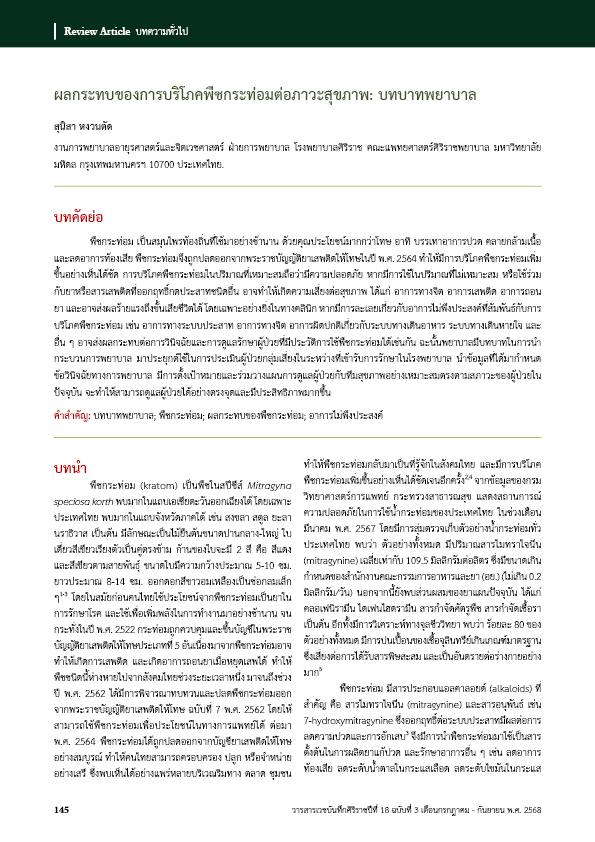
Kratom has historically served as a local medicinal botanical. The pharmacological attributes of the kratom provide both benefits and harms effects upon consumers concurrently. In the year 2021, kratom was excised from classification of illicit substances in the Narcotics Act. As a result, kratom consumption has increased significantly. Generally, the ingestion of kratom in the appropriate dosage is perceived as less hazardous than the consumption of alternative narcotic substances. However, the misuse of kratom, when combined other medications or narcotic drugs exhibiting with depressants effects may increase health risks, which includes mental symptoms, addiction, withdrawal manifestations, and potentially serious consequences, including fatality. In particular, within clinical contexts, if there is any neglect regarding adverse symptoms related with kratom consumption such as neurological symptoms, mental manifestations, disturbances of the gastrointestinal and respiratory systems and others may adversely effects on the diagnosis and management of patients with a history of kratom use. Therefore, nursing professionals are integral to the implementation of the nursing process to the assessment of high-risk patients during hospitalization, analyzing the information obtained to determine a nursing diagnosis, establishing objectives, and devising appropriate care plans in collaboration with healthcare teams tailored to the patients' conditions, thereby enhancing the accuracy and efficacy of patient care delivered by nurses.
Article Details

This work is licensed under a Creative Commons Attribution-NonCommercial-NoDerivatives 4.0 International License.




References
กองควบคุมวัตถุเสพติด. กระท่อม Kratom [อินเทอร์เน็ต]. 2566 [เข้าถึงเมื่อ 28 พฤศจิกายน 2567]. เข้าถึงได้จาก: https://narcotic.fda.moph.go.th/information-about-drugs/kratom.
ธัญรัตน์ศรีสกุล อ. พืชกระท่อมกับการดูแลสุขภาพของคนไทย. J Health Res Innov 2022;5(1):1-9. Available at: https://he02.tci-thaijo.org/index.php/jhri/article/view/1-9
ดวงแก้ว ปัญญาภู, สุเมธี นามเกิด, นิตาภา อินชัย, กุลสิริ ยศเสถียร. กระท่อม: สมุนไพรหรือยาเสพติด. วารสารการแพทย์แผนไทยและการแพทย์ทางเลือก. 2559;14(3):242-56.
การัณย์ภาส ลิ้มควรสุวรรณ. วิจัยเภสัชฯ จุฬาฯ ชี้ พืชกระท่อม ลดปวด-แก้อักเสบ ถอนยาเสพติดร้ายแรงได้ [อินเทอร์เน็ต]. 2566 [เข้าถึงเมื่อ 28 พฤศจิกายน 2567]. เข้าถึงได้จาก: https://www.chula.ac.th/highlight/143370/.
กรมวิทยาศาสตร์การแพทย์ กระทรวงสาธารณสุข. กรมวิทย์เปิดผลตรวจ “น้ำกระท่อม” หลังปลดล็อกพบสารเสี่ยงก่ออันตราย [อินเทอร์เน็ต]. 2567 [เข้าถึงเมื่อ 1 ธันวาคม 2567]. เข้าถึงได้จาก: https://www3.dmsc.moph.go.th/post-view/2184.
รุ่งเรือง ว. พิษวิทยาของพืชกระท่อม. Thai J Hosp Pharm 2021;30(2):118-24. Available at: https://he02.tci-thaijo.org/index.php/TJHP/article/view/248551
Chodchoy P, Sinchai T. The relationship between Mitragynine blood concentrations and death in Thailand. Interdiscip. Res. Rev. [internet]. 2020;15(4):18-21. Available from: https://ph02.tci-thaijo.org/index.php/jtir/article/view/241129
SitarunoS, Juraithip W, Tanatape W, et al. Adverse Events Related to Kratom Discontinuation and the Utilization of Prescribed Medications During Hospitalization: A 4-year Retrospective Study in Thanyarak Songkhla Hospital, Thailand. J Health Science Med Res.2024;42(2):e2023991. Available from: https://www.jhsmr.org/index.php/jhsmr/article/view/991/1053.
ประวัติวิถีสุข อ, สุพรรณ ว, สมบุศย์ ภ, วรสานนท์ ข, วิจิตเวชไพศาล พ. กัญชา กระท่อม และฟ้าทะลายโจร เรื่องที่ต้องทำความคุ้นเคยในงานระงับความรู้สึก. Siriraj Med Bull. 2022;15(4):266-74. Available at: https://he02.tci-thaijo.org/index.php/simedbull/article/view/257313
สมชาย ศรีวิริยะจันทร์. อันตรกิริยาระหว่างยาและพืชกระท่อม ตอนที่ ๑. วารสารสำนักงาน ปปส. 2563;36(3):6-9.
วรินทร ร่มโพธิ์ชี, ประเสริฐ สุขเจริญ. ยาน่ารู้ “กระท่อม”. วารสารศูนย์การศึกษาแพทยศาสตร์คลินิก โรงพยาบาลพระปกเกล้า. 2565;39(4):527-9.
Eaimchaloaya S, Kalayasiri R, Prechawit S. Characteristics and physical outcomes of kratom users at a substance abuse treatment center. Chula Med J. 2019;63(3):179-85.
สันติ สิลัยรัตน์. ภาวะดื้อต่อยากลุ่ม Opioids ในระยะวิกฤติ Opioid Tolerance in Critical Illness [อินเทอร์เน็ต]. ม.ป.ป. [เข้าถึงเมื่อ 1 ธันวาคม 2567]. เข้าถึงได้จาก: https://www.wongkarnpat.com/viewpat.php?id=2718.
