
Clinical Outcomes and Predictive Factors in Acute Tandem Occlusion: A Single-Center Experience
DOI:
https://doi.org/10.33192/smj.v78i5.278546Keywords:
Tandem occlusion, Mechanical thrombectomy, Acute ischemic stroke, Carotid stenting, Clinical outcome, Predictive factorsAbstract
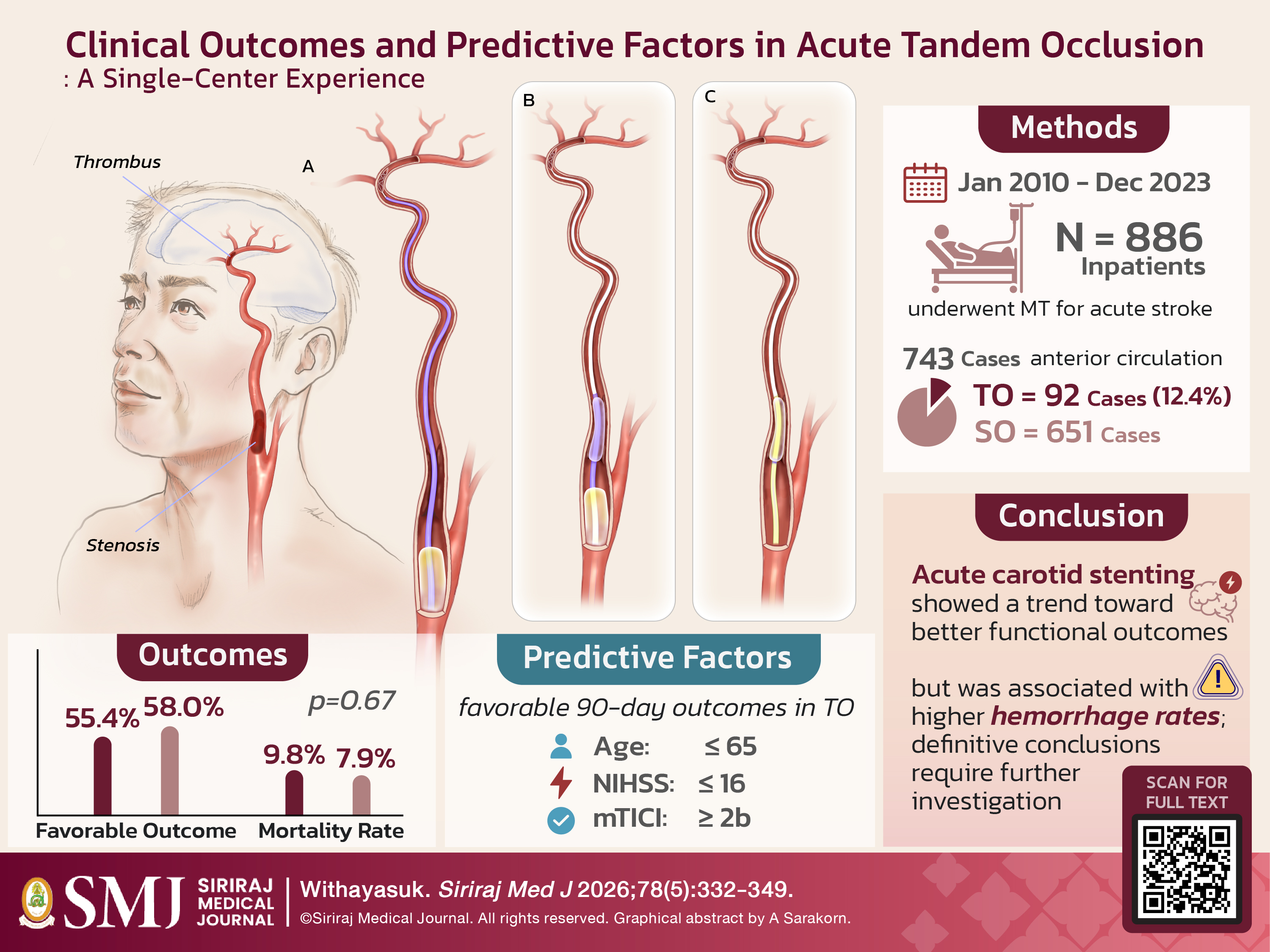
Objective: To evaluate treatment outcomes and analyze predictive factors associated with favorable outcomes in patients with acute tandem occlusion (TO) stroke who underwent mechanical thrombectomy (MT) at a single, high-volume center.
Materials and Methods: This retrospective study analyzed patients with anterior circulation stroke who underwent MT between January 2010 and December 2023. Ninety-two patients with TO, defined as severe stenosis (>70%) or occlusion of the cervical internal carotid artery (c-ICA) with concurrent intracranial occlusion, were identified. The primary endpoint was a favorable functional outcome (modified Rankin Scale [mRS] 0–2) at 90 days. Multivariate logistic regression was performed to identify independent predictors.
Results: Of 743 anterior circulation patients (651 single occlusion [SO], 92 TO [12.4%]), favorable outcomes were achieved in 55.4% of TO patients with a mortality rate of 9.8%, not significantly different from SO (58.0% favorable, 7.9% mortality; p=0.67) in unadjusted comparison. Multivariate analysis identified three independent predictors of favorable outcomes: age ≤65 years (OR 5.2, 95% CI 1.6–16.5, p=0.005), initial NIHSS ≤16 (OR 3.9, 95% CI 1.2–12.5, p=0.022), and successful recanalization (mTICI ≥2b) (OR 6.5, 95% CI 1.1–39.9, p=0.043).
Conclusion: MT for acute TO yields outcomes comparable to SO in unadjusted analysis. Age ≤65 years, lower initial NIHSS, and successful recanalization are key predictors of favorable outcomes. Acute carotid stenting showed a trend toward better functional outcomes but was associated with higher hemorrhage rates; definitive conclusions require further investigation.
References
Feil K, Herzberg M, Dorn F, Tiedt S, Küpper C, Thunstedt DC, et al. Tandem Lesions in Anterior Circulation Stroke: Analysis of the German Stroke Registry-Endovascular Treatment. Stroke. 2021;52(4):1265–75.
Bracco S, Zanoni M, Casseri T, Castellano D, Cioni S, Vallone IM, et al. Endovascular treatment of acute ischemic stroke due to tandem lesions of the anterior cerebral circulation: a multicentric Italian observational study. Radiol Med (Torino). 2021;126(6):804–17.
Jadhav AP, Zaidat OO, Liebeskind DS, Yavagal DR, Haussen DC, Hellinger FRJ, et al. Emergent Management of Tandem Lesions in Acute Ischemic Stroke. Stroke. 2019;50(2):428–33.
Enriquez BAB, Nome T, Nome CG, Tennøe B, Lund CG, Beyer MK, et al. Predictors of outcome after endovascular treatment for tandem occlusions: a single center retrospective analysis. BMC Neurol. 2023;23(1):82.
Zevallos CB, Farooqui M, Quispe-Orozco D, Mendez-Ruiz A, Patterson M, Below K, et al. Proximal Internal Carotid artery Acute Stroke Secondary to tandem Occlusions (PICASSO) international survey. J Neurointerventional Surg. 2021;13(12):1106–10.
Zhu F, Bracard S, Anxionnat R, Derelle AL, Tonnelet R, Liao L, et al. Impact of Emergent Cervical Carotid Stenting in Tandem Occlusion Strokes Treated by Thrombectomy: A Review of the TITAN Collaboration. Front Neurol. 2019;10:206.
Marko M, Cimflova P, Poppe AY, Kashani N, Singh N, Ospel J, et al. Management and outcome of patients with acute ischemic stroke and tandem carotid occlusion in the ESCAPE-NA1 trial. J Neurointerventional Surg. 2022;14(5):neurintsurg-2021-017474.
Anadani M, Marnat G, Consoli A, Papanagiotou P, Nogueira RG, Siddiqui A, et al. Endovascular Therapy of Anterior Circulation Tandem Occlusions: Pooled Analysis From the TITAN and ETIS Registries. Stroke. 2021;52(10):3097–105.
Wilson MP, Murad MH, Krings T, Pereira VM, O’Kelly C, Rempel J, et al. Management of tandem occlusions in acute ischemic stroke - intracranial versus extracranial first and extracranial stenting versus angioplasty alone: a systematic review and meta-analysis. J Neurointerventional Surg. 2018;10(8):721–8.
von Kummer R, Broderick JP, Campbell BCV, Demchuk A, Goyal M, Hill MD, et al. The Heidelberg Bleeding Classification: Classification of Bleeding Events After Ischemic Stroke and Reperfusion Therapy. Stroke. 2015;46(10):2981–6.
Farooqui M, Zaidat OO, Hassan AE, Quispe-Orozco D, Petersen N, Divani AA, et al. Functional and Safety Outcomes of Carotid Artery Stenting and Mechanical Thrombectomy for Large Vessel Occlusion Ischemic Stroke With Tandem Lesions. JAMA Netw Open. 2023;6(3):e230736.
Diana F, Romoli M, Toccaceli G, Rouchaud A, Mounayer C, Romano DG, et al. Emergent carotid stenting versus no stenting for acute ischemic stroke due to tandem occlusion: a meta-analysis. J Neurointerventional Surg. 2023;15(5):428–32.
Min X, Du J, Bai X, Wei T, Dmytriw AA, Patel AB, et al. Antegrade or Retrograde Approach for the Management of Tandem Occlusions in Acute Ischemic Stroke: A Systematic Review and Meta-Analysis. Front Neurol. 2021;12:757665.
Yang D, Shi Z, Lin M, Zhou Z, Zi W, Wang H, et al. Endovascular retrograde approach may be a better option for acute tandem occlusions stroke. Interv Neuroradiol J Peritherapeutic Neuroradiol Surg Proced Relat Neurosci. 2019;25(2):194–201.
Grigoryan M, Haussen DC, Hassan AE, Lima A, Grossberg J, Rebello LC, et al. Endovascular Treatment of Acute Ischemic Stroke Due to Tandem Occlusions: Large Multicenter Series and Systematic Review. Cerebrovasc Dis Basel Switz. 2016;41(5–6):306–12.
Lockau H, Liebig T, Henning T, Neuschmelting V, Stetefeld H, Kabbasch C, et al. Mechanical thrombectomy in tandem occlusion: procedural considerations and clinical results. Neuroradiology. 2015;57(6):589–98.
Koge J, Tanaka K, Yoshimoto T, Shiozawa M, Kushi Y, Ohta T, et al. Internal Carotid Artery Tortuosity: Impact on Mechanical Thrombectomy. Stroke. 2022;53(8):2458–67.
Qu LZ, Dong GH, Zhu EB, Lin MQ, Liu GL, Guan HJ. Carotid-cavernous fistula following mechanical thrombectomy of the tortuous internal carotid artery: A case report. World J Clin Cases. 2023;11(25):6005–11.
Chudapongse R, Sangpetngam B, Chankaew E, Aurboonyawat T, Churojana A, Withayasuk P. Comparative Evaluation of Imaging Modalities for Eligibility in Endovascular Treatment of Delayed Onset Acute Anterior Circulation Ischemic Stroke in Siriraj Hospital: A Retrospective Analysis. Siriraj Med J. 2024;76(9):573–80.
Churojana A, Mongkolratnan A, Sangpetngam B, Aurboonyawat T, Chankaew E, Withayasuk P, et al. A Comparison of Mechanical Thrombectomy for Large Vessel Occlusion in Acute Ischemic Stroke between Patients with and without Atrial Fibrillation. Siriraj Med J. 2018;70(4):278–83.
Chaivanit T, Chaivanit P, Bumrungrachapukdee P, Unprasert P, Wattanavaekin K, Benyakorn T. Comparison of Primary Patency Rate between Drug-Coated Balloon and Plain Balloon Angioplasty in Hemodialysis Access. Siriraj Med J. 2022;74(6):388–94.
Puangpunngam N, Supokaivanich N, Ruangsetakit C, Wongwanit C, Sermsathanasawadi N, Chinsakchai K, et al. Endovascular thrombectomy versus open surgical thrombectomy for thrombosed arteriovenous hemodialysis graft. Siriraj Med J. 2019;71(6):491–8.
Published
How to Cite
License
Copyright (c) 2026 Siriraj Medical Journal

This work is licensed under a Creative Commons Attribution-NonCommercial-NoDerivatives 4.0 International License.
Authors who publish with this journal agree to the following conditions:
Copyright Transfer
In submitting a manuscript, the authors acknowledge that the work will become the copyrighted property of Siriraj Medical Journal upon publication.
License
Articles are licensed under a Creative Commons Attribution-NonCommercial-NoDerivatives 4.0 International License (CC BY-NC-ND 4.0). This license allows for the sharing of the work for non-commercial purposes with proper attribution to the authors and the journal. However, it does not permit modifications or the creation of derivative works.
Sharing and Access
Authors are encouraged to share their article on their personal or institutional websites and through other non-commercial platforms. Doing so can increase readership and citations.