
Development and Evaluation of an Interactive Online Game-Based Learning Program on Knowledge, Attitudes, Subjective Norms, Perceived Behavioral Control, and Intention to Use E-Cigarettes among Lower Secondary School Students
DOI:
https://doi.org/10.33192/smj.v78i10.282775Keywords:
Electronic nicotine delivery systems, vaping, adolescents, students, prevention program, intentionAbstract
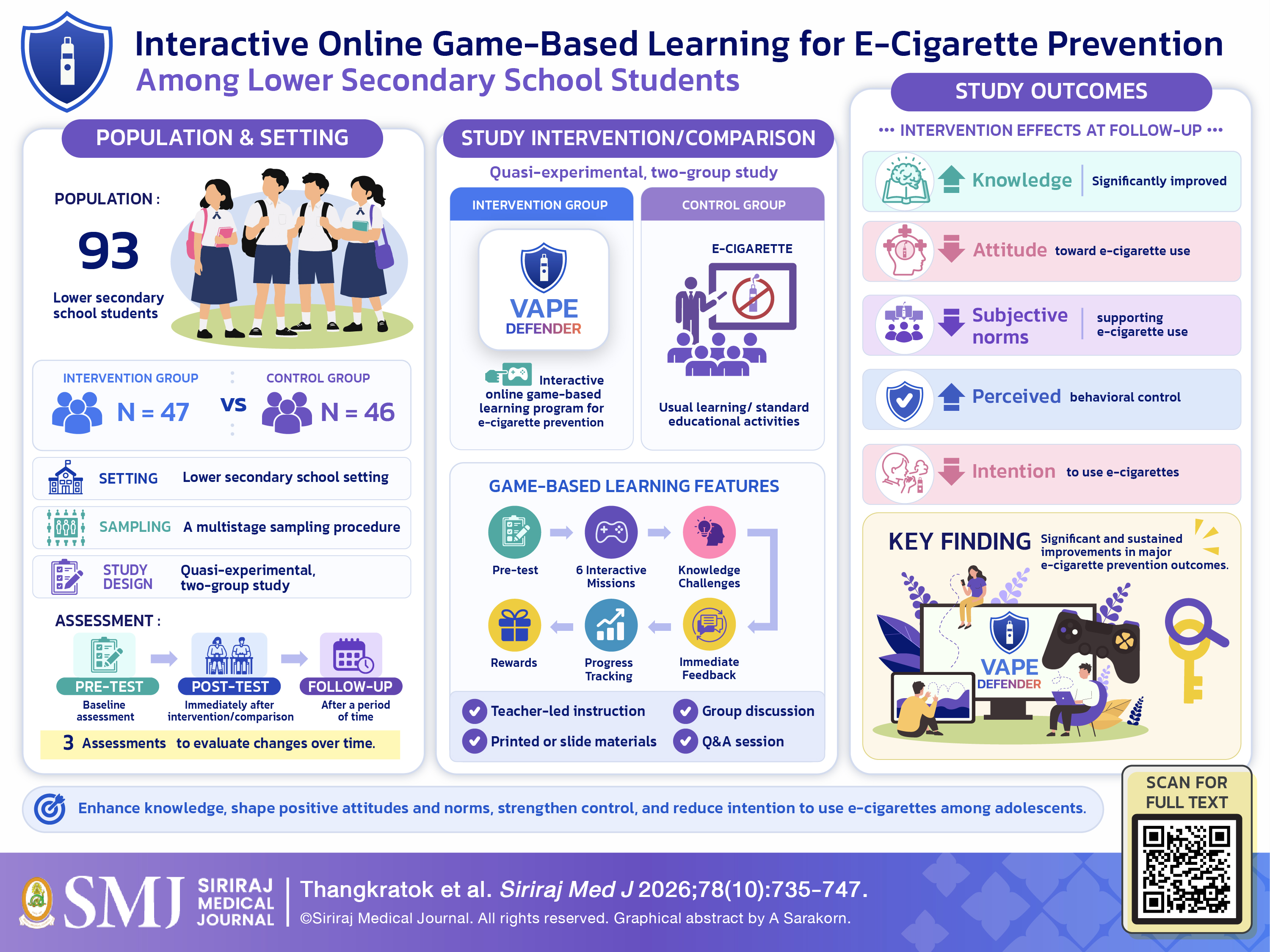
Objective: This study aimed to examine the effectiveness of an interactive online game-based learning program on knowledge, attitudes, subjective norms, perceived behavioral control, and intention to use e-cigarettes among lower secondary school students.
Materials and Methods: A quasi-experimental study was conducted in two lower secondary schools, with one school assigned to the intervention condition and the other to the comparison condition. Ninety-three students participated (intervention, n = 47; comparison, n = 46). Knowledge, attitudes, subjective norms, perceived behavioral control, and intention to use e-cigarettes were assessed at pretest, posttest, and follow-up. Longitudinal changes were analyzed using repeated-measures models. Because each condition included only one school, between-group findings were considered exploratory and may reflect school-level effects.
Results: Compared with the comparison school, students in the intervention school showed greater improvements in knowledge at posttest and follow-up. Attitudes, subjective norms, and intention scores decreased at both assessments, indicating less favorable attitudes toward e-cigarette use, lower perceived social pressure to use e-cigarettes, and lower intention to use e-cigarettes. Perceived behavioral control showed little immediate change but increased at follow-up.
Conclusion: Participation in the interactive online game-based learning program was associated with favorable changes in knowledge and psychosocial determinants related to e-cigarette use. However, the observed differences cannot be separated from school-level effects. Studies involving multiple schools in each condition are needed to confirm intervention effectiveness.
References
Sakboonyarat B, Poovieng J, Jongcherdchootrakul K, Hempatawee N, Hatthachote P, Mungthin M, et al. Emerging trends and determinants of electronic cigarette use among young Thai men, 2022–2024. BMC Public Health. 2025;25(1):3842.
Palacheewa N, Thangkratok P. Exploring the intention to use e-cigarettes and its influencing factors among Thai non-formal education students: a cross-sectional study. Tob Prev Cessat. 2026:12.
Seeherunwong A, Tipayamongkholgul M, Angsukiattitavorn S, Muangsakul W, Singkhon O, Junda S, et al. Association between socioecological factors and electronic cigarette use among Thai youth: an institution-based cross-sectional study. BMJ Open. 2023;13(7).
Nakju S, Tanapek S, Assawamaitree S, Nitikorn K. Prevalence and factors associated with intention to use e-cigarettes among lower secondary school students in Bangkok: a cross-sectional study. Tob Induc Dis. 2026:24.
Zhou X, Hao X, Chen Y, Deng H, Fang L, Zhang L, et al. Social media marketing strategies for electronic cigarettes: content analysis of Chinese Weibo accounts. J Med Internet Res. 2024;26:e51594.
Patanavanich R, Aekplakorn W, Glantz SA, Kalayasiri R. Use of e-cigarettes and associated factors among youth in Thailand. Asian Pac J Cancer Prev. 2021;22(7):2199–207.
Vittaporn S, Kanthajaem K, Coothongkul A, Pooseesod K. Effectiveness of an intervention program to develop e-cigarette control leaders at the University in Lampang Province, Thailand. Tob Prev Cessat. 2024:10.
Patanavanich R, Glantz S. Successful countering of tobacco industry efforts to overturn Thailand’s ENDS ban. Tob Control. 2021;30(e1)–e19.
Chen Y, Chen J, Wang Z, Zhao X, Gao R, Cai Y, et al. Effective features of e-cigarette prevention videos: a qualitative study with primary school students. Tob Induc Dis. 2025:23.
Kong G, Schott AS, Lee J, Dashtian H, Murthy D. Understanding e-cigarette content and promotion on YouTube through machine learning. Tob Control. 2023;32(6):739–46.
Al-Hassan SM, Duell N, Lansford JE, Dodge KA, Gurdal S, Liu Q, et al. Parents’ learning support and school attitudes in relation to adolescent academic identity and school performance in nine countries. Eur J Psychol Educ. 2024;39(4):3841–66.
Lee S, Kim J, Bockhold S, Lee J, Chun J, Yu M. Game-based digital interventions for enhancing positive development and addressing substance use in adolescents: a systematic review. Children. 2024;11(12):1554.
Nyman J, Salanterä S, Pasanen M, Parisod H. Effectiveness of a digital health game intervention on early adolescent smoking refusal self-efficacy. Health Educ Behav. 2024;51(4):562–72.
Ajzen I. The theory of planned behavior. Organ Behav Hum Decis Process. 1991;50(2):179–211.
Dienlin T, Johannes N. The impact of digital technology use on adolescent well-being. Dialogues Clin Neurosci. 2020;22(2):135–42.
Maeneja R, Rato J, Ferreira IS. How is the digital age shaping young minds? A rapid systematic review of executive functions in children and adolescents with exposure to ICT. Children. 2025;12(5):555.
Alduraywish SA, Aldakheel FM, Alsuhaibani OS, Jabaan ADB, Alballa RS, Alrashed AW, et al. Knowledge and attitude toward e-cigarettes among first year university students in Riyadh, Saudi Arabia. Healthcare. 2023;11(4):502.
Marques P, Piqueras L, Sanz MJ. An updated overview of e-cigarette impact on human health. Respir Res. 2021;22(1):151.
Zimmermann E, Tomczyk S. Using social media to promote life skills among adolescents: a debate on opportunities, challenges, and implications for health and education. J Prev. 2025;46(2):201–11.
Mancone S, Corrado S, Tosti B, Spica G, Diotaiuti P. Integrating digital and interactive approaches in adolescent health literacy: a comprehensive review. Front Public Health. 2024;12:1387874.
Moreno MA, Binger K, Zhao Q, Eickhoff J, Minich M, Uhls YT. Digital technology and media use by adolescents: latent class analysis. JMIR Pediatr Parent. 2022;5(2).
Tavares N. The use and impact of game-based learning on the learning experience and knowledge retention of nursing undergraduate students: a systematic literature review. Nurse Educ Today. 2022;117:105484.
Slagter SK, Gradassi A, van Duijvenvoorde ACK, van den Bos W. Identifying who adolescents prefer as source of information within their social network. Sci Rep. 2023;13(1):20277.
Antikchi M, Heydari S, Bakhshi F. The effect of game-based scenario writing on the clinical reasoning of internship nursing students in cardiovascular emergencies and critical care units. BMC Med Educ. 2025;25(1):597.
Lin W, Wang JY, Yueh HP. Learning information ethical decision making with a simulation game. Front Psychol. 2022;13:933298.
Haddock A, Ward N, Yu R, O’Dea N. Positive effects of digital technology use by adolescents: a scoping review of the literature. Int J Environ Res Public Health. 2022;19(21):14009.
Raeside R. Advancing adolescent health promotion in the digital era. Health Promot Int. 2025;40(2).
Songsin N, Wannapaschaiyong P, Loylib P, Dampueak W, Kingkaew WMM, Siladlao S, et al. Perception and attitude towards electronic cigarettes among rural Thai young adults. Siriraj Med J. 2024;76(9):604–10.
Simanjuntak AM, Putra MRE, Amalia NP, Hutapea A, Suyanto, Siregar IE. Lung and airway disease caused by e-cigarette (vape): a systematic review. Siriraj Med J. 2024;76(5):325–32.
Published
How to Cite
License
Copyright (c) 2026 Siriraj Medical Journal

This work is licensed under a Creative Commons Attribution-NonCommercial-NoDerivatives 4.0 International License.
Authors who publish with this journal agree to the following conditions:
Copyright Transfer
In submitting a manuscript, the authors acknowledge that the work will become the copyrighted property of Siriraj Medical Journal upon publication.
License
Articles are licensed under a Creative Commons Attribution-NonCommercial-NoDerivatives 4.0 International License (CC BY-NC-ND 4.0). This license allows for the sharing of the work for non-commercial purposes with proper attribution to the authors and the journal. However, it does not permit modifications or the creation of derivative works.
Sharing and Access
Authors are encouraged to share their article on their personal or institutional websites and through other non-commercial platforms. Doing so can increase readership and citations.