
Effect of the Grasp and Grow Program on Fine Motor Development Among Preschool Children in Pathum Thani Province, Thailand
DOI:
https://doi.org/10.33192/smj.v78i10.283174Keywords:
Motor Skills, Child, Preschool, Child Development, Hand StrengthAbstract
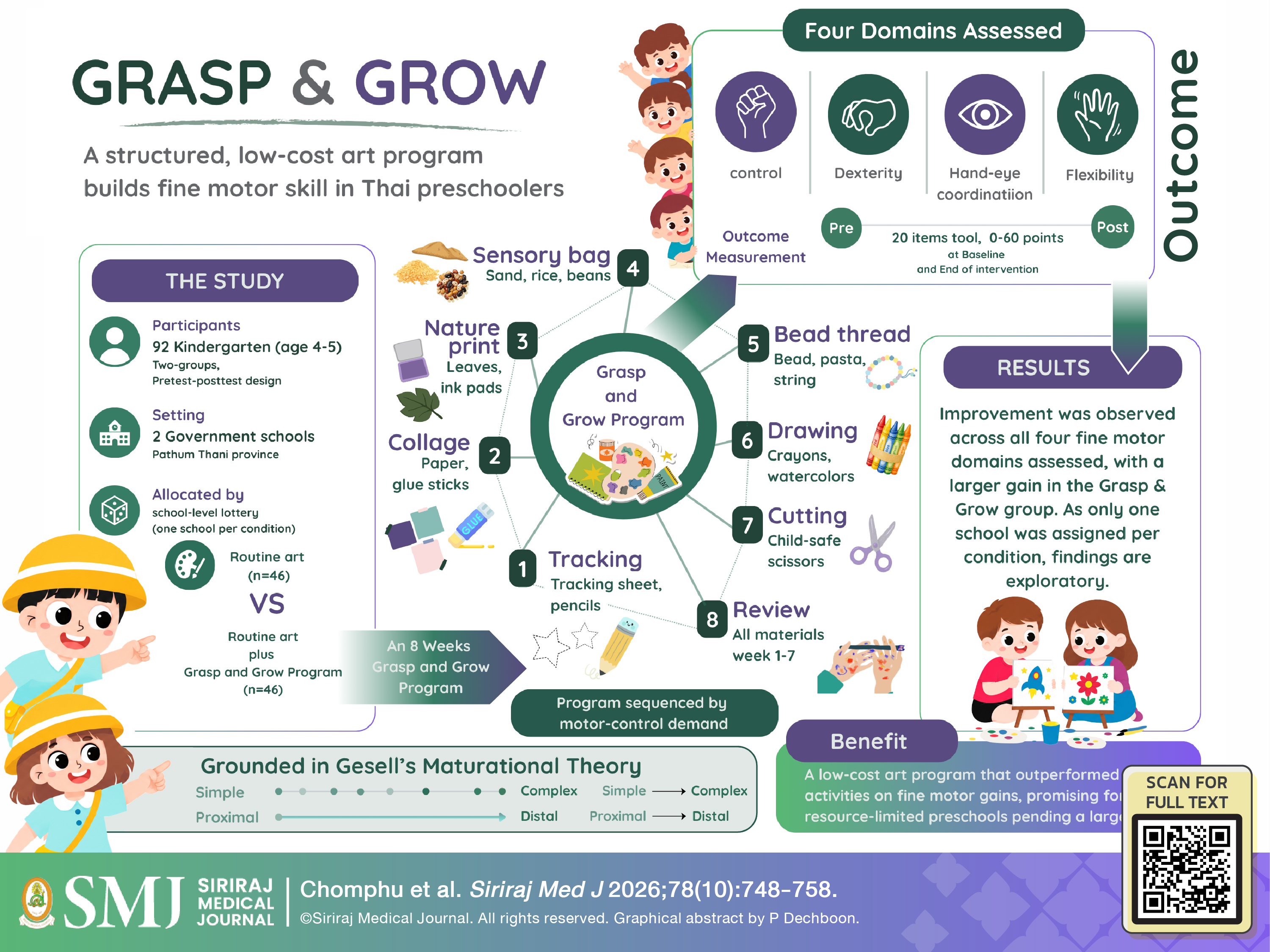
Objective: This study aimed to evaluate the effect of the Grasp and Grow program on fine motor development among preschool children (Kindergarten 2) in Pathum Thani Province, Thailand, compared with routine art instruction.
Materials and Methods: A two-group pretest-posttest design was implemented, with one school allocated to each condition (single-cluster-per-arm) at two government primary schools in Pathum Thani, Thailand, between July and September 2025. Ninety-two Kindergarten 2 children (age 4-5 years) were allocated by school-level lottery to an experimental group (n=46), receiving an 8-week, classroom-delivered program of seven structured art-based activities grounded in Gesell’s Maturational Theory, or a comparison group (n=46) receiving routine art instruction. Fine motor development was assessed using a 20-item structured observation instrument.
Results: Baseline fine motor scores were lower in the experimental group (28.63 vs. 33.63, p<0.001). At posttest, the experimental group scored higher (48.43 vs. 37.00, Cohen d=2.14, p<0.001). The ANCOVA-adjusted between-group difference was 12.98 points (95% CI: 10.74-15.22), F(1, 89) = 132.66, Cohen d=2.59, p<0.001). Three analyses (the primary analysis and two additional sensitivity analyses) showed a consistent direction (Cohen’s d range: 2.49-2.59), though this consistency does not establish a causal effect given shared design limitations.
Conclusion: In this exploratory, single-cluster-per-arm study, children receiving the Grasp and Grow program showed significantly greater fine motor improvement than those receiving routine art instruction. Given the unreplicated school-level allocation, this finding should be treated as hypothesis-generating rather than evidence of a causal program effect. Given its low cost, the program may offer schools in resource-limited settings a feasible option pending confirmation through a teacher-led, cluster-randomized trial.
References
Gaul D, Issartel J. Fine motor skill proficiency in typically developing children: on or off the maturation track? Hum Mov Sci. 2016; 46:78-85.
Cameron CE, Brock LL, Murrah WM, Bell LH, Worzalla SL, Grissmer D, et al. Fine Motor Skills and Executive Function Both Contribute to Kindergarten Achievement. Child Dev. 2012;83(4):1229–44.
Iivonen S, Sääkslahti AK. Preschool children’s fundamental motor skills: a review of significant determinants. Early Child Development and Care. 2014; 184(7):1107–26.
Office of the Education Council, Ministry of Education. Competency of early childhood development for ages 3-5 years: guidelines for teachers and caregivers. 1st ed. Bangkok: Office of the Education Council, Ministry of Education; 2009. 116p.
Matichon. Department of Health reports 1 in 4 Thai preschoolers show developmental delay in language and fine motor/intelligence post-COVID-19 [Internet]. 2022 Nov 1 [cited 2025 Jan 19]. Available from: https://www.matichon.co.th/weekly/pr/article_622847
van der Walt J, Plastow NA, Unger M. Motor skill intervention for pre-school children:
a scoping review. Afr J Disabil. 2020;9:747.
Thongsut P, Palintorn N. The development of fine-motor of early childhood students Kindergarten 2 by using creative arts activities. J Buddhist Stud MCU Ubon Ratchathani. 2023;5(1):141-50.
Faul F, Erdfelder E, Lang A-G, Buchner A. G*Power 3: a flexible statistical power analysis program for the social, behavioral, and biomedical sciences. Behav Res Methods. 2007;39(2):175-91.
Cohen J. Statistical power analysis for the behavioral sciences. 2nd ed. Hillsdale (NJ): Lawrence Erlbaum Associates; c1988. 567 p.
Logan SW, Robinson LE, Wilson AE, Lucas WA. Getting the fundamentals of movement: a meta-analysis of the effectiveness of motor skill interventions in children. Child Care Health Dev. 2012;38(3):305-15.
Donovan JJ, Radosevich DJ. A meta-analytic review of the distribution of practice effect: now you see it, now you don't. J Appl Psychol. 1999;84(5):795-805.
Noiniam P. The ability in using fine motor of children aged 4–5 years through creative soil art activities [master's thesis]. Bangkok: Graduate School, Srinakharinwirot University; 2013. Available from: https://hdl.handle.net/20.500.14740/41076
Wangthomrong L, Boonsinsukh R, Wannapakhe J. Developing Cerebral Palsy Screening of Functional Abilities in School (CPS-FAS). Siriraj Med J. 2024;76(8):497-503.
Koo TK, Li MY. A guideline of selecting and reporting intraclass correlation coefficients for reliability research. J Chiropr Med. 2016;15(2):155-63.
Sawilowsky SS. New effect size rules of thumb. J Mod Appl Stat Methods. 2009 ;8(2):597-9.
Gesell A, Amatruda CS. The embryology of behavior: the beginnings of the human mind. New York: Harper & Brothers; 1945. 289p.
Luo Z, Jose PE, Huntsinger CS, Pigott TD. Fine motor skills and mathematics achievement in East Asian American and European American kindergartners and first graders. Br J Dev Psychol. 2007;25(4):595-614.
Pitchford NJ, Papini C, Outhwaite LA, Gulliford A. Fine motor skills predict maths ability better than they predict reading ability in the early primary school years. Front Psychol. 2016;7:783.
Butler E, Clarke M, Spirtos M. Do motor difficulties in infancy predict 7-year-olds' behavioural health? Findings from the Avon Longitudinal Study of Parents and Children.
J Pediatr Clin Pract. 2025;17:200167.
Strooband KFB, de Rosnay M, Okely AD, Veldman SLC. Systematic review and meta-analyses: motor skill interventions to improve fine motor development in children aged birth to 6 years. J Dev Behav Pediatr. 2020;41(4):319-31.
Additional Files
Published
How to Cite
License
Copyright (c) 2026 Siriraj Medical Journal

This work is licensed under a Creative Commons Attribution-NonCommercial-NoDerivatives 4.0 International License.
Authors who publish with this journal agree to the following conditions:
Copyright Transfer
In submitting a manuscript, the authors acknowledge that the work will become the copyrighted property of Siriraj Medical Journal upon publication.
License
Articles are licensed under a Creative Commons Attribution-NonCommercial-NoDerivatives 4.0 International License (CC BY-NC-ND 4.0). This license allows for the sharing of the work for non-commercial purposes with proper attribution to the authors and the journal. However, it does not permit modifications or the creation of derivative works.
Sharing and Access
Authors are encouraged to share their article on their personal or institutional websites and through other non-commercial platforms. Doing so can increase readership and citations.